
Dance Review: From Light to Darkness, Music from the Sole Finds Its Groove
By Jessica Lockhart
The blend of rhythmic dance and gorgeous music made for a very harmonious collaboration.
House Is Open, Going Dark, Music from the Sole at the Boston Arts Academy Theater on October 19
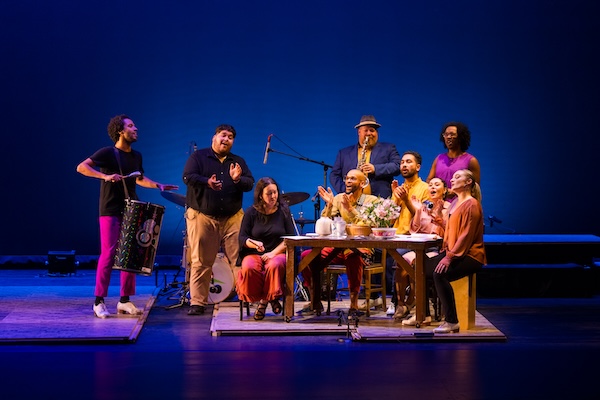
The full company of Music from the Sole’s House Is Open, Going Dark. Photo: Robert Torres
This tap dance company’s name makes it clear that the dancer’s shoes provide “the sole,” the dancers tapping out complex rhythms as their shoes hit the wooden floor. But live musicians are also on stage for their latest work, House Is Open, Going Dark, and they play another version of sole — Afro-Brazilian “soul music.” The blend of rhythmic dance and gorgeous music made for a very harmonious collaboration.
As the audience entered the theater, the “House Was Open,” with dancers and musicians milling about on the stage. They encouraged the audience to come up onstage with them before the show began. The warm and welcoming atmosphere suggested a party or an open house. There were five musicians and four dancers, though those numbers changed throughout the show as the drummer got up and danced and one of the dancers took over drumming. Another dancer grabbed the mic and sang while the guitarist danced. The company shared the stage and shared how and who made the music. The idea of “Going Dark” would come later in the performance. The start was all joy!
Founded in 2015, the company is led by two artistic directors. Composer and performer Gregory Richardson is the production’s musical director; Leonardo Sandoval, originally from Brazil, is the choreographic director and dances in the show as well.
The evening’s tap dancing was very intricate and wonderful. All the dancers had their own style, and these varied approaches complemented each other. The show began with the stage filled by a dining table, sofa, and a big TV. Very homey and comfortable. Then the stage was cleared, so the dancers could really move around the space. The musicians were positioned all over the stage as well, and the various forces worked together; the performance took the form of a give and take, sometimes a call and response. Kathy Kaufmann provided effective lighting designs, particularly when a dancer was vocalizing sounds, almost like “scat” singing. We heard those sounds coming from the tap shoe of a dancer when only their face was visible — the rest of the stage was dark. The dancer’s face seemed to be floating in the air. Then another face appeared, and another. It was eerie to not see their feet. Another time, Kaufmann only lit up a dancer’s hands in red light, while we heard the tapping. The visuals were powerful and assisted the force of the aural — by just focusing on a small section of a dancer’s body.
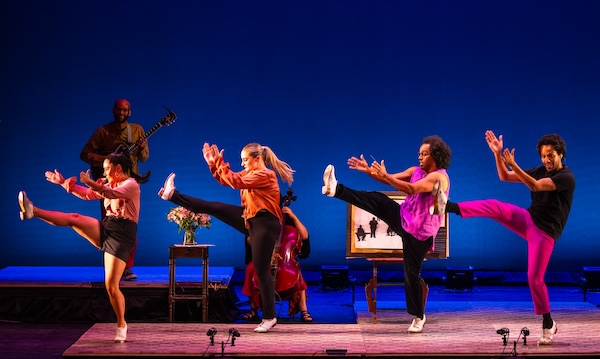
Dancers Ana Tomioshi, Brittany DeStefano, Lucas Santana, and Leonardo Sandoval in Music from the Sole’s House Is Open, Going Dark. Photo: Robert Torres
The company also generated sounds from slapping their hands on their legs and chest as well as stomping their feet. This was done with tap shoes off. Socks or sneakers still created plenty of rhythm. They engaged audience members by teaching them to mimic a rhythmic phrase. The audience clapped their part and then the dancers had their part. Back and forth. Then the dancers went wild, upping the complexity of the initial rhythm. After that, a dancer remained on stage and kept doing more difficult moves — until he slipped and fell. He got up and tried the moves again and couldn’t pull it off. But he kept trying and falling, relentlessly, until he lay crumpled to the ground, panting and broken.
Was this the reference to “Going Dark”? Seeing a dancer struggle, but not want to give up? It was dramatic, and intense. Most dance concerts only present skill and precision. Was showing us his stubborn determination to get the move right a look behind the scenes, an opportunity to see how much of a struggle it is to perfect a dance or be an artist? One definition of going dark means becoming unresponsive. At one point, the dancer sat perfectly still; he didn’t move while the music kept playing. This uncomfortable display was intentional; we were watching a person who was lost. It was an edgy choreographic choice, to add an experience of darkness in what is usually a very uplifting form of dance. Eventually, two dancers came back on stage and sat with him. They breathed together slowly and methodically — we saw the darkness lift and the three stood and slowly began to dance again. The breakdown seemed to reflect what is going on in our world these days. Amid experiences of happiness we are surrounded by much craziness and confusion.
The music was composed for the piece: many of the company’s musicians contributed to the score. The band’s instruments included piano, electric guitar, cello, saxophone, and drums. The performers were: Brittany DeStefano, Orlando Hernandez, Matt Parker, Gregory Richardson, Dylan Rowland, Leonardo Sandoval, Lucas Santana, Ana Tomioshi, and Jennifer Vincent.
Jessica Lockhart is a National Endowment for the Arts Fellow in Dance Criticism and has a BA in Communication from the University of Southern Maine. Lockhart is a Maine Association of Broadcasters award-winning independent journalist. Currently, she also works as program director at WMPG Community Radio.