Film Review: Hal Hartley’s “Where to Land” — Intimations of Mortality
By Tim Jackson
Director Hal Hartley is an old-school romantic, one who sees human frailty and longing not as invitations to despair but as reasons to take part in the joy of living.
Where to Land, directed by Hal Hartley. Screening at the Brattle Theatre through October 22.
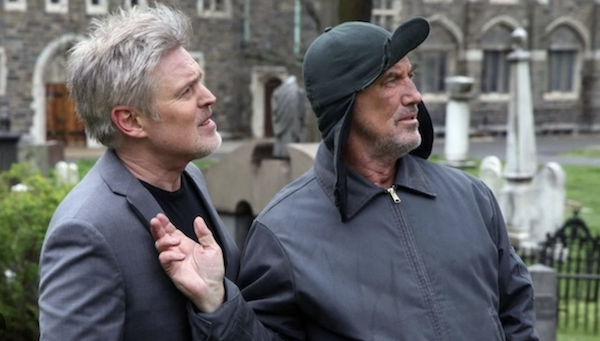
A scene from Where to Land. Photo: Possible Films
Hal Hartley’s films can often appear stagy and disjointed, full of rambling conversations, odd entrances, and characters who randomly come and go. By the end of a Hartley movie, his protagonists may be as confounded by the world as when they began. His dialogue is delivered with a deliberately neutral affect; characters wax on about life, love, and, in this case of his latest film, Where to Land, mortality. The title refers to the grave as the place we all ultimately arrive, one way or another. Late life here becomes a matter of practical reckoning rather than tragedy: when to write a last will and testament, what to do with one’s material possessions, and how to face the inevitable.
So it is with Joe, played by Bill Sage, a successful director of romantic comedies now looking for work as a cemetery groundskeeper. At 58, he begins to think about aging, out of curiosity rather than despair or illness. He’s not depressed, suicidal, or even unwell; he simply wants a job outdoors where, as Joe explains, he can “feel tired at the end of the day.” He’s a lifelong New Yorker, and the graveyard is both conveniently close to his apartment and an appealing chance to engage in honest labor while being surrounded by nature.
Nevertheless, Joe begins to take stock of his life — drafting a will, wondering whether he’ll land the groundskeeper job, and taking a tentative inventory of his possessions. Meanwhile, life continues much as before, though he’s uncertain whether he’ll go on directing his comedies. His reflections on the future of work, the meaning of long-held possessions, and the value of one’s labor strike a common chord, yet they are hardly the stuff of high drama. Still, there’s a quiet joy in Hartley’s gentle whimsy. These are concerns that people of a certain age inevitably grapple with. There are few overarching conflicts as the story unfolds; disagreements take the form of casual exchanges — conversational, almost Socratic. It’s life at its most unguarded, relaxed, and human.
Joe’s modest odyssey begins as he interviews for a position with the current groundskeeper, Leonard, played by the grizzled Robert John Burke. In addition to acting, Burke is a firefighter and holds a Black Belt, a background that lends his character a rugged authenticity. “You’re not exactly dressed for the job,” he says. “Do you have any skills?” “Well, I rake leaves and cut grass,” Joe replies. After a short lecture from Leonard that the job involves “husbandry” — the careful maintenance of the landscape — Joe is interviewed by the head of the church who oversees the property. Alice, played by the actress Lorraine Farris (Blue Bloods), asks Joe whether he attends church, then launches into a parodic comic monologue about faith and the practice of worship.
Other friends and family drift in and out of the story, engaging Joe in chats about his sudden urge to write a will and take a position at a cemetery. Their concern is good-natured, symptomatic of a collective response to what they suspect might be a mild midlife crisis. Edie Falco, playing Joe’s ex-wife, drops by to polish the silverware — once a wedding gift, now another relic destined, like its owner, for a resting place. She gently suggests that Joe is merely weathering a predictable trauma about growing older. “I guess it is,” says Joe, less than concerned. Meanwhile, surrounded by books, he offers his choice of tomes to Oliver, the plumber, played with marvelous camaraderie by Joe Perino (The Sopranos), who stops by repeatedly to ask, “You got hot water?” An avowed anarchist, he lingers for a few philosophical exchanges about the perils of capitalism.
Joe’s niece, Veronica, becomes the first to suspect that his recent behavior stems from a serious health issue after she discovers a letter from a hospital. The matter is quickly and comically dismissed. Newcomer Kaitlyn Sparks is luminous in the role. Joe’s girlfriend, Muriel, is an actress starring as a superhero in a successful cable series franchise. She is played by Kim Taff, who, ironically, has far more theater than film or TV experience. Muriel is weary of performing her long-running role and is eager for a change, to do something more meaningful. Joe’s marriage proposal isn’t the kind of transformation she has in mind, but he takes her rejection in stride. Muriel’s search for a new artistic challenge leads to the character’s hilariously self-referential riff on romantic comedy tropes that take on a life of its own in a surprising twist.
There are other fine cameos. One standout is Kathleen Chalfant (Familiar Touch) as Elizabeth, a 100-year-old writer and friend whom Joe visits, bearing the gift of a cigar. Their meeting turns into a rambling conversation on life, global warming, and the fate of the next generation. Twirling the cigar thoughtfully between her fingers, Elizabeth offers a series of sobering reflections on the past, present, and future.
Hal Hartley, now 65, uses his parade of New York cameos to take stock of the thoughts that inevitably come with aging. One need not be fatally ill in order to seriously ruminate on life, on what comes next, or on what it all means. Where to Land, his 14th feature, traces its lineage back to The Unbelievable Truth and Trust, both of which showcase the comic brilliance of the late Adrienne Shelly. Over the years, Hartley has cultivated a repertory of actors, such as Martin Donovan and Parker Posey, performers attuned to his distinct rhythm and stylized dialogue. The new cast members here serve his unique sensibility with equal finesse.
I noticed on the bookshelves in his latest film three volumes on Jean-Luc Godard — a fitting homage. Like much of Godard’s work, Hartley’s films are self-aware, deliberately stylized, and more theatrical than they are naturalistic. His scenes are enriched by a choreography of tone and gesture that reveals a director reflecting on his late career. Hartley remains, at heart, an optimist with an imperious imagination; even his numerous short films brim with quirky wonder. In an age crowded with dystopian visions, from directors like Ari Aster, Bong Joon-ho, David Cronenberg, and Yorgos Lanthimos, Hartley stands apart. He is an old-school romantic, one who sees human frailty and longing not as invitations to despair but as reasons to take part in the joy of living.
Tim Jackson was an assistant professor of Digital Film and Video for 20 years. His music career in Boston began in the 1970s and includes some 20 groups, recordings, national and international tours, and contributions to film soundtracks. He studied theater and English as an undergraduate, and has also worked helter-skelter as an actor and member of SAG and AFTRA since the 1980s. He has directed three feature documentaries: Chaos and Order: Making American Theater about the American Repertory Theater; Radical Jesters, which profiles the practices of 11 interventionist artists and agit-prop performance groups; When Things Go Wrong: The Robin Lane Story. And two short films: Joan Walsh Anglund: Life in Story and Poem and The American Gurner. He is a member of the Boston Society of Film Critics. You can read more of his work on his blog.