
Dispatch #4 from the New York Film Festival: Richard Linklater’s “Nouvelle Vague”
By Erica Abeel
In Nouvelle Vague, director Richard Linklater thrillingly captures the sense of Jean-Luc Godard as an artist feeling his way in real time, as if in a dark room, toward a new vision.
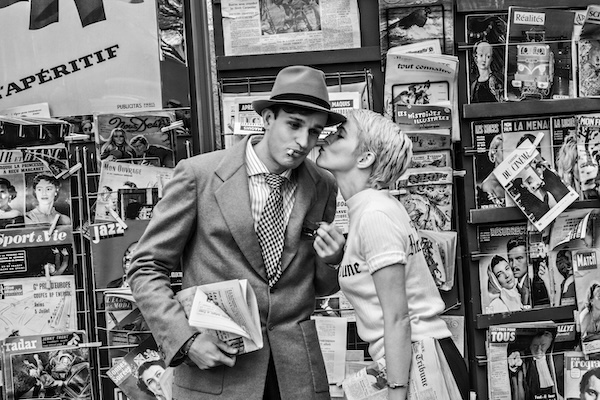
A scene from Nouvelle Vague. (L-R) Aubry Dullin as Jean-Paul Belmondo and Zoey Deutch as Jean Seberg. Photo: Jean-Louis Fernandez/Courtesy of Netflix
If I had to choose a favorite from this year’s New York Film Festival it would be Nouvelle Vague by Richard Linklater. Perhaps to fully enter the spirit of this film it helps to be conversant with the immortals of French cinema; a Francophile; a fan of the hang-out style of movie that Linklater sometimes favors (most famously with Dazed and Confused).
It helps to be nostalgic for a moment in the ’60s when movies greatly mattered and the latest foreign film to land in New York was an event. (Remember the old Plaza Theater on East 58th Street? How Russia’s Ballad of a Soldier had us in tears when the young soldier ran across a wheat field to embrace his mother before returning to the front?)
It also helps to be nostalgic for the Paris of the early ’60s that Linklater has revived in Nouvelle Vague, a period before large tranches of the city became a theme park for tourists and Brasserie Lipp a destination for the wives of Romanian oligarchs dining on the pommes de terre a l’huile loved by Hemingway.
Absent all that, you’ll still find Nouvelle Vague a delight. It reimagines the making of Breathless, the film by Jean-Luc Godard that scrapped the old rules and forever altered the conventions of cinema. (The title Breathless will also forever misconstrue the original title À Bout de Souffle. The French connotes being tapped out or “beat,” a very different resonance. It’s not widely known, but Allen Ginsberg and his Beat cohorts were living in Paris in the late ’50s when Godard shot his film. So: an intriguing instance of transnational cross-pollination?)
Nouvelle Vague is set in motion by Godard’s irritation at lagging behind his fellow film critics at the storied Cahiers du Cinéma, the only kid on the block who hasn’t yet made a film. His colleagues at Cahiers — Eric Rohmer, Claude Chabrol, Francois Truffaut, and the rest — have all weighed in with works stamped with the personal vision of an auteur, films that aim to dismantle the staid “tradition of quality” of mainstream French cinema. Linklater flashes their labeled photos on the screen, a mischievous nod to viewers who will recognize these pioneers of the French New Wave.
Godard is not a little envious that Truffaut is about to premiere his masterpiece The Four Hundred Blows at Cannes. With his trademark arrogance, he empties the cash box at Cahiers and high-tails it down to Cannes. There he wheedles Georges de Beauregard (Bruno Dreyfurst), a producer in financial straits, into backing a film from a treatment he wrote years ago with Truffaut. At some point he observes, “All you need to make a movie is a girl and a gun.”
Mirroring Breathless, Nouvelle Vague (scripted by Holly Gent and Vincent Palmo) is in grainy black-and-white, duplicates its 4:3 aspect ratio, and even marks the screen’s upper right to signal a reel change. Linklater also slips in a tantalizing sequence of Godard driving to Cannes. Film buffs will recognize a poplar-lined highway that’s awfully like the one driven by Michel Poiccard, the petty criminal played by Jean-Paul Belmondo in Breathless.
The sequence took me back to the famous shot across the bow that opens Breathless, a monologue by Michel that no one before Godard would have deemed film-worthy: “If you don’t like the sea … or the mountains … or the big city … then allez vous faire foutre!” Next Michel, a self-described “jerk,” refuses to stop for women hitchhikers, muttering “trop moche.” Cue the skittery jazz score that mimicked the chaotic, reckless energy of Belmondo’s Michel.
The making of Breathless, in Linklater’s telling, is a daily battle. Essentially Godard drives everyone nuts, both producer and cast. In lieu of a conventional script he scribbles the day’s scenes on napkins over breakfast in a café. Questioned about his methods he’s apt to say, “I’m trying to seize reality.” “Let’s make everything jump.” “Aim for anarchy.”
This reassures no one, nor does his working schedule. He shoots for a few hours a day and only when he feels inspired; to the producer’s dismay he sometimes begs off entirely, claiming he’s unwell. Zoey Deutch — playing Michel’s girlfriend, Patricia, the Jean Seberg role — is always about to quit, still traumatized by the pans from French critics of her work in the films Bonjour Tristesse and Saint Joan. Beauregard the producer doubts they’ll end up with a finished product.

A scene featuring Zoey Deutch as Jean Seberg and Guillaume Marbeck as Jean-Luc Godard in Nouvelle Vague.
Butting up against naysayers at every turn, Godard holds to his own inscrutable course, insisting on “amateurish” jump cuts and the “spontaneity” of hand-held shots. The only participant on board with Godard’s guerilla-style filmmaking is his cinematographer (Matthieu Penchinat), who has previously covered wars and perhaps feels right at home. Often comically invisible in a man-sized wheeled contraption, he gets one indelible shot after another. It raises goose bumps to revisit those legendary scenes of Patricia shouting “Herald Tribune” on the Champs Elysees in her corn-bred American voice.
Linklater thrillingly captures the sense of Godard as an artist feeling his way in real time, as if in a dark room, toward a new vision. This salute to his artistic forebear is always seasoned with a mischievous tone. When Godard’s assistant complains about the film’s lack of “continuity,” it gets a laugh from audiences who know that’s, well, kind of the point.
Linklater has cast unknowns who only somewhat resemble the original figures. The lack of exactitude adds an amateurish tone. I mean that as a compliment. In this regard Linklater echos Stendhal, who favored an improvisatory quality as opposed to the polish and professionalism endorsed by the Academy. French intellectuals know their literary history and in Cahiers Godard signaled his admiration for the novelist.
Aubry Dullin is a semiclose match to Belmondo as lowlife Michel Poiccard — but who could replace the inimitable Jean-Paul Belmondo? The weak link is Zoey Deutch as Patricia. She certainly looks like Jean Seberg in her blond pixie cut, striped shirt dresses of the ’50s, and white bobby socks — but crucially, she doesn’t sound like her. Seberg’s pitch-perfect turn was inseparable from her American-accented French: – qu’est-ce que c’est dégueulasse? (which may be the last line of Breathless). That clueless American voice and its faux innocence leads to the bullet that kills Michel. Deutch gets the accent disastrously wrong and it’s a clinker.
Meanwhile, unknown Guillaume Marbeck, whose resemblance to Godard is uncanny, could hardly be better. The ubiquitous dark glasses limit expressive possibilities, of course, but Marbeck crushes it with an unflappable bearing and Godard’s distinctive voice. Bringing new meaning to the word “nasal,” the voice conveys Godard’s unbreachable confidence in what he’s about. He moves through the film tossing out gnomic aphorisms. “Photography is truth. The cinema is truth 24 frames per second.” “Art and crime need time to flourish.” “Destiny and death are cinema’s pet themes.” The uninflected nasal tone produces the eerie effect of channeling the actual Godard through an echo chamber.
It could be objected that Nouvelle Vague feels insider-y and pitched to cinephiles familiar with minutiae of the French New Wave. In truth, Linklater is paying tribute to the innovators who have fueled his own creative life, aiming this film at the Happy Few with whom he appears, at moments, to be in conversation. Grant him that. His breezy indifference toward playing to the crowd and following his own artistic impulses instead is part of what makes him great. A longtime mainstay of indie film, Linklater has explored a gamut of genres, ranging from the three Before films; to Waking Life, a trippy adult animated film that conveys stoner bro philosophy; to the commercially successful School of Rock starring Jack Black and produced by the likes of Scott Rudin. Improbably, a thread links School of Rock with Nouvelle Vague. “If you wanna rock,” Black says, “you gotta break the rules. You gotta get mad at the man!” Jean-Luc Godard might agree.
Erica Abeel is a novelist, critic, and former professor at CUNY. Among her novels are Wild Girls, named a Notable Book by Oprah Magazine and now available on Audible; and The Commune, a comic satire on the launch of Second Wave Feminism that Kirkus called “a joyous literary romp with hidden depth.” Her novel The Laws of Desire is forthcoming from She Writes Press.
Did not see it at FF but loved your review! domna