
Book Review: “House of Diggs” — The Tragic Arc of a Black Civil Rights Champion
By Kathleen Stone
House of Diggs is an engaging biography of an important Black Congressman, an effective advocate for racial equality who fell prey to the temptation of ‘living large.’
House of Diggs: The Rise and Fall of America’s Most Consequential Black Congressman, Charles C. Diggs, Jr. by Marion Orr. The University of North Carolina Press, 360 pages, paperback 29.95
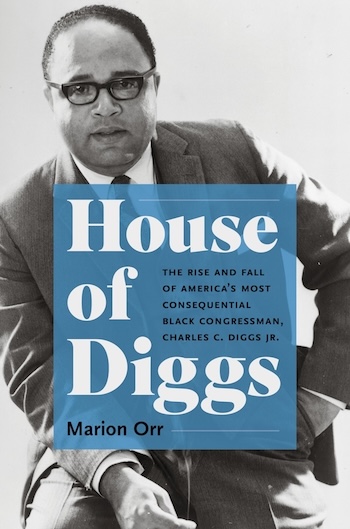 In his new biography of Charles Diggs, Jr., a Michigan Congressman, author Marion Orr does not hesitate to let readers know that some of the serious problems Diggs faced were of his own making. Indeed, the story begins on a day in 1979 when Diggs, who had served in the House of Representatives for 24 years, was censured for padding his office payroll and accepting kickbacks from members of his staff, practices that led to a criminal conviction and seven months in federal prison. After the prologue, however, most of the book tells of Diggs’s ascent in politics, his determination to root out racial discrimination, and the skill and finesse he brought to his work.
Diggs was born in 1922 in Detroit. His family lived in a second-floor apartment above a funeral home, later known as the House of Diggs, which his father had started and developed into a thriving business to serve the Black families of Detroit. When Diggs was seven, the Great Depression hit. Unemployment hurt Black Detroiters badly, and the funeral home went bankrupt. But his father continued the community activities he had always embraced and got himself elected to the state Senate. Four years later, the business reopened and became an even more prominent part of the Black community. As Diggs described it, “the funeral home was more than a funeral home. It was a community center,” a place for his father to meet with constituents, as Diggs himself would later do.
In 1943, Diggs was drafted into the U.S. Army and served on military bases in a number of states, including in the South where he experienced Jim Crow, rigorously enforced. He knew about Jim Crow from his father, who had grown up in the Mississippi Delta, but his own experiences, such as having to sit behind a curtain that separated him from other passengers in a train dining car, even as he wore his military uniform, impressed on him the realities of the system. Of course, Detroit was not free of racial discrimination and that, too, contributed to the sense of mission he would develop.
After discharge from the Army, Diggs went back to Detroit, where he lived with his parents and worked at the funeral home, eventually being named general manager. He married his first wife, who also worked at the funeral home, and they had three children. His father, though, encouraged him to get into politics, partly because the older Diggs had been convicted of a bribery charge and could no longer claim his seat in the state Senate. The younger Diggs took the advice and was elected, thus beginning his political career. In 1954, he went to Washington, D.C., to serve in the House of Representatives. While he never forgot the indignities of racial discrimination, he framed his advocacy for civil rights as about something more than personal experience. Civil rights were good for America – for its citizens, for the health of its democracy and for its standing among nations of the world.
As a new Congressman, Diggs attended the trial of Emmett Till’s accused murderers in Mississippi, where he supported the boy’s mother and sat with Black journalists at their segregated table in the courtroom. Back in Washington, he founded the Congressional Black Caucus, a group that pressed legislators and presidents, beginning with Richard Nixon, for action on civil rights. He led the House committee that oversaw the District of Columbia, finally establishing home rule for the District. He also joined the House Foreign Affairs committee, a position he used to advocate for American pressure on African countries that were denying equal rights to their Black citizens. His international work merged with that of the Congressional Black Caucus because, as he saw it, there was little difference between oppression of Blacks in this country and that faced by Africans in the motherland.
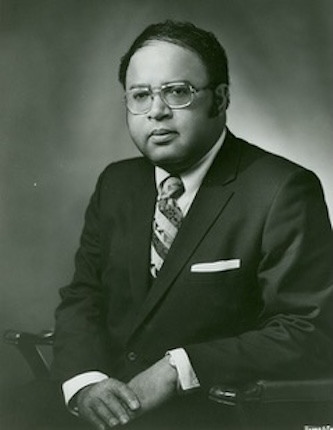
Michigan Congressman Charles Diggs, Jr. Photo: Wikimedia
Frederick Lippitt Professor of Public Policy and Professor of Political Science and Urban Studies at Brown University, Orr proves to be an excellent guide to understanding Congressman Diggs’s work. His expertise in the American political system animates the book. He writes clearly and engagingly about issues such as campaign strategy, coalition building, maneuvering within Congress, and lobbying the White House.
A convergence of factors put a halt to Diggs’s political career. For years, he had spent beyond his means, but usually was able to cover expenses by dipping into funds of the family business. Eventually, though, the funds dried up. His father, older and ill, was no longer able to run the funeral business on his own. The manager he hired looked the other way, or maybe participated himself, in employee pilfering of company funds. With the business under financial strain, there was less available for Diggs, just when he needed more – for gambling, drinking, and extra-marital affairs. To solve his money problems, Diggs substantially raised the pay of his Congressional staffers, then directed them how to spend it– for a portrait of himself, catering events, flowers for colleagues and constituents, to pay overdue invoices from the funeral home’s accountant and former bookkeeper.
When these practices came to light, Diggs fought the legal charges brought against him in court, but he eventually lost. In Congress, Newt Gingrich, then newly elected, pounced. He introduced motions to bar Diggs from voting and to have him expelled from Congress. Again, Diggs fought back. In the end, he agreed to accept censure, the most severe punishment other than expulsion available to Congress.
Toward the end of the book, Orr returns to the dramatic scene of the prologue. Diggs sits alone, listening as the Speaker of the House reads the censure resolution and bangs the gavel. As a narrative structure, it works well. For most of the book, the reader is immersed in Diggs’s good work, but knows that the denouement is coming. The tension builds until, finally, the story returns to how and why things went so wrong. Orr writes: “As his public profile and self-regard increased, he regularly succumbed to temptation. He was ‘living large,’ and all that cost money – money he didn’t have on his own.” Plus, six children and four wives also cost money. Human weakness, packaged together with a commendable will to improve lives, is the story of House of Diggs.
Kathleen Stone is the author of They Called Us Girls: Stories of Female Ambition from Suffrage to Mad Men, an exploration of the lives and careers of women who defied narrow, gender-based expectations in the mid-20th century. Currently she is at work on a second book about women in the skilled manual trades. Her website is kathleencstone.com.