
Book Review: “Against Morality” — The Shaming Regime
By Franklin Einspruch
“Against Morality” is the cri de coeur of a cultural critic who realizes that the presentation of art and its adjacent pursuits, including much art itself, have become the subsidiaries of progressive politics.
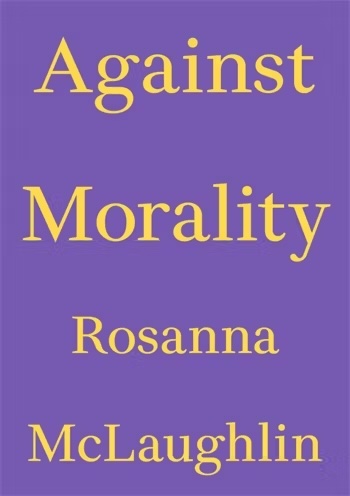
Against Morality by Rosanna McLaughlin. Columbia University Press, Floating Opera Press, 88 pages, $17
 Against Morality opens with the author, British cultural critic Rosanna McLaughlin, determining if she’s having a stroke. She checks her limbs for numbness, assures that she can focus on a tree in the distance, and reads some text aloud in case she was waxing aphasiac. What brought this on was an art review.
McLaughlin is a fan of the painter Chaim Soutine, having marveled at his work in an exhibition at Somerset House in 2017. Soutine was an extraordinary French painter who developed a profound and influential style of expressionism. A Soutine portrait is both consummately sympathetic and aggressively corporeal. McLaughlin notes that “it is as if his brush is caressing and beating his subjects at the same time.” While looking at works by and writings about Soutine on the web, she came across a review of the Somerset House exhibition. McLaughlin was too polite to name the reviewer and, as a courtesy, I won’t either. But she was correct that he shoehorned the painter into a progressive political stance. “An outsider who identified with the underdog,” he wrote, “Soutine’s eye sympathetically drifted to the underclass beneath this moneyed illusion” of the French belle époque.
The whole interest of Soutine is his defiance of such polemics. His paintings combined irreconcilable emotions into dissident chords. The portraits relay love, disgust, and sadness at once. They do not reduce to a comfortable liberal message. Some of them are hard to look at. “Finding myself utterly unable to marry the interpretation to the artworks,” McLaughlin recalls, “I began to worry that something had gone terribly wrong. Am I having a stroke? I wondered, clutching my blanket.” I replied in my imagination: No, my dear colleague. You’re experiencing what the rest of us have been putting up with in art writing for the last quarter century.
Against Morality is the cri de coeur of a cultural critic who realizes that the presentation of art and its adjacent pursuits, including much art itself, have become the subsidiaries of progressive politics. The results are often reductive, misleading, and repellent to moral complexity.
Of course, reactionaries or authors mistaken for them have been saying as much for forty years. “On reflection, moral judgment in the arts appears rather as a tribute to their power to influence emotion and possibly conduct,” wrote Jacques Barzun in 1989, in a book with the telling title of The Culture We Deserve. “And reflecting further on what some critics do today, one sees that a good many have merely shifted the ground of their moralism, transferring their impulse of righteousness to politics and social issues.” But when Barzun, Hilton Kramer, or Robert Hughes argued for the primacy of taste over politics, it was possible to dismiss them as straight white men and continue beating the audience over the head with progressive moralizing.
Not so McLaughlin. In writing of her advocacy for the complications of Hieronymus Bosch’s panel depicting hell, she clarified that it’s not “because I myself long to be spit-roasted by devils or tenderized by a kindly sadist, as promising as those scenarios may sound.” She mentions her wife at one point, and described Cate Blanchett’s portrayal of Tár in the film of that name as “mesmerically attractive.” One would think that with McLaughlin, unabashedly gay and familiar with kink, inveighing against “flattening culture,” her fellow political travelers would be obliged to deal with the argument: that art worth looking at does not kowtow to sociopolitical programs.
That is, one would think it if we hadn’t watched Jed Perl proclaim the same argument a decade ago, the point at which McLaughlin marks the beginning of “a concerted attempt to make art communicate clear and approvable messages, to clean up the canon, to preach a sanctioned set of tenets, ironing out any of the ambivalences that make art move.” Perl too is a straight white man. But he was and is no kind of conservative, though he was suspected of becoming one in 2014, when he wrote for The New Republic, “The trouble with the reasonableness of the liberal imagination is that it threatens to explain away what it cannot explain.” In that article he lamented, “The erosion of art’s imaginative ground, often blamed on demagogues of the left and the right, is taking place in the very heart of the liberal, educated, cultivated audience—the audience that arts professionals always imagined they could count on.”
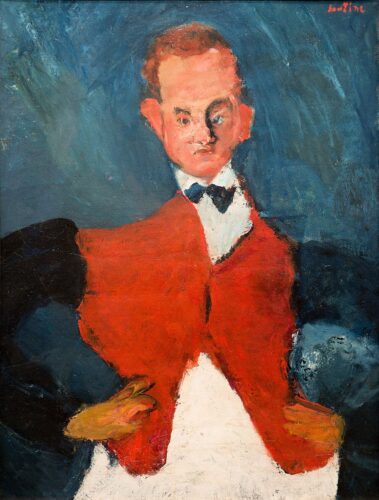
Chaim Soutine, The Floor Waiter (Le Garçon d’étage), 1927. Collection Musée de l’Orangerie, Paris
The problems hardly started a mere decade ago. Rather, the tendency of progressive politics to shame people into compliance had so intensified by the middle-20-teens that Donald Trump’s coarse disregard of social norms looked like liberation itself in comparison. The Biden presidency promised a return to decency and normalcy but delivered neither. In early fall of 2024, California sociologist Arlie Russell Hochschild produced a book, Stolen Pride: Loss, Shame and the Rise of the Right, describing how Trump was leveraging progressive shaming to climb back to power. Even with the strategy laid bare, it worked. Having destroyed their presidential aspirations twice, progressives cling to the possibilities of shame, with Olúfẹ́mi O. Táíwò in the September 2025 Boston Review extolling shame as a function that “reminds us of who we want to be when we fall short, a goalpost that is necessarily anchored to the lofty height that our conduct fell beneath.” While admitting that we could learn to “shame better,” he described shame as “a robustly liberal alternative to… political violence,” as if there was no alternative to shame but assassinations.
But while McLaughlin is a sufficiently independent thinker to recognize the intellectual and political failures of a progressive milieu from the inside, at times she seems unable to think beyond it. Case in point is her discussion of Documenta 15. The 2022 art fair in Kassel relinquished curatorial control to a network of arts collectives. In the ensuing chaos, Indonesian collective Taring Padi displayed a mural-sized banner depicting, as McLaughlin recounts, “a Mossad agent with a pig’s snout, and an Orthodox Jewish man with fangs wearing a bowler hat emblazoned with the letters SS.” In the ensuing fury, “There was certainly no room… for a discussion of global politics, of how the oppressed can, and frequently do, also act as oppressors, of the aftereffects of Israel’s history of warmongering.” She decries the “deplatforming and defunding” of Palestinian artists and their supporters for “their stated objection to the killing of Palestinian civilians.” This is having noted the “many Ukrainian flags hoisted above Western art institutions after the Russian invasion,” in contrast to the “absence of Palestinian flags raised in the wake of Israel’s brutal war on Gaza, following the Hamas-led armed incursion of October 7, 2023.”
She attributes this to the tendency of the shaming regime to employ the “language of social justice and solidarity” as “a costume that can dress up any issue,” but this is skipping steps. After the October 7 atrocities, but before the Israeli military response, institutions had the opportunity to fly the flag of Israel just as they had flown the Ukrainian colors. They did not. Art writer Katya Kazakina, in an October 20, 2023 essay for Tablet, observed with betrayal that no major gallery, no museum, and no art magazine expressed support for Israel or the Jews more broadly. “Those who remain silent are the same businesses and institutions that issued almost instant (and correct) support for Ukraine after Russia’s invasion last year, for Black Lives Matter after George Floyd’s murder; that telegraph their support for LGBT rights and minority rights through exhibitions, policies, and statements,” she wrote.
One could argue that even those statements should have been withheld, on the grounds laid out by McLaughlin that morality is deleterious to both creation and appreciation. But once made, the art world painted itself into a corner. The silence described by Kazakina was tacit admission that Jews were not under protection of the ethos of so-called “anti-racism” that had been advocated, with incidents of violence, property destruction, and professional and social annihilation, for the prior three years. It was also tacit admission that progressives regard Israel as part of the Western order that many of them want to overthrow. To then raise the flag of Palestine over the museums, or advocate for artists who reveled in the October 7 pogrom and called for global Intifada, would have made those volatile admissions obvious.
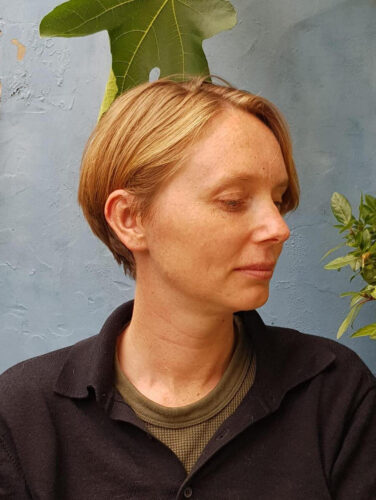
Rosanna McLaughlin. Photo: Courtesy of the artist
McLaughlin blames the lack of commitment to the Palestinian cause on expediency. But, in the end, museums, galleries, and art magazines are bourgeois operations that can’t promulgate the rhetoric of progressive radicalism. And they should be chided for pretending they could. The public seems to sense this. Putting aside questions of legality and civics in regards to Trump’s targeting of the Smithsonian institutions and the National Endowment for the Arts, it’s notable how little protest it elicited from anyone besides their direct beneficiaries. Galleries are closing left and right, and anyone with a serious financial stake in fine art will tell you that collectors have largely stopped reading art criticism.
Against Morality, despite its presentism and blind spots, has a trenchant and original chapter titled “Liberal Realism.” This is her term for the aforementioned shaming regime. “Liberal Realism is the product of a culture that demands its ideology be unambiguously reflected in its art.” It is the contemporary analogue of Soviet Realism, the superficially joyous portrayals of Stalinism that served as implicit instructions on how to feel about the regime. So it is with Liberal Realism, except that it’s not joyous and the threatened gulag is social. “Liberal Realism,” in McLaughlin’s condemnation, “is the art of those who sit in the educated rubble of civilization, among the structures and narratives we have so expertly disassembled, unable and afraid to countenance building something new, of risking putting something out in the world – unless its meaning and politics have already been assessed, confirmed, and approved – because we all know all too well how easy it is to tear a thing to shreds.”
Liberal Realism is not just a style of art, but a curatorial ethos. “Thus, the viewer is told what to think and why, artworks become illustrations for the meta-narrative of biography, and artists and their subjects ciphers for social-justice narratives, their work simplified to better meet the needs of the moment.” In 2020, four museum directors associated with the exhibition “Philip Guston Now” canceled its 2021 due to concerns regarding his depictions of Klansmen from the late ’60s and first half of the ’70s. They announced a delay, possibly for three years, “until a time at which we think that the powerful message of social and racial justice that is at the center of Philip Guston’s work can be more clearly interpreted,” as they put it in a statement. When McLaughlin viewed the iteration of the show at the Tate Modern, it was less condescending than the one I reviewed at the Museum of Fine Arts, Boston. But she notes that “pains were taken to convince the audience of Guston’s good politics, framing his work as anti-racist.”
McLaughlin may be the first progressive to recognize aloud that this episode of abject cowardice on the part of the museums caused long-term damage to institutional credibility and the perception of art in general:
One of the calling cards of Liberal Realism is the propensity to dress up self-serving tendencies as moral superiority, she writes. “The reframing of Guston as anti-racist primarily served the institutions that had agreed to show his work…. It did not serve the viewers, who were patronized by the dubious revisionism, and who were faced with the prospect of viewing Guston’s work in environments hostile to taking the artworks on their own terms.
Furthermore, “in its triumphalist attitude of having ‘solved’ the problem of racism his paintings, it relieved audiences from having to contend with the uncomfortable notion that racism is a part of everyday life, as quotidian as cigarettes and cars, and part of their own psychological makeup.” This last bit is off the mark, as the whole idea of the shaming regime at the time was to make white audiences experience their racism as ubiquitous and irredeemable. The last thing that the Boston leg of “Philip Guston Now” wanted was to oblige black viewers to confront the racism lurking in their psyches. On the contrary, the exhibition encouraged them and their sympathizers—really more the latter than the former—to engage in acts of self-care that challenging art museum shows do not actually call for. They too were deprived of an opportunity for aesthetic contemplation, but from the other direction.
Returning to Soutine, McLaughlin concludes that worthy art “pushes the viewer to go beyond what they think they ought to feel, what they think they already know, and to experience a fundamental irresolution that contains with it something of the beauty and horror of being alive.” It certainly can; McLaughlin’s admiration of Bosch’s hell panel accompanies a too-swift dismissal of the Eden panel. But to clarify further, the imposition of morality on art is an assault upon a realm of private experience that we cherish, firstly because we have nothing else, and secondly because we presume all others to have one of their own regardless of their identity. Paradoxically, this intensely personal phenomenon binds us to our fellow creatures. Key to what McLaughlin is calling Liberal Realism is the presumption that our inner lives belong to the shaming regime, to reorder according to its will. McLaughlin is correct that art is becoming a gigantic drag under Liberal Realism, but she is only scratching the surface on a profound danger.
That said, at least she is scratching the surface. The question is who will receive her message, between non-progressives already apprised and progressives reluctant to hear her.
Franklin Einspruch is an artist in writer in southern New Hampshire. He is the editor of Aphorisms for Artists: 100 Ways Toward Better Art by Walter Darby Bannard (Allworth Press, 2024). His Substack is Dissident Muse Journal.
I feel deeply conflicted here. Sure, much art of yesteryear seemed morally neutral. When I look at a Kandinsky, I don’t discern a political view–but an attempt to describe a feeling, a wild perspective, that might just change the way I look at things. At the same time, there is no requirement that art disengage from moral symbolism. Art both reflects and produces culture. If a person of color sees fit to communicate the personal despair of living in what she perceives as an unjust society–who are we to disallow that? James Baldwin wrote about it; surely, modern painters can brush about it in their own way . . . Shaming, I agree, may be a different issue. Forced conformity is never a good idea. And, to that extent, both reviewer and author are apt.
This review is already long, but I might have added that it would have been interesting if McLaughlin had attempted to deal with the characteristics of successful moral art. She’s really against moralizing, not morality per se. For that matter the Bosch panels to which she refers are dealing with the problem of human capriciousness and frailty, via the state of man pre- and post-Fall. She completely blows that off.
You’re correct, art is not required to do anything except succeed as art. Nothing, even moral content, is off limits. The problem is when you expect the moral content to make the work succeed, or judge art for failing to meet a moral standard, or subordinate artistic goals to political goals, or turn art into an excuse to bludgeon the audience with political exhortations.
Bill just wrote about how an Actors’ Shakespeare Project production of Macbeth featured a minor character breaking out into a tirade about “‘MAGA fascism,’ the gun lobby, ‘ICE disappearing people into the black hole of history,’ the likelihood that AI will ‘make us all obsolete,’ Rudy Giuliani, and ‘Democrats who keep voting to fund a genocide in Gaza.'” This is an abject failure to understand what art is for and of what it’s capable, and the kind of moralizing which McLaughlin correctly opposes.
We’re living through all of those things, so why shouldn’t artists make work about them? Sure, much of it is hacky and performative, and shoehorning it into a speech during MACBETH seems like a bad idea, but there’s also a history of great overtly political art across media.
This whole piece seems like it was written a decade ago. When the mayor of Miami Beach tries to get a movie theater evicted for showing NO OTHER LAND, college students are arrested for op-eds and the US government revokes immigrants’ visas for criticizing a disgusting bigot, the true McCarthyism has returned, and it’s not being carried out by liberals at art museums.
Hi Steve:
Franklin was referring to a recent column of mine. Here what the artistic director Christopher V. Edwards said about the Boston Globe‘s complaint about the infusion of polemics into Macbeth:
“When Shakespeare’s Macbeth was first performed around 1606, following the assassination of King Duncan in Act 2 – the audience would have been treated to the Porter character emerging from the world of 11th Century Scotland and talking about the modern events of 1600s London – with references to English tailors, and the ‘equivocator’ line often thought to be a reference to the Gunpowder Plot led by Guy Fawkes the year prior.”
“We saw it as our duty as stewards of this play to have our Porter (played by Dennis Trainor Jr.) break from the world of Cold War America and discuss the political matters of today – from artificial intelligence to global warming to the genocide in Gaza.”
“Don Aucoin of The Boston Globe clearly did not enjoy that portion. And he’s fully right to have his own opinion on it. But we wish he had been able to see that not as ’straining for relevance’ as he put it – Macbeth is clearly relevant enough for our own times to stand on its own two feet – but the exact opposite, as harkening to the tradition of the piece and how Shakespeare’s audiences would have engaged with this work itself.”
The Porter scene, which is difficult for modern audiences, is often transformed, sometimes via improvisation. So it makes sense to let him speak to contemporary issues.
There is a tradition, that goes back to the Elizabethans, of changing the script in performances for different audiences. Some Eastern European theaters would add material – that would speak to social concerns — in a classic play. Theatergoers knew what was up — it is a technique that has often been made use of in authoritarian countries.
Since Franklin mentioned my last column, I will respond to that point. Though I should also note that it is not just progressives, but MAGA types as well, such as the late Charlie Kirk, who want to turn art into a political bludgeon. He and others are on record recommending censorship, defunding, and shaming to encourage the production and highlighting of art that praises what they see as “American values.” (Art that no doubt savages the woke “enemy within.”) I assume Franklin condemns those efforts—currently being haphazardly put into action—as well. What I like about his review is that he points out the political cowardice of our major arts institutions, which are generally silent as the NEA is undercut and creative freedom hamstrung, in some cases successfully. What do they believe in when times get tough? Anything beyond the consumer bottom line?
As for politics and art, it is a complex issue, but I will try to keep it short. Bullying proclamations of “this is what art is” strike me as absurd as when I orate on “what criticism is.” I am a theater critic, so I will use examples from the stage. Back in the ‘80s I saw a Living Newspaper production from South Africa. I have not forgotten it. Sharp satire, compelling poignance, beautiful performances, this was a magnificent (and very theatrical) cry for freedom that provoked and moved. To say that because it was didactic it was not art is bosh. (For those who were rooting for the other side, Trump appears to be making up for the political attack on white supremacy by mainstreaming the immigration of white South Africans.)
On the other side of the coin, Václav Havel and Polish dramatists under Soviet domination could not produce plays that truthfully reflected life under authoritarianism (because the writers risked imprisonment—some were jailed for daring to speak up). They wrote absurdist plays that were not political at all—they had nothing to do with the oppression around them. Which made their surreal dramatics even more political: by not having a message, they sent a strong message (a cry for freedom of the individual, a plea to be left alone), at least at the time. Given where America is going, it would be interesting to revive some of these works—dramatists may have to learn how to write under a soft-authoritarian regime.
Franklin seems to think that critics should hew to the idea that art exists in a transcendent realm free of social and moral considerations, that art should, ideally, be hermetically sealed from moral/political impurities. Art is “for and capable of” many different things—and should be judged accordingly. (An ancient debate: critics ranking the most important art from the highest to the lowest.) There are all kinds of art, and it is propelled by various intentions. Criticism is a vital part of the dialogue to calibrate and determine the value (or valuelessness) of the efforts. The critic’s own values, political and otherwise, will inevitably come into play. Different artists will call for nuanced calibrations. The French writer Louis-Ferdinand Céline was an antisemite, but he penned some amazing novels. One condemns what one sees as hatred (if licensed by the author) in them and celebrates a genius who influenced several Jewish authors, including Philip Roth.
Art works exist in time and our reception of them are informed by our immediate existence. As a theater critic, I am acutely aware of this existential encounter—the performance I see will never happen again, and it reflects the hopes, dreams, perspectives, vision, feelings, terror, angst, of the people making the production at the time.
And that brings us to Macbeth. My understanding is that the text was pretty much the same, albeit set in the ‘50s. The inclusion of polemical material is an act of political theater, and it is not a new strategy. Check out some of the antifascist stage productions of the ‘30s—texts were changed nightly based on who was in the audience. The stage should mirror contemporary fears, joys, and anxieties. Right now, America is sliding toward tyranny, a belief I share with millions of others, including those I mingled with today in Boston’s huge “No Kings” protest. Our theaters are not registering this crisis, and I believe that is a mistake. (There would definitely be an audience for shows that deal with the emergency.) Granted, good art can be made under authoritarian rule. There are plenty of examples; there’s nothing like police repression to get the creative juices flowing. But I (and the theater company) are in favor of democracy, which I believe is healthy for art (and the country) if only because it welcomes a diversity of points of view and tolerates imaginative freedom. Thus, the troupe, while it still can, found a way to take its concern about the contemporary threat of tyranny directly to the audience—in a play about tyranny. Macbeth qua Macbeth still stands and can be staged in a traditional way by any company that wants to. And who knows? MAGA may demand productions of Macbeth that fit its ideology, as Stalin did. At that point, people may be afraid to complain about the didactic derangement, as Franklin is doing with this recent production. But critics who disagree with what they see should speak up…loudly. And not be afraid that they will be condemned as agents of “Antifa.”
Or Trump may go to a rehearsal of Hamlet at the Kennedy Center and react as Stalin did at a run-through of the tragedy at the Moscow Art Theatre in the early ’40s. He is alleged to have asked, “Why is this necessary—playing Hamlet in the Art Theater?” That remark frightened the theater directors to the point that they considered canceling the production. It sent a chill through the Russian theatrical community—self-censorship accelerated
If two years ago a minor character in an already anachronistic production of Macbeth broke into an even more anachronistic soliloquy about “Bidenist fascism” and proceeded to complain about the regime’s browbeating Facebook to censor true information and satire about Covid policies, designating parents showing up at school board meetings to complain about progressive indoctrination as domestic terrorists, putting Tulsi Gabbard on a TSA watchlist after she criticized Kamala, trying to stand up a Disinformation Governance Board, and flooding the country with 8 million illegal immigrants, you would have squirmed through it and despised the director for the rest of your life. I think that you would be less eager to endorse the kind of polemics you believe the arts should be promulgating if you and yours had ever been the subject of the associated complaints. The difference between you and me is that I don’t long for you to be subjected to the equivalent harangues.
The idea that we are lapsing into fascism is catastrophizing routine political disappointment. As far as I’m concerned, everyone who stayed silent about the tendency to autocracy in the last administration can remain silent about this one.
https://dissidentmuse.substack.com/p/bidenihilism
“Franklin seems to think that critics should hew to the idea that art exists in a transcendent realm free of social and moral considerations, that art should, ideally, be hermetically sealed from moral/political impurities.” This is incorrect. Art exists in a transcendental realm that is a superset of social and moral considerations. When we’re considering social or moral questions with respect to themselves, it is of utmost importance whether we’re considering them intelligently and wisely. When we’re considering them with respect to art, it only matters whether they’re interesting, whether they’re enabling the art. Socialism is a revolting doctrine, but even I can appreciate the brilliance of, say, the Taller de Grafica Popular, and it’s impossible to imagine the Taller sealed off from political “impurities.” Whereas that Macbeth aside sounds like an abdication of artistic integrity, throwing red meat out for an audience eager to chew on it, even if it’s complete shlock and breaks the world that they were building. If it was a 1950s set, why wasn’t the aside about McCarthyism? That might have been interesting.
Good art excuses bad politics. Good politics, whatever that may mean to someone, does not excuse bad art. That’s McLaughlin’s book in summary. What’s missing from it, including recognition that “good politics” means different things to different people and that the whole argument is not terribly original, is why good politically or morally informed art works as good art.
Believe me, I would have loved the Porter in Macbeth to launch into all the topics you mention, including a horror that you (strategically?) leave out — the Biden administration’s un-wavering support of Israel’s war crimes in Gaza. I would have loved to write about the speechifying. I don’t mind harangues if they reflect what is going on in the world around us. And if they are surrounded by the Bard’s poetry. Maybe it is having been a theater critic for four decades, but I have seen a lot, including a performance piece in which a woman stuffed yams up her vagina. Crazed political rhetoric ain’t nothing. I do take your point that a fusion of Trump’s attacks on freedom of speech and McCarthy scapegoating would probably have been more effective. Which I would have said in a review.
Your argument that current accusations of Trump’s move toward dictatorship being “routine political disappointment” doesn’t merit much of a response because it is blatantly absurd. Not sure anyone, including many members of MAGA, believe that. The White House press rep recently insisted that protestors are terrorists, members of Hamas/Antifa, and financed by George Soros. The same old disappointment? I think not — it is the “enemy within.” Get with the program. To be consistent, you might want to accept a version of this rationalization — the charges are a hysterical (pumped up by fill-in-the-blank forces) response to political business as usual.
We just had the largest public demonstration in American history — 7 million people (at least that is what I have heard) peacefully on the streets. And millions more will join them in the future to protect democracy and the U.S. Constitution from being tossed on the scrap heap. Silence means complicity.
You saw Karen Finley? That’s historic, not that I envy your witnessing her perform.
There’s nothing absurd about it, I’ve watched progressives liken every Republican president since Reagan to Hitler. The idea that Trump failed to implement fascism in his first term but this time he’s really going to do it is laughable. Nobody thinks this outside of blue enclaves. It’s made even more ridiculous by the fact that the Biden administration tried to set up a censorship network that would have been the envy of the Stasi if it had succeeded. I have observed that progressives only become fretful about democracy when they’re being prevented from implementing autocracy. It’s nice to hear that they’ve become defensive about the Constitution – it’s a refreshing change from just last fall, when The New York Times suggested that the Constitution is “dangerous.”
https://www.nytimes.com/2024/08/31/books/review/constitution-secession-democracy-crisis.html
Which relates to this “no kings” business. I’m not sure who said that everyone participating on Saturday was Hamas and antifa, but the protests were funded by two dozen Democrat PACs and some Soros-affiliated organizations, and attracted the usual Israel haters. If you think it was any less astroturfed than anything else, you should read that Bidenihilism piece I linked in the comment overhead and scrutinize those Eric Hoffer quotes.
In any case, the correct challenge to creators is not to make art that fixes the political situation, but to turn the political situation into the source of good art, if it is within their power to do so. The latter may be difficult, but the former is hopeless.
I saw Finley. It was more memorable than a lot of theater I have sat through.
As for the utter absurdity of your position, I will stick by it. The usual talking point exaggerations, surprisingly broad brush from a critic — aren’t we about calibration and discrimination? The “antifa” charge was, as I said, made by the White House Press Secretary — on Fox News, the fount of truth — so add that onto your list of dark forces manipulating the masses to hate Your America. It took a lot of money to get around 7 million people in the streets — perhaps a global cabal?
Polls suggest that the belief that Trump is an authoritarian — in the Orbán mode — is growing. If Biden failed to set up his nationwide censorship network (?!), Trump is going about the job with nihilistic fervor: note the AI slop from the White House picturing “King” Trump in a jet dropping shit on the protesters. He has also funded a no-rules-barred police force to help him. Censorship at libraries is increasing, as is money cut off from credible artists as well as scientific/ medical research, supposedly because of ‘woke’ beliefs or policies. Also, what drove many out in the streets — and will continue to do so — is not Soros’ greenbacks (of course, there is dark money on both sides), but the fact that millions of people’s health care costs are going up, including for MAGA. Marjorie Taylor Greene is registering the alarm.
We do agree that artists are not there to fix the political situation, but the idea of what is “good” art has not solidified into dogma for me — good to whom, where, and why? Answering those questions is a matter of civilized debate rather than name-calling, exciting as that can be. And, as I have argued before, there is reality to be respected, beyond the ideological hysteria on both sides — the climate crisis is real and it will become increasingly horrific. What will art be like in a world depleted of nature? That question has been and will be a good source for art that matters. Art that tells us that there is nothing to worry about, or that what is happening to the environment around us is an illusion, or that we should believe “alternative facts” — hopeless. But I would love to review a play — funding by fossil fuel giants? — that argues the latter.
“Good to whom, where, and why?” This is the question that art answers when it is the kind of art that McLaughlin derides. Or as Max Weber put it, “This is the history of art when it is an art of means and not of inspiration, or prophecy, or revelation.” The uses to which art is put must serve the art, or it is propaganda.
The question demands one of a number of dynamic/ unstable answers. As a contrary to the spirituality of Weber, for example, there is Walter Benjamin’s famous “There is no document of civilization which is not at the same time a document of barbarism. And just as such a document is not free of barbarism, barbarism taints also the manner in which it was transmitted from one owner to another.” I think the latter is overkill, but so is the Weber. Criticism at its best, which isn’t often, articulates the various tensions that should be pointed out (revealed?) when one answer becomes dogma.
There is a LOT to unpack in both the book review and the subsequent comments/dialogue. I’m still digesting and will return to this many times in the future I suspect. That said, I feel enormously privileged to have been a fly on the wall to the exchanges between Bill and Franklin! You served up not just food for thought but a banquet. Thank you.