
Theater Review: Manual Cinema’s “Leonardo! A Wonderful Show About a Terrible Monster” — Amusing, Joyful, and Creative
By Joan Lancourt
With its visual and emotional impact, Leonardo! A Wonderful Show about a Terrible Monster provides an expansive, more inclusive view of what theater can do for children.
Leonardo! A Wonderful Show About a Terrible Monster, written and performed by Manual Cinema, inspired by the books Leonardo, The Terrible Monster & Sam, The Most Scaredy-Cat Kid in the Whole World by Mo Willems. Directed by Sarah Fornace. Presented by Wheelock Family Theatre at Boston University at 180 Riverway, Boston, through October 19.

A scene from Manual Cinema’s Leonardo! A Wonderful Show About a Terrible Monster. Photo: Rebecca Michelson
Given the current political drama on our national stage, it would be easy to think that there are any number of more important things to occupy our limited attention spans than reading (or writing) a review of a local theater performance written and produced specifically for children and their families. But if we discard the notion that theater (for children as well as for adults ) is just entertainment –– a distracting and amusing diversion from the current avalanche of daily crises –– we might be able to see that theater is one way to inculcate the core values and beliefs children need to learn during their early formative years. Theater, with its in-person immediacy, its dramatic storytelling, and its superior ability to engage its audience at both an emotional and a cognitive level –– and, above all, in its ability to elicit empathy –– deserves to be seen as more than a pleasant diversion.
Case in point: Wheelock Family Theatre’s (WFT) current presentation of Leonardo! A Wonderful Show about a Terrible Monster, adapted by Sarah Fornace and Drew Dir from a popular children’s book by Mo Willems. It is an excellent example of how a positive set of core values, beliefs, and behaviors –– about personal identity, the heavy burden of being laughed at and mocked by one’s peers, our capacity to transform a weakness into a strength, and the essential importance of friendship –– can be embedded in an amusing, joyful, and creative hour of visual and interactive storytelling. This show is entertaining — but more than entertainment. With its visual and emotional impact, Leonardo! A Wonderful Show about a Terrible Monster provides an expansive, more inclusive view of what theater can do for children. It demonstrates, through concrete actions on stage, that even the very young among us have the agency needed to make important, life-enhancing choices.

A scene from Manual Cinema’s Leonardo! A Wonderful Show About a Terrible Monster. Photo: Rebecca Michelson
The story itself is simple: Leonardo is something of an outcast. He is a young monster, who by popular definition of what a monster should be –– a bully who scares and instills fear in others –– is a failure. He is absolutely unable to scare anyone. He is mocked and made fun of by his fellow monsters. As the story unfolds, he comes up with an idea: he will find the world’s biggest scaredy-cat, and then, surely, he will succeed at scaring the “tuna salad” out of him. Confident that he has hit on a solution to his problem, he goes on to dream of eventually being named “Monster of the Year.” His search for a kid who is scared of everything –– even a butterfly, a telephone, bacon and eggs, Halloween pumpkins and of their own reflection in a mirror –– involves a trip to the library (a not so subtle hint that libraries and librarians are wonderfully helpful places).
Leonardo also encounters another unsuccessful monster. named Frankenthaler, who is also searching for a kid who is scared of everything. This plot twist offers the young audience the soft message that they will most likely not be alone when they feel they don’t measure up. This reassuring insight then leads to the ‘quest’ to find the most scaredy-cat kid in the world, followed by the predictable (to adults) string of new failures. But, in the process, Leonardo learns one of the early life-changing lessons: persistence pays off. When he finds his scaredy-cat kid, a young boy named Sam, whom he is, once again, unable to scare, Leonardo learns that, instead of being an unsuccessful monster, he can become a wonderful friend instead. The give-and-take between the two offers further insight — friends don’t have to agree on everything.
What is not simple, and what sets this production apart from a straightforward staged retelling of the Mo Willems book, is the artistry of the Manual Cinema Company production. Pre-teens and teens will be drawn to the visuals of this inventive, Emmy Award-winning performance collective (led by Drew Dir, Sarah Fornace, Ben Kauffman, Julia Miller, and Kyle Vegter). The company’s seamlessly blended cinematic/stage techniques include innovative handmade shadow puppets, multiple screens and overhead projectors, live actors and puppeteers, and an inspired use of sounds and music. All of this theatricality serves an inventive and imaginative visual experience. The movements of the live actors and puppeteers as they act out the story –- their movements caught by video cameras, the images projected onto a large screen suspended above the stage – is fully visible center stage. The audience can choose to watch what’s on stage, or on the screen, or both, as the story unfolds.
The company also brings in a Narrator (a talented Lily Emerson) to make sure that even the youngest audience members are able to follow the story. Emerson also draws on the tried-and-true technique of periodically asking audience members direct questions, and she waits for their resounding answers. At one choice point, she asks the audience what Leonardo should do, and the audience –– both parents and children –– enthusiastically shout out a range of possibilities. Key to the production are the puppeteers: Kevin Michael Wesson (Leonardo), Sharina Latrice Turnage (Kerry), and Karley Gesine Bergmann (Sam). Choreography is by Sarah Fornace, and music, lyrics and sound are by Ben Kauffman and Kyle Vegter. Storyboards and 2D puppet designs are by Drew Dir, costumes and wigs by Mieka Van der Ploeg, lighting by Try Brazeal and Nick Chamernik, and hand and rod puppets by Lizi Breit.
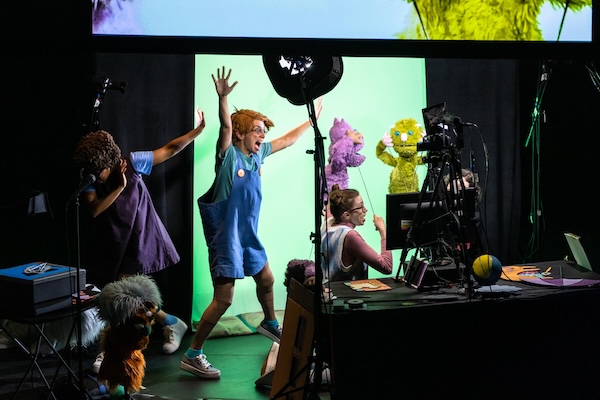
A scene from Manual Cinema’s Leonardo! A Wonderful Show About a Terrible Monster. Photo: Rebecca Michelson
In keeping with what has become a nationwide range of best practices for preparing young audiences (Theater for Young Audiences) before a theater performance, WFT and MCC send an email to all ticket holders. It includes links to several resources that show how the performance can be accessible to diverse needs, which range from visual, hearing, and mobility impairments to the emotional and sensory needs of children on the autism spectrum. One appealing resource: a series of visuals and texts that a parent can use to walk their child through the steps of ‘going to the theater.’ There is a picture of a calendar with the date of the performance circled; a page depicting “I will drive to the theater with my family;” tips about waiting in line to get into the theater and picking up the tickets in the lobby; a page enumerating services audience members might use (e.g. a Braille program, an elevator, an audio description or an assisted listening device). Pages offer an explanation of the caption screens on each side of the stage, of the importance of ASL interpreters, and of how the MCC uses cameras and videos, as well as live actors, to tell the story.
The email also describes the stage set, how the puppets are animated, and how when the lights dim the play is about to begin. A story synopsis is provided, and advice on what to do if you are upset that the idea you have shouted out isn’t picked by the Narrator. (Take a deep breath; ask someone for help; or even take a break and come back when you feel better.) There is advice on how to clap at the end of the performance, and how to sit quietly if that’s what you want to do. Finally, a link to a Sensory Guide alerts parents to specific moments in the show that might possibly be especially scary for younger children, such as when there might be loud or frightening sounds, like yelling or growling.
Resources such as these, as well as the choice of subject matter for each play, are part of a nationwide effort among TYA theaters to position the performing arts as a significant part of the educational experience, a vital way to meet the socio/emotional developmental needs of childhood and adolescence. The WFT also calls for a commitment to multicultural and multiethnic casting, a high level of professionalism, and a broad range of classes in acting, musical theater, and design that will intrigue students interested in learning more about the various aspects of the performing arts.
Now, more than ever, we need to enrich the lives of the next generation with vivid, creative, in person, communal experiences. Whether as a result of too much screen time, or Covid distancing, isolation is fast becoming a major mental health problem among the young. Sitting in the audience, even if it’s on Mom’s or Dad’s lap, makes a child part of a larger community. The collective cheers and boos can make them feel connected to others in a visceral way. And that link, especially when those others are in some way different from themselves –– either in abilities, race, gender, or class –– nurtures the bonds necessary for a healthy democratic society. Attending and supporting WFT performances like Leonardo! A Wonderful Show About a Terrible Monster is an easy way to prepare the next generation to value the freedoms we care for the most.
Joan Lancourt, Ph.D., is a local author, most recently of More Than Entertainment: Democracy and the Performing Arts –– Junior Programs, Inc. (1936-1943) Pioneers of Theater for Young Audiences. The book’s website is www.juniorprogramsbook.com
Tagged: "Leonardo! A Wonderful Show About a Terrible Monster", Manual Cinema, Sarah Fornace