Theater Review: “Madame Mozart, The Lacrimosa” — A Comic Requiem About Genius and Survival
By David Greenham
Whatever really happened in those hectic weeks of December 1791, this modern take on the creation of Mozart’s Requiem might well turn out to have classic possibilities of its own.
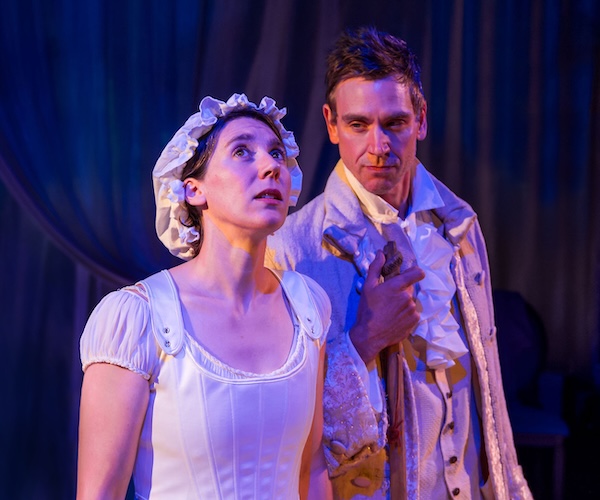
A scene featuring Jocelyn Duford and Jeremy Beazlie in Punctuate4 Productions’ staging of Madame Mozart, The Lacrimosa. Photo: courtesy of the artist
Madame Mozart, The Lacrimosa, a play with music by Anne Undeland. Directed by Myriam Cyr. Music direction by John Churchwell. Set and lighting design by Len Schnabel. Audiovisual and sound design by Kosmo Hayes. Costumes and graphic design by Cat Stramer. Staged by Punctuate4 Productions at the Natti-Willsky Performance Center in conjunction with Gloucester Stage Company, Gloucester, through October 19.
Classical music was often playing in the background of my youth. My parents were avid choral singers, and for them any chance to sing the great Mozart Requiem with a full orchestra was a highlight of the year.
What fun, then, to have the opportunity to catch Anne Undeland’s new comic drama, Madame Mozart, The Lacrimosa, at Gloucester Stage, where guest company Punctuate4 has taken up residency this fall. Its 100-minute dreamscape/fictional history focuses on the effort to complete Mozart’s Requiem in the days after his death.
The tale begins on December 5, 1791, when we meet Madame Maria Constanze Mozart (Jocelyn Duford), who is struggling to drag the wrapped body of her dead husband down to the cold basement of their Vienna home. Crying and scared, she’s frantic to stuff the corpse into a box — she needs to buy time and figure out what to do next. “Take me with you Wolfie, I can’t do this alone,” she cries.
Her seven-year-old son Karl Thomas (Jeremy Beazlie) wants to know where his father is. Moments later, we hear the composer’s overbearing student, Herr Franz Xavier Süssmayr (also Beazlie) banging at the door, demanding to see the master. Constanze knows that she’s got to work fast to come up with a plan if she is going to survive. It’s the 18th century — women have no property rights; she’s a widow, which means that she’ll lose her house, her money, and most likely, her two young children.
But she’s clever. Her husband’s unfinished requiem is the key. It’s been commissioned “anonymously,” but she knows who the man with the money is — the tiny and disgusting Count Franz von Walseff (also Beazlie), who Süssmayr calls “The Great Flatuator.” If she can manage to get the requiem finished — and convince the count to make the check out to her — Constanze might just be able to score a masterpiece maneuver of her own, saving herself and her children from poverty.
The show’s plot was inspired by author and musician Gerald Elias’s short story “Lacrymsa.” Madame Mozart, The Lacrimosa was commissioned by the Great Barrington Public Theater, and had its premiere there this past summer. The story is based on snippets of fact. Mozart did leave the unfinished masterpiece, and Süssmayr (not Salieri) completed it. Unsurprisingly, Constanze’s influence on the finished version of the piece is unknown. It’s likely she had some; after all, she was a trained musician and capable of composing music. More important, Constanze was known for her business acumen; she saved the family’s fortune and Mozart’s work after his death.
Out of this desperate quandary, dramatist Anne Undeland has fashioned an appealing entertainment, a fun and fast-moving burlesque. By turns ridiculous and absurd, the story also celebrates the ingenuity of Constanze, a smart and talented woman who can be plenty inventive when she needs to be.
The concept, a play with music, also provides considerable delight. In the background sits pianist John Churchwell, who provides snippets of Mozart’s music. He’s only seen through a sheer curtain, but his playing augments the action powerfully. Most effective are the scenes in which Constanze and Süssmayr discuss specific sections of the now-famous Requiem; Churchwell deftly underscores the dialogue.
The story has plenty of humor, drama, and intrigue. The proceedings are also peppered with modern references that will spark a wry smile from audience members.
Jocelyn Duford soars as Constanze, managing to combine the character’s near-farce frenzy with the sorrow of a woman who just lost her beloved husband and fears losing her children as well. Her strength and determination is inspirational; throughout, this Constanze refuses to lose her dignity as she manipulates those who want to control her and the fate of Mozart’s Requiem. If she can pull her scheme off — while extracting a little revenge against the self-important men who surround her — well, all the better.
Jeremy Beazlie has a blast playing every other role, young Karl Thomas, lecherous Süssmayr, the flatulent count, Mozart’s kind but insecure student Herr Joseph Leopold Eybler, Mozart’s bitter father Leopold, and Constanze’s ridiculous mother Cäcilia Weber. Beazlie creates quickly recognizable caricatures — but he can give them depth when it’s needed.
Director (and Punctuate4 artistic director) Myriam Cyr brings a strong visual and sonic vision to this production. The set’s flowing curtains (by Len Schnabel), combined with his lights and the audiovisual/sound design from Kosmo Hayes, resonate with a Northern Lights feel. Colors explode when Constanze is caught up in the beautiful sounds of Mozart’s music. The road-runner transitions, the chameleon-like Beazlie jumping from one character to the next, are seamless, and the romp zips along smoothly.
Undeland is aware of the relevancies of this historical comedy. Constanze’s fight against the patriarchy feels familiar and immediate. By making the commission “anonymous,” the wealthy count has a plan to claim Mozart’s work as his own — a plot point that’s probably rooted in fact. Constanze tricks him by planning the composition’s world premiere to include the presence of Emperor Leopold II — thus making sure Mozart gets the credit. When the count realizes he’s been subverted, he seethes, calling Constanze “a nasty woman.” She slyly retorts that “men were my best teachers.”
Whatever really happened in those hectic weeks of December 1791, this modern take on the creation of Mozart’s Requiem might well turn out to have classic possibilities of its own.
David Greenham is an arts and culture consultant, adjunct lecturer on Drama at the University of Maine at Augusta, and is the former executive director of the Maine Arts Commission. He can be found at https://davidgreenham.com/
Tagged: "Madame Mozart The Lacrimosa", Anne Undeland, Jeremy Beazlie, John Churchwell, Myriam Cyr