
Television Review: Gender, Grit, and Glamour — Netflix’s “The New Force” Puts a Welcome Spin on the Cop Genre
By Sarah Osman
While not without its flaws, the series proves that traditional TV cop drama can be given a new spin, and it is especially gratifying when the innovation involves kick-ass women.
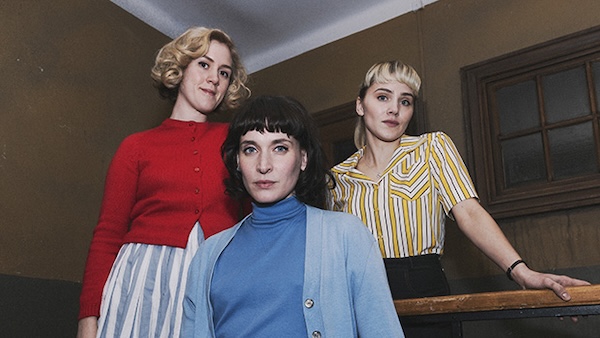
The ladies of The New Force. Photo: Netflix
Normally, I wouldn’t be drawn to a show about cops. But the premise of Netflix’s The New Force drew me in. Set in 1958, the Swedish series follows the first female police officers in Stockholm. Despite Sweden being far more progressive than most countries, the lady cops faced rampant sexism from their male counterparts. Still, the ladies persisted.
We follow Carin (Josefin Asplund), Siv (Agnes Rase), and Ingrid (Malin Persson), recent graduates of the police academy. They’re assigned to Klara, Stockholm’s most crime-ridden neighborhood. The female cops were brought because of a personnel shortage; the media celebrate their presence but the men do not. Ingrid’s partner refuses to speak to her (and embraces police brutality), Siv is dismissed for her looks, dubbed “Miss Sweden” and, although Carin’s partner actually treats her with respect, he still doesn’t care about a case involving a dead prostitute. As Carin continues to investigate the case, more of Klara’s seedy underbelly is revealed, including how some of the cops aren’t as innocent as they seem.
The crime boss/dead hooker plot isn’t the most captivating, simply because every other cop show in the last 25 years has had this same story. What is more interesting is how the protagonist trio grapples with a misogynistic, corrupt system. Ingrid is hesitant to report her cop partner’s love of beating people, since her job is on the line. Siv isn’t afraid to flirt with Detective Oscar (Hannes Fohlin) to further her chances of becoming a detective. Carin’s boyfriend is hesitant to introduce her to his high-society mom, who disapproves of her being a cop. In addition to probing Stockholm’s crooked police system, the show also gives us glimpses of life in the late ’50s. Contraceptives were rare. Impoverished industrial workers drink and beat their wives. Class differences are highlighted, especially between blue-collar and white-collar workers.
While the mafia/brothel corruption plot makes sense for a cop show and ties the episodes together, what doesn’t make sense here is the hip-hop. It’s established that we are indeed in the ’50s, from the skirts and pantyhose the ladies wear to the swing music they dance to. So the sudden cuts of hip-hop music juxtaposed with ’70s-style stills of people being arrested are jarring. Sometimes modern music works in a historic series, especially if it’s used subtly, like Bridgerton’s classical takes on current pop songs. But the latter series, from its costumes to its plotlines, already has a fantasy aspect from the get-go. The New Force doesn’t. The series is inspired by the real-life stories of the first Swedish female police force. So why the sudden shift to two separate decades (the ’70s and the ’90s)? If The New Force returns for a second season, let’s hope the inexplicable exploitation of hip-hop scenes does not.
Despite the weaker elements in The New Force, the three lead actresses are phenomenal. Asplund plays Carin with a bouncy optimism that faces a challenge: she is struggling to be a fair cop. She tries her best to get justice for Monica (the sex worker who was murdered), but inadvertently hurts more sex workers in the process. Rase plays Siv as a woman of steely determination; there’s an ambitious glint in her eyes that lets you know she will do what it takes to succeed, even if that means mowing down her fellow “skirt cops.” It’s not easy playing a subdued character, but Persson is brilliant as Ingrid, shifting her eyes away as her cop partner torments anyone he deems guilty.
Admirably, The New Force is a new type of police drama. While not without its flaws, the series proves that traditional TV cop drama can be given a new spin, and it is especially gratifying when the innovation involves kick-ass women.
Sarah Mina Osman is based in Los Angeles. In addition to The Arts Fuse, her writing can be found in The Huffington Post, Success Magazine, Matador Network, HelloGiggles, Business Insider, and WatchMojo. She has an MFA in Creative Writing from the University of North Carolina Wilmington and is working on her first novel. She has a deep appreciation for sloths and tacos. You can keep up with her on Instagram @SarahMinaOsman and at Bluesky @sarahminaosman.bsky.social.
I found the ending shocking, inconclusive, and annoying. Who killed Monica, Jack or her father? Why did her father’s protection of Jack never come to light? If there is no season 2 where these shocking developments are addressed I found watching a waste of time.