
Film Review: “Orwell: 2+2=5” — Big Brother Is Here
By Tim Jackson
Director Raoul Peck, like his subject George Orwell, encourages critical thinking and urges us to consider how best to resist the strengthening forces of tyranny.
Orwell: 2+2=5, directed by Raoul Peck. Playing at Landmark Kendall Cinema
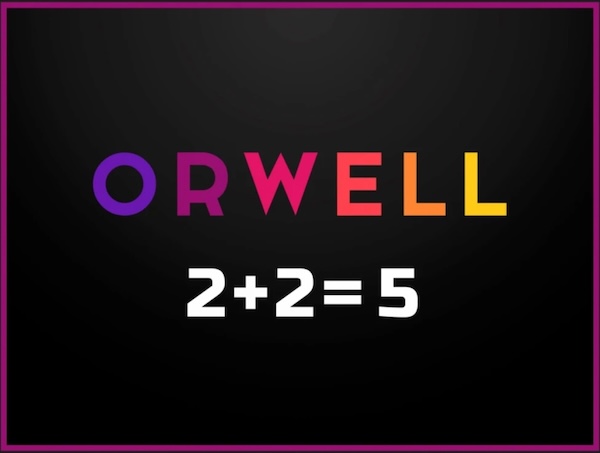
Raoul Peck’s film I Am Not Your Negro was a profound meditation on race and identity in America, told through the words of James Baldwin. Narrated by Samuel L. Jackson and enriched with archival footage and news clips, the film took the form of a lyrical visual essay, what critic A.O. Scott called a “sober, unblinking gaze into America’s racial abyss.” In his latest film, Orwell: 2+2=5, produced with Alex Gibney (Taxi to the Dark Side), Peck takes a similarly creative approach. Drawing on the writings of George Orwell, he points to stark and uncompromising parallels between Orwell’s final book, 1984, and today’s social, political, and technological realities. This is fertile ground, and Peck fully embraces its relevance. Orwell: 2+2=5 should be required viewing for anyone seeking to understand how Orwell’s warning about authoritarianism, and its links to technology, not only predicted our current landscape of domestic and global politics, but continues to resonate today.
Peck frames his film around the slogans that run through Orwell’s novel — “War is peace, freedom is slavery, ignorance is strength.” Opening with a montage of faces of global citizens, he signals that his documentary is meant to address a world increasingly subject to tyrannical control, where political discourse is riddled with doublespeak, populations are deliberately kept in ignorance. Who really holds and deftly manipulates the reins of power? Orwell’s intent was to uncover the truth of our predicament: “I write because there is some lie I want to expose, some fact to which I want to draw attention, and my initial concern is to get a hearing.” These words come from the author’s essay “Why I Write,” and they are voiced with appropriate gravitas by the actor Damian Lewis.
Peck succeeds in weaving a dynamic montage of film and news clips that both entertain and reveal, with painful clarity, how much of the world — including the United States — is sliding into governments who demand centralized control. His aims here are similar to Orwell’s, including the latter’s goal to “make political writing into an art.”
Sequences from various screen adaptations of 1984 underline the disturbing contemporary parallels of Orwell’s vision: Peter Cushing appears in several moments from 1954’s live BBC production, which also featured Donald Pleasence. Edmund O’Brien is seen repeatedly in excerpts from Michael Anderson’s 1956 British film, originally intended as a warning against Soviet tyranny but now freighted with new meaning; and Lorne Greene, later famous for starring in TV’s Bonanza, surfaces in the 1953 Westinghouse Studio teleplay opposite Eddie Albert of Green Acres fame. Peck also draws on the best-known film version of the novel — Michael Radford’s theatrical release, which starred John Hurt as Winston Smith and Richard Burton in his final screen role.

William Everston, Orwell. Wood and polymer clay with bronze. Inside is carved a line from 1984: “If you want a picture of the future, imagine a boot stamping on a human face — forever.” Photo: Bill Marx
Other clips visually reinforce the narration’s social and political arguments. Footage from Ken Loach’s I, Daniel Blake and Lauren Greenfield’s Generation Wealth starkly illustrates class inequality. Images of opulence and decay from Terry Gilliam’s Brazil, David Lean’s Oliver Twist, and Sydney Pollack’s Out of Africa stand as reminders of colonialism’s exploitation and excesses. Sequences from an adaptation of Orwell’s antifascist fable Animal Farm — presented with puppetry, animatronics, and CGI — underline the story ‘s infamous slogan: “All animals are equal, but some are more equal than others.” A scene from 2018’s Fahrenheit 451 supplies an unmistakable echo of today’s wave of book bans and burnings, censorship driven by reactionary zealotry. (The film notes that 3,364 titles have been banned around the world, 1984 among them.) Speculating on the fruits of censorship, Orwell observed that it comes from the belief that “history is something to be created.”
Biographically, the narration is framed by Orwell’s final days on the Scottish island of Jura, where he was dying of tuberculosis as he completed 1984, his last book. We hear how the writer recalls his upbringing in what he described as the “lower-upper-middle class.” Men of modest means had the opportunity to join the military so they could “play at being gentlemen.” For Orwell, the British cult of “character” — the belief that true manhood lies in the ability to impose one’s will on others — carried dangerous consequences. This obsession with unquestioned authority shaped an imperial politics that justified British domination in India (and elsewhere) and France’s violent suppression of rebellion in Algeria. Orwell saw that empire was not noble stewardship but what he called a “monstrous intrusion.”
Real world examples are also used effectively in the documentary. News clips illustrate how methods of control, similar to those in Orwell’s novel, are being employed today. These strategies of repression include intimidation of the media, the manipulation of language, and microscopic surveillance of the population. These techniques have been put into service by regimes including those of Pinochet in Chile, Marcos in the Philippines, Orban in Hungary, Museveni in Uganda, and Putin’s servile Russia. The United States has not been spared this move toward totalitarianism. The evidence of our slide into fascism is frightening.
Orwell’s critiques continue to undercut the bromides of contemporary politics. For example, the slogan “war is peace” reflects how the US, despite its benign rhetoric, has been continuously at war throughout its history — in fact, our military budget exceeds that of the entire economies of many advanced countries. Big Brother is making a big profit; surveillance capitalism is raking in billions of dollars. The current president’s firings and indictments, motivated by anger and revenge, are also about shutting down dissent and spreading fear.
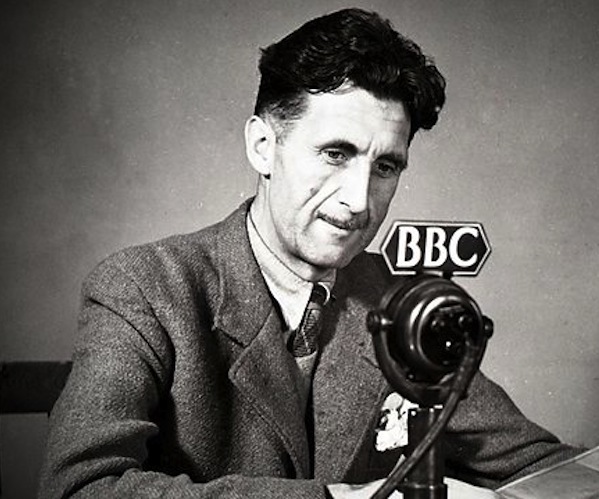
George Orwell broadcasting at the BBC. Photo: Wikimedia
The “death of truth” remains the most dangerously salient aspect of Orwell’s dystopian vision. He warned that “monopolies are actively interested in maintaining the status quo, and therefore in keeping the common man from becoming too intelligent.” That warning becomes prophetic as we confront the vast anti-intellectual empires of Rupert Murdoch, Jeff Bezos, Silvio Berlusconi, Vincent Bolloré, Michael Bloomberg, and others. The late critic Danny Schechter (WBCN’s former “News Dissector”) labeled it dumbing down via a “Media-ocracy.” A graphic in the documentary underscores the point: more than $560 million has been spent on media lobbying over the past 26 years. This is followed by a John Oliver–style litany of “pre-fabricated phrases,” echoed word-for-word across domestic news broadcasts. Language becomes an instrument dedicated to deception: reductions to valuable social programs are rebranded as “cuts,” a handout to the wealthy is sold as a “stimulus package.” And the list goes on.
The erosion of truth is being accelerated by the rise of AI. We see fabricated images of Trump surrounded by adoring Black men and women, propagandistic reinforcement for his exaggerated claims of popularity among that community. We hear Orwell warn that “this sort of thing is frightening to me because it often gives me the feeling that the very notion of objective truth is fading out of the world.”
Nobel Peace Prize–winning journalist Maria Ressa, in a recent commencement address, alerts a college crowd that “social media has turned our world upside down, spreading lies faster than fact, amplifying hate and fear, fueling hatred by design for profit.” Her words are underlined by the delusional voices of insurgents on January 6, who openly declare intentions shaped by alternative facts, lies, and religious extremism. In a voiceover, Trump says about the rebels: “These were great people. And did I mention the word love? The love in the air. I’ve never seen anything like it.” Then we hear rioters in full froth chanting, “Heads on pikes.” It is precisely frightening juxtapositions like these that carry Orwell’s vision of authoritarian bedevilment into the modern age: his words remain prescient about the dangers absolute power poses to the future of mankind.
Orwell: 2+2=5 does not pretend to offer solutions. That is not its aim. The film addresses the urgency of our predicament, the intertwining of Damian Lewis’s measured narration with an imaginative use of concerning images and an ominous, ever-shifting score. The doc’s didacticism is softened by its inventive use of film footage and Orwell’s language to provoke reflection, even among those who agree with its conclusions. Peck wants us to think critically, to consider the best ways to resist the strengthening forces dedicated to tyranny. In this sense, Orwell: 2+2=5 is a call to arms driven by Orwell’s faith in humanity: “Common decency is necessary. My chief hope for the future is that the common people have never parted ways with their moral code.”
Tim Jackson was an assistant professor of Digital Film and Video for 20 years. His music career in Boston began in the 1970s and includes some 20 groups, recordings, national and international tours, and contributions to film soundtracks. He studied theater and English as an undergraduate, and has also worked helter-skelter as an actor and member of SAG and AFTRA since the 1980s. He has directed three feature documentaries: Chaos and Order: Making American Theater about the American Repertory Theater; Radical Jesters, which profiles the practices of 11 interventionist artists and agit-prop performance groups; When Things Go Wrong: The Robin Lane Story. And two short films: Joan Walsh Anglund: Life in Story and Poem and The American Gurner. He is a member of the Boston Society of Film Critics. You can read more of his work on his blog.
Tagged: "Orwell 2+2=5", 1984, George Orwell, antifascism, authoritarianism, fascism