
Film Review: Dispatch #3 — From the New York Film Festival, Jim Jarmusch’s “Father Mother Sister Brother”
By Erica Abeel
Father Mother Sister Brother invites you into a space of present-ness where you need to slow down and reset your metabolism. It invites you to tune out all the noise and sit with the silences between people. A daring ask in a digital world where everyone’s glued to their screens, all the better to pick up the noise.
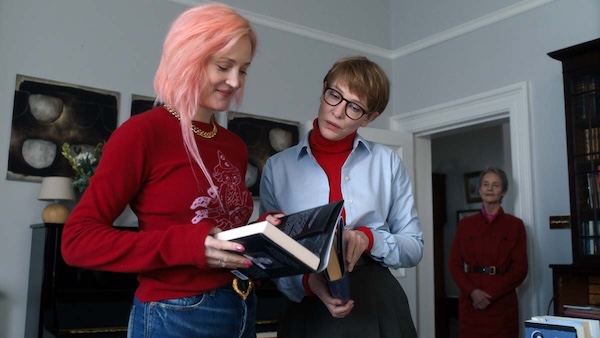
Vickie Krieps, Cate Blanchett, and Charlotte Rampling in a scene from Jim Jarmusch’s Father Mother Sister Brother. Photo: NYFF
Over the past couple of weeks I’ve been attending the tightly curated press screenings for the New York Film Festival, which run ahead of, then concurrently with, the public ones. Though not as crazy-intense as in Cannes, where cinema = the universe, press and industry people at film fests tend to inhabit a sort of bubble, oblivious to the rest of the world — even the whole rest of the festival. So the other night when I went to a public screening of Father Mother Sister Brother by Jim Jarmusch it was a bit of a reality check.
I was blown away by the huge turnout that filled virtually every seat in cavernous Alice Tully Hall. I was struck, too, by what Dennis Lim (the fest’s artistic director) and his team have pulled together. Here on tap were the standouts of world cinema — and this at a time when filmmaking in the US is reportedly on life support. Directors and cast regularly appear onstage to comment on the work. The lineup of filmmaker “conversations” offers to-die-for pairings. Consider the prolific and ballsy Claire Denis ( 1999’s Beau Travail and 2023’s The Stars at Noon) swapping insights with Barry Jenkins, creator of the exquisite Moonlight! One Saturday saw the premiere of Mr. Scorsese, a five-hour documentary by fellow filmmaker Rebecca Miller (the first two hours screened for press were riveting). Next evening brought a panel with Scorsese that included Michael Imperioli of Goodfellas. In the Revivals section you could take in the restoration of Shades of Silk (1978), a memory piece by Canadian-French Mary Stephen about an erotically charged relationship between two Chinese women in 1930s Shanghai (Arts Fuse review). And, the fest being showbiz, let’s not forget the splashy “surprise” screening at Tully of Josh Safdie’s Marty Supreme, the Timothée Chalamet starrer that critics are treating like the second coming (with one notable dissenter). I disliked Uncut Gems, which Safdie made with his bro Benny, but maybe Josh does better working solo.
That evening with Jarmusch I sensed the hunger in New York for good movies. The city has failed cinephiles with a lack of venues for indie/art/foreign film, arguably due to the agenda of real estate developers. Lincoln Plaza Cinema, storied home for indie and foreign film, sits empty after the owners of the space refused to renew the lease. The multiplexes serve up formulaic plots, sequels and reboots, comedies with Adam Sandler. A Tron IMAX double feature anyone? In the cultural mecca that is New York the dearth of screens is a disgrace.
Homeboy Jim Jarmusch is beloved in these parts, ever since Down by Law (1986), when Tom Waits growled out songs in that guttural voice tipping into vocal fry. And here onstage sat Waits, looking not much different from the rapscallion he plays in in Jarmusch’s new film. Father Mother Sister Brother is an anthology work composed of three panels centered around family relations (or the lack of them) and set, respectively, in rural upstate New York, Dublin, and Paris. Each panel of the triptych is separated by an abstract design evoking light-dappled water. In Part One, Jeff (Adam Driver) and his sister (Mayim Bialik) drive through the wintry countryside on a rare visit to their father (Waits). Jeff has brought a care package (including pasta sauce that, he points out, “already has the cheese in it.”) He also sends his father money for repairs to his derelict house that go undone, suggesting that the old man is bilking him. Waits, with his springy spirals of red hair (which deserve a credit of their own), has prepared for their visit by uglifying the place, covering the nice sofa with a ratty shawl. The three spend much time talking about the water and tea dad serves, joking about whether it’s appropriate to toast with cups of tea. This in lieu of anything more meaningful. At one point, Waits offers an alarming demo with an ax. Driver tries out a chair (incongruously elegant) that looks over a pond, an idyllic view city folk might pay a lot for. The strained silence grows increasingly funny. The kids drive off, wondering whether the Rolex they spot on dad is real or a knock-off. Waits, for his part, hilariously uncorks a side of his life he’s kept under wraps.
The second panel features Charlotte Rampling as a well-off novelist living in a tony Dublin home, reluctantly gearing up for the annual visit of her two daughters (Vickie Krieps in orange/pink hair and a nerdy Cate Blanchett, barely recognizable). Again, communication is not on the menu. Anything even hinting at personal disclosure is throttled by Mummy, though we glimpse shards of her daughters’ back stories. Krieps has asked her Irish girlfriend to drop her at her mother’s house pretending to be an Uber driver so she can promote the myth that her faltering business is thriving and her Lexus is in the shop. Blanchett remains opaque, though you sense an arid loneliness. Rampling presides over the elaborate tea with the hooded, faintly evil remoteness she’s patented, neatly skirting any moment that might open a portal into her daughters’ lives. You may hate her a little, but Jarmusch would rather you didn’t. This is bravura filmmaking that perversely explores how much can be left out. Talk about “experimental.” I thought of Mark Rothko’s “Black-Form” paintings.
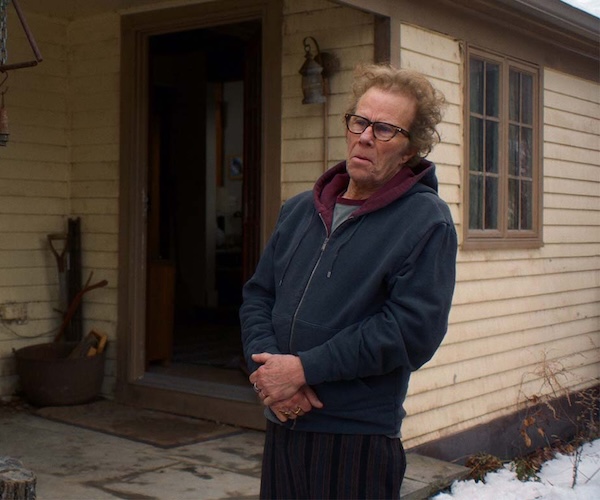
Tom Waits in a scene from Jim Jarmusch’s Father Mother Sister Brother. Photo: NYFF
The final episode involves a pair of twins (Luca Sabbat and Indya Moore) who do in fact find solace with each other after the death of their parents in a small plane crash in the Azores. They roam their parents’ Paris apartment, empty but for a box of their childhood drawings. “They kept everything we ever did,” Luca says. The story concludes with a desolate image of all their parents’ belongings stuffed into a storage locker, while the laid-back rhythms of the song “Spooky” undercuts the dark moment
This is a quiet film, Jarmusch told the audience before the screening. But simplicity, he added, is difficult to pull off. “Quiet” is, perhaps, overstating it, since in this movie nothing happens. Which turns out to be rather exhilarating in a Zen sort of way. To judge by Josh Safdie’s previous work, Father Mother Sister Brother would appear to be the polar opposite of Marty Supreme. Fine. Cinema pitches a large tent.
Father Mother Sister Brother invites you into a space of present-ness where you need to slow down and reset your metabolism. It invites you to tune out all the noise and sit with the silences between people. A daring ask in a digital world where everyone’s glued to their screens, the better to pick up the noise. Actually, the most acutely rendered character in the triptych is Adam Driver’s Jeff. His lunky presence at his father’s place seems to ask, What does it mean, this thing of being related by blood? Through barely visible touches, Driver sketches in a funny-poignant portrait of a well-meaning but pedestrian guy who seems less alive than his mad-hatter dad.
The film’s trio of episodes knit together the way a piece of music is constructed out of recurring motifs. The characters always drive somewhere in a car. The camera repeats overhead shots of food laid out. People look out of windows and mouth lame questions: “Can you toast with tea?” The film would never work as a streaming offering, and I mean that as a compliment. It sits at a far remove from literature or theater or language, relying primarily on its own visual language and sound.
One jarring motif in all three episodes involves skateboarders streaking across the screen. They do not appear playful, but, rather, inject a sense of foreboding, like the shadow of vultures. I’m guessing that Jarmusch, in a brilliant stroke, intends the skateboarders as a metaphor to convey the anxiety shared by grown children: that of their parents’ mortality.
Erica Abeel is a novelist, critic, and former professor at CUNY. Among her novels are Wild Girls, named a Notable Book by Oprah Magazine and now available on Audible; and The Commune, a comic satire on the launch of Second Wave Feminism that Kirkus called “a joyous literary romp with hidden depth.” Her novel The Laws of Desire is forthcoming from She Writes Press.
Tagged: "Father Mother Sister Brother", Adam Driver, Cate Blanchett, Charlotte Rampling, Jim Jarmusch, New York Film Festival 2025