Poetry Review: Shangyang Fang’s “Study of Sorrow: Translations”
By Laura Sheahen
We owe Shangyang Fang a debt for bringing the delicacy, obliqueness, and sheer tremulous beauty of these Chinese poems to English-speaking readers.
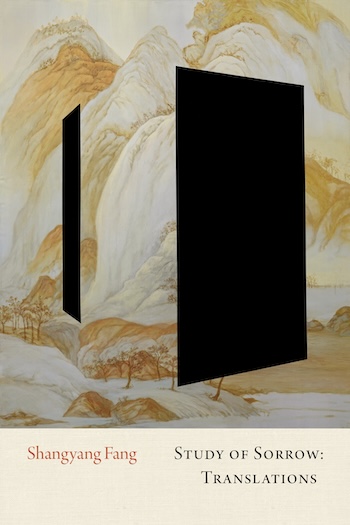
Study of Sorrow: Translations by Shangyang Fang. Copper Canyon, 264 pages, $17
 For poetry lovers who do not speak the languages, reading classic Chinese or Japanese poems is like peering through wavering currents of water at an open treasure chest. We know something good, something amazing, is down there—we glimpse the colors of the jewels and gold glinting—but we usually close the book (or web tab) frustrated, unable to grasp why native speakers have cherished the poems for centuries.
In Study of Sorrow: Translations, a collection of thousand-year-old poems from China, Shangyang Fang has lifted these riches closer to the surface than most. These are song lyrics, written for music during the dynasty that followed the Tang. We owe Fang a debt for bringing the delicacy, obliqueness, and sheer tremulous beauty of these Chinese poems to English-speaking readers.
Divided into seven themes including “Departures,” “Solitude,” and “Unbridled,” with Chinese text en face, the book contains poems by almost thirty poets. Nearly every poem has standout lines: “people silent with darkness”; “a silk-bound letter that writes to the end of love”; “No sorrowful songs for me unless I am drunk./I am drunk.”
In the section “Lovesickness,” lines like “Your needlework remains deeply stitched/along the inner lining of my coat” do what poetry does best—evoke emotion without using the literal words for emotions. We don’t need the word “passion” to find it in the lines “I will light all the candles to read your letter/after dark.” In the excellent “Listening to Rain,” the first two stanzas include the title almost word for word, while in the final stanza the speaker ‘forgets’ the key term: “My heart has changed./Something is falling, drop by drop till dawn.”
In an interview with Adroit magazine, Fang says he arrived in Kansas at age 17 knowing little English. Now, in his very early thirties, Fang seems to be a master of certain poetic effects in English. Using up/down here, instead of saying “fail to write,” is perfect: “I pick up the brush-pen. I fail to put down a line.” Fang’s use of close repetition is more than skillful; it is expert: “sunset is yellowed by plums’ yellowing.” And who else has translated Asian poetry with lines as simple and resonant as “concealed behind a folding fan’s/unfolding”? Kenneth Koch didn’t, David Hinton hasn’t—grateful as we are to them. Arthur Sze, whom we are fortunate to have as our new Poet Laureate, has given us good things. But for readers who do not know Chinese, Fang has created versions that satisfy independent of footnotes and glosses.
Fang explains this kindness in a valuable postscript that (among other things) talks about legends alluded to in the poems. “To avoid using notes at the back of the book, like an ingredient list on the back of canned food, I decided to retell these stories within the span of the poem, translating a lyric poem into a narrative one.” Accept our thanks.
Fang points out that while Tang poetry appears more strict in form, these Song dynasty lyrics—called ci—have their own structure. Ci’s “irregular line lengths are not arbitrary; they adhere to an unyielding matrix of syllable counts, rhyme schemes, tempo, and tonal patterns, all of which had to match specific musical scales.”
Fang also explains that “pronouns are rarely used; without explicit markers like “I,” “you,” “it,” or “we,” the distinction between observer and observed becomes blurred, leaving emotions and images to float unanchored.” Lucky poets, to have such ambiguity built into the language.
Study of Sorrow includes several arresting translations of Li Qingzhao, a poet who even in weaker versions seems incomparable. Many of her poems allude to the absence of her husband, away on official business. “I boil the cardamom seeds/along with their twigs./There’s no need for two cups.” Fang veers from other translations in those key “two cups,” or lack thereof.
Some of the book’s most poignant poems are in the voice of retired men watching life from the sidelines. The section “Passing Years” is full of bittersweet (and just plain bitter) lines like “growing old…. Suddenly, snow filling every avenue in the capital” or “Time abrades me into complete uselessness.”
Take Xin Qiji’s “A Parody of My Recent Life: To the Tune ‘Zhe Gu Tian: Partridge Sky,’” here in its entirety:
When I was young, I led ten thousand
soldiers crossing the Yangtze River overnight.
While the enemies were still filling
their quivers, our arrows attacked
like comets. Now I retire to a village,
a nobody. Not even spring wind can bring
back the black of my beard. That bulk
of stratagems I wrote to the court
on bringing back our lost land . . . Here
I am rewarded with this barren field, a bucket,
a mattock, and a book from a neighbor
in the east, titled How to Grow Trees.
The irony, of course, is that the song lyrics written by these “useless” men—like the trees they may have grown—have outlived many of the historic feats of their day. Surely some of them guessed that?
Fang pays homage to another older man: his grandfather, who “insisted I recite classical poetry before I could even read or write. He would read a line aloud, and I would echo it back, storing the rhymes and tone patterns by rote.” This gift from his grandfather has served him, and us, well.
There are a few infelicities here and there. Phrases like “lichen slouches” and “night’s maudlin tautology” don’t work, nor does “descension” for “descending” in one poem. Fang plays with verb tenses—and explains why in the postscript—but these attempts are not always successful. Otherwise good poems can be interspersed with cliches like “Love hurts” or “The night is weeping.”
But these occasional lapses are redeemed by a wealth of gorgeous lines elsewhere. Shangyang Fang is an important talent whose searching “study” enriches our sense of Chinese poetry immeasurably. With translations “Light-winged as a swallow touching another swallow,” Fang has bridged centuries to bring us songs of true beauty.
Laura Sheahen is an American poet who spends part of her time in Tunisia.