
Book Review: “Fifty Poems” — An Offering on the Altar of Rainer Maria Rilke
By Jim Kates
If, as a commemorative volume, Fifty Poems introduces readers to sample the German poet more extensively, either in the original or in the range of translations currently available, it will have accomplished a valuable task.
Fifty Poems by Rainer Maria Rilke, translated from the German by Geoffrey Lehmann. NYRB, 128 pages $16
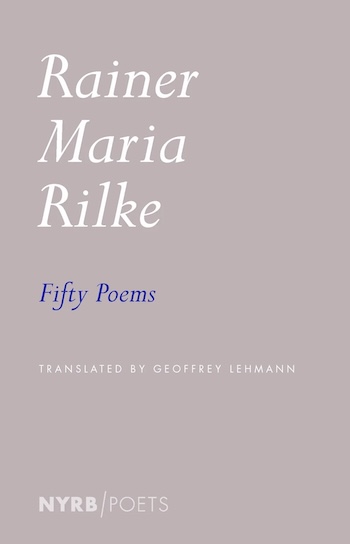 Lord: it is time — for another translation of Rainer Maria Rilke. 2025 marks the sesquicentennial of the birth of this German poet who has been Englished again and again, until we think we must have him all by now. And now that the new poet laureate Arthur Sze has placed encouraging the writing of literary translation at the heart of his national program, we can expect that a certain roster of canonical poets who have always attracted translators — Dante, Neruda, Mandelstam, and Rilke — will receive even more attention.
We can hope for new discoveries of new poets, but reinterpretations and rereadings will surely predominate. I don’t know a single reader with even a modicum of proficiency in German who hasn’t made a stab at “Herbsttag” or one of the other sonnets. Yet of course, there is always room for new readings. Under the circumstances, I am surprised that we have made it almost to the end of the year without numerous published offerings on Rilke’s altar. Certainly next year, the centennial of his death, will bring more.
Still, here is the Australian poet Geoffrey Lehmann’s modest collection of Fifty Poems.
A short and sensible afterword focuses on Lehmann’s approach to translation and his reading of Rilke. The fifty poems are chosen carefully from those Rilke wrote in formal rhyme and meter, a precision the poet departed from in 1922, most famously with his extended Duino Elegies. Lehmann resists the temptation to go over the poet’s life in detail, or his work outside the scope of his own selections. In fact, he gives a very incomplete sketch, focusing mostly on Rilke’s relationship with Rodin, leaving the reader to remember or recover from other resources the rest of the poet’s career and relationships.
“There are only a few very good translations of some of Rilke’s New Poems using rhyme and meter.” Lehmann tells us. (He does not discuss the whole minor industry of critiquing translations of Rilke, from Walter Arndt through William H. Gass.) And it is in Lehmann’s own terms that I take the work here, without engaging the subtleties of Rilke’s original German words, something the translator does for the reader with the single word Abendgrün in “The Apple Orchard.” After referring to Seamus Heaney’s translation “green in the evening sward,” Lehmann lets us into his own process:
Abendgrün [evening green] is not standard German. It may be a neologism of Rilke’s. But there is a standard German word, Abendrot . . . . It is possible therefore that Rilke’s Abendgrün refers to the green afterglow of a sunset….
and his own English goes, “watch the grass in the green afterglow.”
Lehmann does an excellent, succinct job of giving us the grounds of his rewriting. As Fifty Poems provides the original texts as well, the reader is welcome to join in.
“My aim with these rhymed translations is necessarily immodest: to impersonate Rilke in English. To do this, I have adjusted his expression and details where necessary to fit the meter, the available English rhymes and idiomatic flow of the English language.”
In these terms, “The Swan” is an unqualified success and a joy to read:
Our uncompleted lives, this struggling on,
relentless, as though our limbs have all been bound,
is like the awkward waddle of the swan.
A few poems betray a translator’s strain, as in “The Carousel”:
The lion displays his tongue and teeth that bite;
and a hot hand is clinging to his mane,
a small boy riding him who’s dressed in white
where “teeth that bite” awkwardly panders to rhyme and meter and unintentionally brings Lewis Carroll’s Jabberwock to mind, and “weiß ein Junge” becomes an equally awkward “boy . . . who’s dressed in white” for the same reason, with a deceptively misplaced adjective clause that could lead us to think it might be the lion dressed in white. There is nothing Rilkean in this, and it also misses the playful alliterations and internal rhymes of the original (“Und auf dem Löwen reitet weiß ein Junge / und hält sich mit der kleinen heißen Hand, / dieweil der Löwe Zähne zeigt und Zunge”).
But, for the most part, Fifty Poems holds up very well. And if, as a commemorative volume, it introduces readers to sample the German poet more extensively, either in the original or in the range of translations currently available, even better. And if it does tempt readers to look at other versions, or even to make their own, it will fit quite nicely with the aspirations of our new poet laureate.
J. Kates is a poet, feature journalist, and reviewer, literary translator, and the president and co-director of Zephyr Press, a nonprofit press that focuses on contemporary works in translation from Russia, Eastern Europe, and Asia. His latest book of poetry is Places of Permanent Shade (Accents Publishing) and his newest translation is Sixty Years Selected Poems: 1957-2017, the works of the Russian poet Mikhail Yeryomin.