Film Festival Reviews: New York Film Festival’s 2025 “Revivals”
By Steve Erickson
Because NYFF’s “Revivals” supplement showcases new restorations, the expectation is that these movies, including art films from around the world, will become more widely available down the road.
The New York Film Festival’s “Revivals” sidebar offers alternate pathways through film history. While some directors featured this year (Erich von Stroheim, Satyajit Ray) entered the canon decades ago, there were also opportunities to see an art film from ’60s Hong Kong or the debut of Guinea-Bissau-based director Flora Gomes. Because “Revivals” showcases new restorations, one should expect that these films will become more widely available down the road. Angel’s Egg and Robert Wilson and the Civil Wars, reviewed below, already have theatrical rereleases in the works.
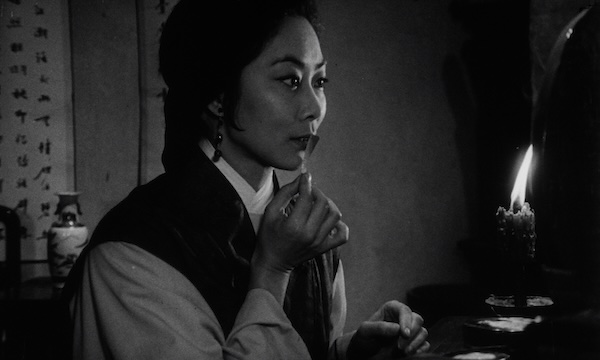
Lisa Lu in a scene from T’ang Shnushen’s The Arch. Photo: NYFF
Director T’ang Shnushen drained the potential for melodrama from her 1968 film, The Arch. An intertitle establishes the location: southwest China during the 17th century. (Interiors were shot in Hong Kong, exteriors in Taiwan.) Following the death of her husband, Madam Tung (Lisa Lu) is about to be honored with the construction of an arch celebrating her chastity and devotion to his memory. She lives in an all-woman household with her own mother and daughter. However, when she meets Captain Yang (Roy Chiao), who comes to stay with them, the two become attracted to each other.
The Arch doesn’t feel like a product of the ‘60s. Because of its reliance on music (performed on zither) and lack of dialogue, it almost comes across as a silent film. Characters speak little to each other. Captain Yang writes down his emotions after watching Madam Tung. Rather than talking, the pair pick plums together. T’ang’s direction is outstanding in its adroit use of superimposition alongside contemplative long shots. Many of the directorial choices are inspired, such as a montage of a hammer striking wood leading into a whipping. Yet, in the end, The Arch is too disconnected from its characters’ emotions to make much impact on the viewer.
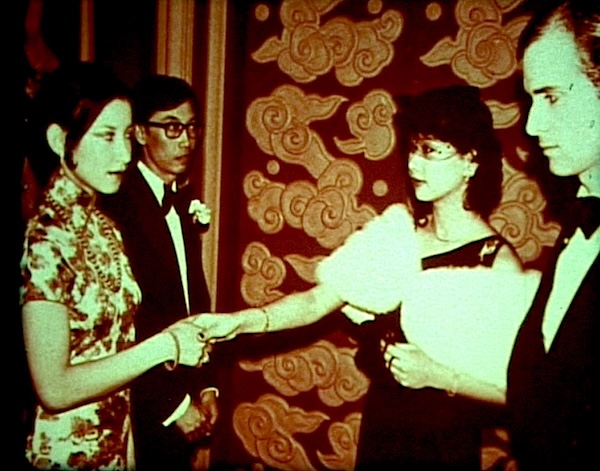
A scene from Mary Stephen’s Ombres de Soie. Photo: NYFF
Rather than tell a story, Mary Stephen’s Ombres de Soie (Shades of Silk) sets a mood and fleshes it out. The director, who was born in Hong Kong, intended to do a riff, from an Asian woman’s perspective, on Marguerite Duras’s India Song. (Duras’s script for Hiroshima, Mon Amour is quoted in an intertitle.) Her camera slowly tracks across a street covered in pink blossoms. Even more lovingly, it passes through a house, caressing photographs, sculptures, and jewelry. The dialogue is routinely severed from the onscreen action.
A love story emerges: two women, Marianne (played by the director) and Lysanne (Alexandra Brouwer), have reunited in 1935 Shanghai, meeting for the first time in eight years. Their relationship is highly homoerotic; they sleep in the same bed. While they silently embrace, their offscreen voices lead into an argument. The glamour of the heavily made-up actors, as well as the vintage costumes, firmly establishes the period setting, re-created in Paris. The pastel cinematography contributes to the vibe. Ombres de Soie is a film that asks to be swooned over. After completing the hour-long effort in 1978, Stephen would go on to edit several Eric Rohmer films. This year, she returned with the documentary Palimpsest, which dives into the origins of her Anglo surname.
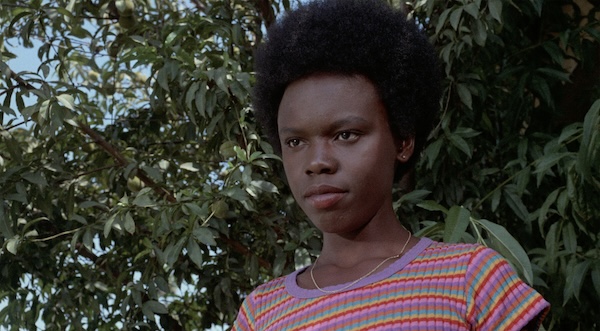
A scene from Ossie Davis’s Black Girl featuring Peggy Pettitt. Photo: NYFF
Although mostly remembered as an actor, Ossie Davis directed five films between 1970 and 1976. Given the timing, they have sometimes been lumped in with Blaxploitation, but 1972’s Black Girl is devoid of sensationalism and crime-driven narratives. Based on a play by J.E. Franklin (who adapted it into a script), the narrative sensitively dramatizes the experience of teenager Billie Jean (Peggy Pettitt). A high school dropout, she gets a job dancing in a nightclub; her aspirations to perform ballet are greeted with derision. Living in a crowded house in Los Angeles, dealing with constant pressure from her two cruel sisters, Billie Jean takes sullen refuge in her bedroom, where she listens to funk records while sitting underneath Jimi Hendrix and Diana Ross posters. Her mother works a menial job in a school.
Some imperfections show: the sprawling cast of characters demands a longer film, and its theatrical origins don’t always work to the film’s benefit. (Except for a few scenes, most of the action takes place indoors.) However, the conflict within its extended family is sketched out with great care. The pressures of poverty and racism have been internalized by its characters; Billie Jean’s mother’s estranged husband only needs to make a visit from Detroit and flash his money around to get back in her good graces. Destructive attitudes are passed around the household — Billie Jean’s half-sisters shower a relative with homophobic and transphobic innuendo because she is going to college. Billie Jean’s struggle to figure out how she can work toward a rewarding life for herself makes for extremely compelling viewing. For a film about African-American women’s experiences in the early ’70s, Black Girl has few rivals. Less attached to neorealism than the L.A. Rebellion films of the late ’70s and early ’80s, this is an example of a form of cinema about the underclass that was rarely noticed.
A nameless girl and man wander around in perpetual nightfall. She occupies herself with tasks she finds meaningful, carrying around an egg believed to contain an angel. They live in an empty, cavernous city full of calcifying animal skeletons and huge fish swimming through the air. This could be the aftermath of nuclear winter or the Old Testament’s flood.

A scene from director Mamoru Oshii’s Angel’s Egg. Photo: NYFF
Such is the setting of Mamoru Oshii’s 1985 masterpiece Angel’s Egg. It may be the closest an animated film has come to the spiritual questioning and sci-fi parables of Tarkovsky’s Stalker.
Spare and atmospheric, Angel’s Egg contains almost no dialogue. For a very long time, the girl simply walks around, filling pitchers of water to fuel her journey. Then she meets a man who wandered off a train. The two travel together, but she resists his desire to crack the egg open. Time and space remain ambiguous.
Swabbed in deep blue tones, the animation of Angel’s Egg captures the spirit of a world without light. (Yoshitaka Amano worked on the artwork.) Rather than telling us about a world in desperate need of renewal, its images show us one, a planet where narratives themselves have become futile. The recurring theme of Oshii’s work is the effects of war, yet Angel’s Egg takes place long after the battle is over (even if we see ghostly soldiers race down the street). Without conventional characters or narrative — though there are a number of references to Christian mythology — this is a movie that should be absorbed and experienced first, and then picked apart for speculative answers. Oshii himself says he doesn’t know what his film is about, but its deep longing for hope amid the catastrophe pokes through.
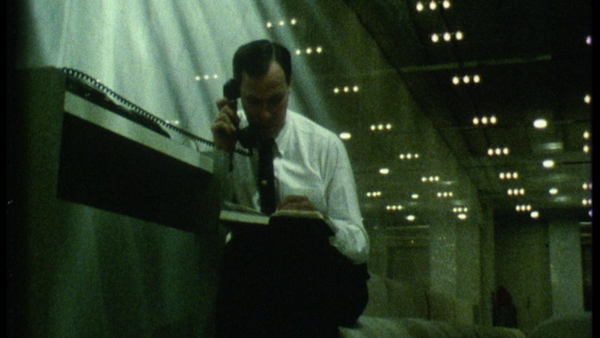
A scene featuring Robert Wilson in Howard Brookner’s documentary Robert Wilson and the Civil Wars. Photo: NYFF
Before his death in 1989, Howard Brookner completed three features. His nephew Aaron has devoted himself to restoring them. Robert Wilson and the Civil Wars profiles the late theater director (who was one of the documentary’s producers) during his struggle to get his most elaborate production off the ground. The first half of Brookner’s film offers a rather dry introduction to Wilson’s innovative theater work, introducing us to his collaborators and delving into his family history. Born in Waco, Texas, Wilson moved to New York for college, where he studied painting and worked as a drama teacher for children. His meeting with a deaf man, Raymond Andrews, influenced his elaborately staged, visually striking, at times surreal, performances, which used text as a source for repetitive ritual.
When queried about Wilson’s theater, Philip Glass (who composed his 1978 opera Einstein on the Beach for Wilson, who was a close collaborator on the work) says “they don’t mean anything, they are what they are.” The documentary’s second half takes its portrait of Wilson in a new, much more dramatic direction. An increasingly frazzled artist travels the globe simultaneously directing and fundraising for his monumental show The CIVIL WarS: A Tree Is Best Measured When It Is Cut Down. He needs to find $1.5 million to present the epic in full (six parts, 12 hours long in toto) at the Los Angeles Olympics. He failed. In the film’s final image, Wilson finally gets to sleep.
Steve Erickson writes about film and music for Gay City News, Slant Magazine, the Nashville Scene, Trouser Press, and other outlets. He also produces electronic music under the tag callinamagician. His latest album, Bells and Whistles, was released in January 2024, and is available to stream here. He presents a biweekly freeform radio show, Radio Not Radio, featuring an eclectic selection of music from around the world.
Tagged: "Angel's Egg", "Black Girl", "Ombres se Soie", "Robert Wilson and the Civil Wars", "The Arch", Howard Brookner, Mamoru Oshii, Mary Stephen, Ozzie Davis