
Film Review: Benny Safdie’s “The Smashing Machine” Grapples with Pain, Power, and Self-Worth
By Tim Jackson
This is far from a conventional sports drama: it is a study of a man’s struggle to find a sense of personal worth and relevance.
The Smashing Machine, directed by Benny Safdie. Screening at Coolidge Corner Theatre, Somerville Theatre, and AMC Boston Common 19, as well as other New England cinemas.
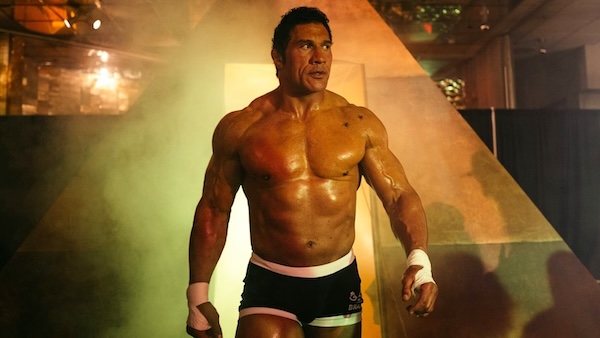
Dwayne Johnson in The Smashing Machine.
This season, the Safdie Brothers are taking a new approach. Each is directing his own film independently. Josh Safdie’s film, Marty Supreme, is set for a Christmas release: it is about professional ping pong players and stars Timothée Chalamet and Gwyneth Paltrow. Benny Safdie’s film, currently in theaters, is far from a holiday romp. The Smashing Machine follows the struggles of Ultimate Fighting Champion Mark Kerr. Dwayne Johnson (The Rock) plays the title role and Emily Blunt plays his girlfriend, Dawn Staples. The film draws on the handheld aesthetic of the Safdie Brothers’ early work, privileging psychology over plot. This is far from a conventional sports drama: it is a study of a man’s struggle to find personal worth and relevance. Beset by his personal demons, Kerr fights to hold on to his reputation, as the “Smashing Machine,” in a severely male-dominated culture.
Benny Safdie’s solo outing adheres to the style of earlier films by the Safdie brothers, which featured flawed outsider characters. Their most successful film, 2019’s Uncut Gems (Arts Fuse review), starred Adam Sandler as a luckless gambler and jewel salesman. He was in a cast largely made up of nonprofessional actors. In 2014’s For Heaven Knows What (Arts Fuse review), the filmmakers discovered and cultivated Arielle Holmes, casting her at the center of a raw, unflinching drama that was drawn from her own memoir. The narrative chronicles the life of a person struggling with a heroin addiction on the streets of New York City. Holmes knew the territory. Another actor from that film, Buddy Duress, starred in Good Time (2017), which also featured Robert Pattinson. Duress had been jailed many times on Rikers Island and was arrested shortly after the film’s shooting ended. His presence infused both movies with an unsettling edginess. Utilizing a handheld documentary approach, and shot by Uncut Gems cameraman Maceo Bishop, The Smashing Machine is another impressive application of the Safdie brothers’ signature style.
The Rock brings his reputation in heavyweight wrestling to the role. In addition to an excellent wig to alter his appearance, Johnson has more than enough bulk, athleticism, and understanding of this battering sport to make for a convincing athlete. Praise should also go to the performance of novice actor Ryan Bader as Kerr’s patient and understanding trainer. In the plot, Kerr ultimately faces off against the trainer. Bader, an actual Ultimate Fighter Champion, applies the same authenticity to his role that The Rock does to his own. Less satisfying is Emily Blunt as Dawn, Kerr’s longtime girlfriend. She is a fine actress, but Blunt is not given a lot to work with here. She is too innately classy to play a working-class woman plagued by desperate emotional needs. Still, Blunt does well in her quarrels with Kerr, which read like exaggerated echoes of everyday disputes, comic in their familiarity as well as painful in their intensity: “You’re spending too much time at work” or “What about my needs?”
The film opens in 1999 with The Rock addressing the camera, explaining how Kerr is driven by a pure animal instinct that “totally takes over.” “It’s almost magical,” he says, a “high like no other.” As Kerr, The Rock speaks in a gentle, matter-of-fact way, particularly when the character is discussing his determination to win: “Am I gonna hurt you first?” or “Would you stick a finger in his wound to spread it? Of course you would. Winning matters.”
The specific details of fighting, the techniques used, are kept hazy. It comes down to whoever can pummel his opponent into submission. Extreme Fighting and cage matches are combat sports pared down to their primal essentials. The Japanese Mixed Martial Arts competition in the film is called the Pride Fighting Championships, and it is a mammoth arena spectacle. Kerr enters the pageant undefeated — his reputation is at stake. When a Japanese interviewer asks what he would do if he loses, Kerr is at a complete loss for words, unable to even articulate defeat.
Wisely, Safdie takes care to develop the ironic resonances between Kerr’s gentle side and his Herculean hulk. We get an early look at that strategy when, after a fierce match, we see Kerr sitting outside the doctor’s office — he is battered and awaiting stitches. He quietly turns to an elderly woman in the waiting room and, like a child, greets her with a simple: “Hi.” They get to talking. Kerr explains what he does for a living. “That’s the bloody thing they’re trying to ban,” the woman responds.
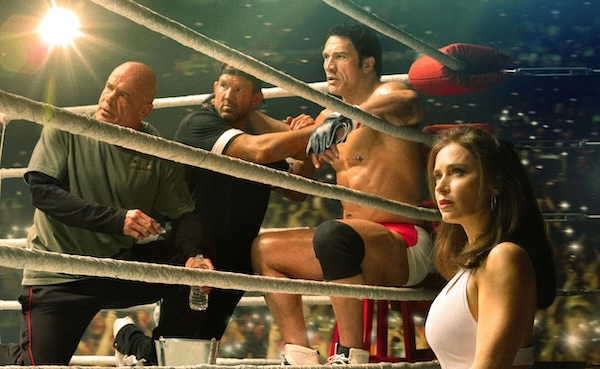
Dwayne Johnson and Emily Blunt in The Smashing Machine.
Later on a plane trip to Japan, apparently flying economy class, Kerr asks a man a few seats over to raise the blinds on the window. “I’d like to see the sunset,” the fighter explains with a calm smile. Later, negotiating terms for a match in Japan, Kerr doesn’t throw his weight around. He remains withdrawn and reasonable, even when faced with organizers who speak little English. These small moments build empathy for the character. As an actor, The Rock demonstrates a surprising talent for projecting Kerr’s interior life, a skill rarely required in the action roles he is most often associated with.
Extreme Fighting calls for an ability to endure bodily abuse, to maintain a relentless workout schedule, and to keep to a meticulous diet. Control is essential. In Kerr’s view, “if we don’t get control of our emotions, we’ll surely get slapped around by them in the bigger picture.” That kind of discipline demands a focus on accomplishing the task at hand, which is to win. “They see it in my eyes” he explains.
Yet there are things Kerr can’t control. One is pain, but there are opioids for that, along with their inevitable risks. A normal relationship is another. Driven by physical and mental stress — compounded by drugs — tempers flare and arguments spiral out of control. Petty complaints foreshadow more heated disputes to come. When Dawn carefully prepares Kerr’s morning protein drink, he gently but firmly, with barely hidden tension, asserts, “I told you I use skim milk, not whole milk.” Dawn is devoted to Kerr, but her well-intentioned actions are often misguided and distracting. “I think I miss taking care of him,” she says at one point. Kerr tries at every turn to be even-tempered, but after a volatile spat — he breaks a door in half with one punch — he turns to her, nearly in tears, and begs her to “Treat me like a man.”
Despite its interest in Kerr’s psyche, The Smashing Machine, to a large extent, favors style over substance. The contrast between intimate domestic strife and battles featuring gleaming, muscular bodies wrangling in front of arena audiences is well-suited to the Safdie verité style. The narrative formula is true to the arc of a sports film — it culminates with a final face-off. But that melodramatic finale is beside the point. What really keeps us engaged are Kerr’s battles with pain, addiction, and self-worth, along with the director’s forgiving humanism.
Tim Jackson was an assistant professor of Digital Film and Video for 20 years. His music career in Boston began in the 1970s and includes some 20 groups, recordings, national and international tours, and contributions to film soundtracks. He studied theater and English as an undergraduate, and has also worked helter-skelter as an actor and member of SAG and AFTRA since the 1980s. He has directed three feature documentaries: Chaos and Order: Making American Theater about the American Repertory Theater; Radical Jesters, which profiles the practices of 11 interventionist artists and agit-prop performance groups; When Things Go Wrong: The Robin Lane Story. And two short films: Joan Walsh Anglund: Life in Story and Poem and The American Gurner. He is a member of the Boston Society of Film Critics. You can read more of his work on his blog.