
Film Festival Review: Dispatch From the New York Film Festival, 2025
By Erica Abeel
It’s hard to imagine that Hollywood suits would get behind a movie focused on a corrupt political regime, even one that’s now history.
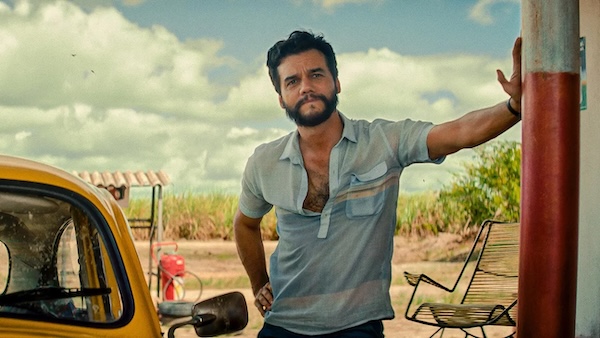
Wagner Moura in The Secret Agent. Photo: courtesy of Neon
The New York Film Festival kicks off the city’s cultural calendar with a blast of creative energy. Running from September 26 to October 13 (and presented by Film at Lincoln Center), this 63rd edition is nothing if not eclectic. Early in the press screenings I saw three films united only by images on a screen yet worlds apart in their esthetic and spirit. The Secret Agent by Brazilian filmmaker Kleber Mendonça Filho is a stirring political drama, set in 1970s Recife, that inflects historical realism with the surreal and absurd. Miroirs No. 3 from German auteur Christian Petzold is a haunting quasi-fairy tale that explores a troubled young woman’s encounter with a traumatized family. Peter Hujar’s Day by Ira Sachs is a yawn-mongering yak-athon that squanders the talents of Ben Whishaw and Rebecca Hall while never letting on what it’s meant to be.
Among the fest’s “bigger” films, The Secret Agent arrives here decked with awards from Cannes (Best Director for Mendonca Filho; Best Actor for star Wagner Moura of Narcos fame; the FIPRESCI PRIZE for Best Film). It was picked up by hot distributor Neon, known for such provocations as Oscar-winner Parasite. Amid the raucous revelry of Carnival week, a widower named Marcelo (Moura) arrives in 1977 Recife, Brazil. In an opening scene that telegraphs a major theme, Marcelo pulls up at a gas station in his little yellow Volkswagen and notices a corpse sprawled close by, barely covered by a flap of cardboard. The range of reactions his face subtly conveys could be a master class in acting.
Marcelo is a technology researcher, we learn, who’s fallen afoul of the reigning military dictatorship and is ducking a pair of hired assassins. When pin-holed by a pair of cops (who ignore the dead body) at the gas station, he fears he’s landed on the regime’s radar. Marcelo shelters in his hometown community of fellow political dissidents presided over by a 77-year-old dynamo of a woman (the delightful Tania Maria). With the help of an underground organizer (perhaps the “secret agent” of the title; it’s never clear), he hopes to acquire a fake ID and get the hell out of Brazil with his young son, who’s being cared for by his father-in-law. Even the safe communal spaces are edged with impending danger. In the film’s third act it becomes a high-stakes thriller when the bad guys close in on Marcelo amidst the chaos of Carnival.
In his past films, Filho has foregrounded socio/political issues plaguing Brazil. So it’s no big surprise that Marcelo earned a death threat because of a past run-in with the corrupt official Ghirotti, who re-routed the funding for Marcelo’s research team at the university to benefit himself and other corporate interests. In an explosive flashback, Ghirotti gets drunk over dinner and drops slimy remarks about Marcelo’s wife Fatima (Alice Carvalho). The evening spirals into physical violence, partly fueled by Marcelo’s macho sense of outrage. He’s told his son that his mother died of pneumonia, but it’s suggested that Ghirotti had her disappeared, like so many others during this period. I’m not a violent man, Marcelo tells the Resistance organizer, but I’d kill Ghirotti with a hammer. In a cringingly funny scene with the hit men, the official dickers at length over the price to ice Marcelo. This is where Filho excels, working the fine edge between humor and horror.
He also contrives a shapely denouement by jumping to the present where two young researchers — who have periodically appeared in flash-forwards—sort through audio of bugged conversations and newspapers of the time to discover what became of Marcelo. Much of that sense of period was achieved through the use of anamorphic Panavision lenses that Filho favors. “It probably has to do with the fact that so many films that made me want to make movies have that certain look … The lenses are not super sharp or modern, but that’s actually something that I really like.”
Despite the panache of distributor Neon, it’s not at all clear to me that American viewers will go for this film and its bold maximalism. At two hours and forty minutes, it’s a long sit, especially because it refuses to kill its darlings (as we say of fiction). Consider a scene in which a wealthy woman guilty of criminal negligence is coddled by the normally brutal local police – one of several tangents that fail to advance the plot. There’s also the ick factor: Filho regales the viewer with a mutilated human leg hauled from the rotting carcass of a giant shark; and then – call it assaultive surrealism — follows the leg as it goes on a rampage, kicking gay lovers having at it in a darkened park. Add to this that Filho may have never met a grotesque face out of Hogarth he didn’t want to shoot in close-up.
In his award-winning turn, Wagner Moura is, of course, the exception; his charismatic melancholy, decency, and lanky physical grace carry the film. Still, it’s hard to imagine that Hollywood suits would get behind a movie focused on a corrupt political regime, even one that’s now history. Especially a film like The Secret Agent because here’s the thing: the paranoia, injustice, and fear play as contemporary. Cannes has always been a political as well as a cinematic event; the indictment of a brutal military dictatorship may partly explain the accolades this film earned on the Croisette. From where we sit, we can only marvel that such a film got made at all. Here the days of Norma Rae and All the President’s Men are likely over – let’s hope not for good.
Erica Abeel is a novelist, critic, and former professor at CUNY. Among her novels are Wild Girls, named a Notable Book by Oprah Magazine and now available on Audible; and The Commune, a comic satire on the launch of Second Wave Feminism that Kirkus called “a joyous literary romp with hidden depth.” Her forthcoming novel reimagines characters from Ingmar Bergman’s Smiles of a Summer Night.
Tagged: "Day by Ira Sachs", "Miroirs No. 3", "The Secret Agent", Ben Whishaw, Christian Petzold, Kleber Mendonça Filho, New York Film Festival 2025, Peter Hujar, Rebecca Hall
1 Comment
Leave a Comment

Nice review but do we care about what “Hollywood suits” will think about the movie?