Concert Review: Horizon Ensemble Polishes a Neglected Gem by French Composer Germaine Tailleferre
By Aaron Keebaugh
Happily, the admirable Horizon Ensemble is championing Germaine Tailleferre’s mesmerizing piano concerto.
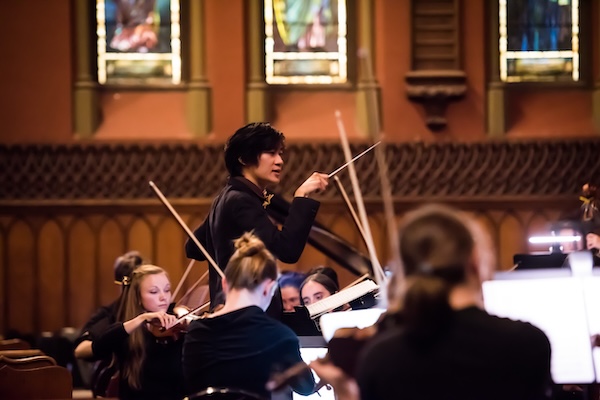
Julian Gau conducting Horizon Ensemble at Boston’s The Church of the Covenant. Photo: Joseph Lee
French composer Germaine Taillefarre was no stranger to hardship. But rather than give into it, she persevered.
Her struggles began when her father refused to support her interest in music. She pursued studies at the Paris Conservatoire nevertheless and later supported herself by teaching and performing, often living from paycheck to paycheck. Two marriages that ended in divorce stymied her career for a time. But, when she returned to composition, she did so with an unrelenting vigor that comes across in many of her compositions. The result was that she was so prolific scholars are still grappling to understand the full breadth of her catalogue.
Tailleferre’s efforts won her the admiration and support of Les Six, a group of French composers who, under the self-appointed leadership of Jean Cocteau, eschewed what they saw as the melodrama of Wagner and the harmonic effluvium of Debussy. They favored a more simpler and direct musical language. “We need music of the earth,” Cocteau wrote in the pamphlet The Cock and the Harlequin. “I want someone to make me music that I can live in like a house.”
But, at least in Tailleferre’s case, concentrating so intently on the present may have ensured historical oblivion. She is only remembered for a few chamber pieces. Yet a dive into her larger works reveals expert craftsmanship, as attuned to past glories as to contemporary tensions. For example, her Piano Concerto No. 1 was popular following its 1924 premiere precisely because of how the piece fused Bachian elegance with modern, ear-stinging dissonance and effervescent textures. Unfortunately, it has since been neglected. As far as I am aware, there is only a single recording, available below
Happily, the admirable Horizon Ensemble is championing Tailleferre’s mesmerizing concerto. Saturday afternoon at the Church of the Covenant, pianist Yuseok Seol, conductor Julian Gau, and the orchestra revealed that this composer’s music can sparkle anew in the right hands. (Note: The live-streamed performance will be made available on YouTube at a later date.)
The musicians are given plenty to work with, despite the concerto’s brief, fifteen-minute span. Here the pianist is less a hero struggling against the larger forces than a fellow member of the group. Tailleferre crafted a musical canvas that behaves (sonically) like a cubist painting. Musical shapes — played out between strings, winds, and soloist — mingle on a single dimension. This is music of compromise and cooperation rather than heated division.
Saturday’s performance revealed the music’s nuanced interludes of brightness and cheer. Pianist Seol worked marvels with the rippling arpeggios and dense harmonic clusters. His tone was pearly and deep, his technique crystalline, even when Gau pushed the tempo to a whip-crack pace. In all the right moments, Seol’s phrases lifted easily above the contrapuntal blur.
Colors also abounded. The off-kilter rhythms of the finale framed Seol’s peals of harmony, an effect that recalled the gamelan references of Francis Poulenc’s Concerto for Two Pianos. But the heart of this reading was to be found n the Adagio. There, Seol unfolded his lines with hymnic reverence. Gau was a sensitive partner, drawing an accompaniment that channeled both the comedic and emotionally tender elements in the piece.
The rest of the concert’s first half only deepened those accomplishments.
Tomer Rozen’s Comedy harkened back to classicism in all its elegance and high-minded humor. A Boston-based composer, Rozen frames Ivesian hilarity with nimble dances that could fit just as easily in a piece by Pergolesi. But the music’s graceful flourishes eventually shatter into titters, grunts, and guffaws — only to lilt once again as if nothing had changed. Gau highlighted the amusing whimsy by tearing through the myriad fugues, marches, and dances.
Similarly, Joseph Bologne’s overture to The Anonymous Lover sparkled like distant starlight. The composer also listed the piece as his Symphony No. 2. And, despite its eleven-minute length, the piece packs a mighty punch.
Gau, acting as harpsichordist and conductor, teased out an infectious vitality, even if the orchestral playing was not wholly polished. Still, the players gradually hit their stride. Crescendos, full and in ideal balance, spiced up the overarching melodies with furious panache.
The second half was dedicated to Camille Saint-Saëns’s Symphony No. 3. Nicknamed the “Organ Symphony,” this score from 1886 is among the most popular in a long line of late-nineteenth-century French symphonies. Saint-Saëns’s canvas, dedicated to a cyclic treatment of themes, owes as much to Liszt and Wagner as to timeless notions of form and balance.
Gau led with a careful eye for detail that never sacrificed momentum. He carefully shaped every subtle gesture in the opening movement. Crescendos rose and faded smoothly. Quotations of the “Dies irae” resounded with the right amount of mystery.
That said, it wasn’t a perfect reading. Spotty attacks and frayed ensemble textures threatened to interrupt the flow early on. To be fair, the chugging string figures in the Allegro moderato are nearly impossible to line up with the accompanying winds. But Gau and the musicians achieved a stronger unified blend as the movement progressed.
Gau pushed the tempo in the Scherzo, encouraging the dense textures to lift. The Trio made for an aptly delicate contrast.
The Church of the Covenant’s grand organ, played by Yangfan Xu, generated solemnity in the Adagio and punched out bold assurance in the finale. The orchestra’s verve and grandiosity made a reassuring point: when played with gusto, even the most familiar works can still yield rich discoveries.
Aaron Keebaugh has been a classical music critic in Boston since 2012. His work has been featured in the Musical Times, Corymbus, Boston Classical Review, Early Music America, and BBC Radio 3. A musicologist, he teaches at North Shore Community College in both Danvers and Lynn.
Tagged: Germaine Taillefarre, Horizon Ensemble, Julian Gau, Les Si, Yangfan Xu