
Film Review: “Tura!” – V is for Varla
By Ed Symkus
A new documentary bares (almost) all about stripper-actress Tura Satana.
Tura! is written and directed by Cody Jarrett. It’s available on VOD (Apple TV+, Amazon Prime Video, Fandango at Home) beginning September 26.
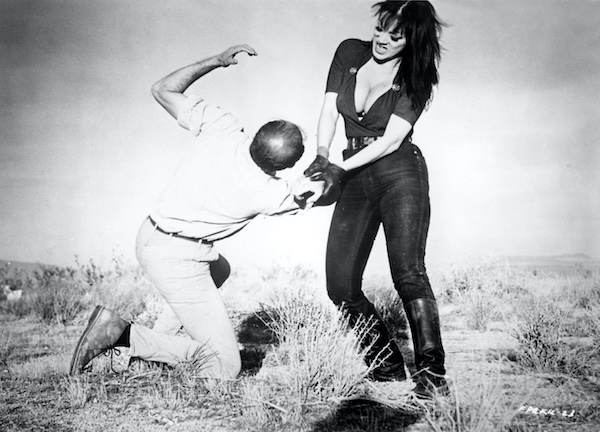
A scene featuring Tura Satana (in black, as Varla) from Faster Pussycat, Kill Kill!
It’s fitting that the documentary Tura! has an exclamation point in the title. The film its subject, Tura Satana, is best known for, in which she plays Varla, a buxom, tough-as-nails, black leather-clad, go-go-dancing, race car-driving, money-loving, knife-wielding, man-hating, psychotic lesbian, in Faster, Pussycat! Kill! Kill! And that has three exclamation points in the title!
It could also be argued that Satana’s life (1938-2011) was filled with metaphorical exclamation points. She was an extremely successful exotic dancer, went through two failed marriages, had two (out-of-wedlock) daughters, and maintained a rotation of high-profile flings – if she kept a diary, there would be juicy mentions of, among others, Rod Taylor, Forrest Tucker, David Janssen, and a singer from Tupelo who went by the name of Elvis.
Aside from her leading role in Faster, Pussycat! – the notorious 1965 Russ Meyer film – she scored small parts on TV shows (The Man from U.N.C.L.E., Burke’s Law) and in films (Irma la Douce, Our Man Flint, The Astro-Zombies).
While she never enjoyed a prolific acting career, her exotic facial features – her mother was white, her father was Japanese – along with her staggering physique, and her unique skills as a stripper (one of her tricks involved specialized tassel twirling), gained her pop icon status.
The film gets around to all of that, but it begins with the relaying of a horrific incident that set her on a course of determination and retribution from which she never strayed … until justice was served.
In Chicago, when she was 9, just a couple of years after the end of WWII, those Asian features making her a target in the minds of some Americans, she was abducted, beaten, raped, and left for dead by five white men. Details of the event are narrated, as if being recalled by her, but via the voice of actress-comic Margaret Cho, who executive produced the film.
It’s about an hour later, after a multitude of stories about Satana’s life and career, that the results of her festering need for vengeance are revealed. Yet, as another section of narration suggests, those men “created Varla.”
It’s often been said, by friends and family and co-workers, that although Satana was playing a part in Faster, Pussycat!, she did it in such a convincing, passionate manner, that she really was Varla.
Director Cody Jarrett has populated his film with some of those people, all of whom are in awe of Satana.
Exploitation director John Waters says, “I think women like her, and men are scared of her, but they think she’s hot.”
Ted Mikels, who directed her in The Astro-Zombies (and two of its three sequels), says, “She had a personality that was overpowering to a lot of people.”
Author and musician Pamela Des Barres (former member of the “groupie” group the GTOs) calls her a “fantastic feminist role model.
Burlesque performer Angel Walker is a tad more blunt, explaining, in a direct reference to Faster, Pussycat!, “In our day, men beat the fuck out of women. No women beat the fuck out of men. She did!”
Jarrett has structured the film in a mostly chronological approach, with Cho’s narration – and on a few occasions the actual voice of Satana – talking about her getting a job as a dice girl at a club in the Chicago suburb of Calumet City, filling in for a dancer one night, then turning that event into a livelihood.
There’s a casual mention that “I dated various guys, and a few girls,” a nightclub poster describing her as “the most gorgeous Oriental in the world,” a wonderful story about her relationship with Presley, a matter-of-fact statement that “she taught him everything about pleasing a woman,” and some happy memories from Dennis Busch, who gave a memorable performance as The Vegetable in Faster, Pussycat!
While the film omits the details of her two marriages, and glosses over most of her other acting roles, there are plentiful photos and clips to keep things interesting. And a brief “making of” segment about Faster, Pussycat! provides some good laughs.
Of course, it was that film that made her name, even though, upon release, it was a box office flop. It lived in obscurity until a couple of decades later, when home video took hold and it became a best seller as a videocassette, a big draw at midnight screenings, and helped make Satana a late-in-her-career star and, surprisingly, a symbol of female empowerment and an icon within the LGBT community.
The film winds down rather quickly, and doesn’t get into many specifics about her final days, beyond the facts that “her illness came on fast,” and that she wasn’t one to pay much attention to her doctors. But Jarrett saves some surprises for the last few minutes, with stories told by Satana’s daughters Lani and Jade, involving Tony Bennett and comedian Marty Allen.
Ed Symkus is a Boston native and Emerson College graduate. He went to Woodstock, has interviewed Russ Meyer, Eva Green, and Julie Andrews, and had a nice chat with Roger Ebert, and has visited the Outer Hebrides, the Lofoten Islands, Anglesey, Mykonos, Nantucket, the Azores, Catalina, Kangaroo Island, Capri, and the Isle of Wight with his wife Lisa.
Tagged: "Faster Pussycat! Kill! Kill!", Cody Jarrett, Dita Von Teese, John Waters, Russ Meyers, documentary, “Tura!”