Film Review: “Plainclothes” and the Surveillance of Desire
By Steve Erickson
Despite its abrasive style, Plainclothes leaves no doubt about what is going to happen or what is meant to be its takeaway message.
Plainclothes, directed by Carmen Emmi. Available on VOD starting on November 4.
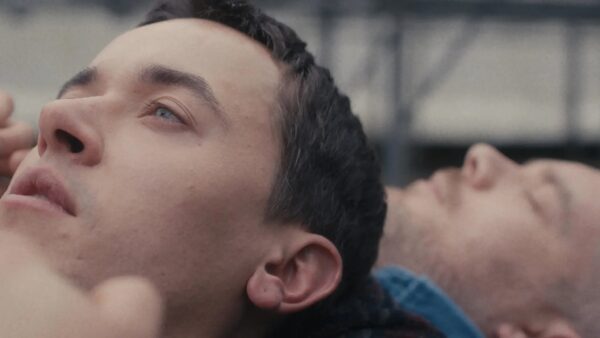
Tom Blyth, left, and Russell Tovey in Plainclothes. Photo: Magnolia Pictures
Plainclothes journeys inside its protagonist Lucas’ (Tom Blyth) mind with the help of glaring lights, screeching noise, and jump cuts. À la Darren Aronofsky and early ‘90s Oliver Stone, director Carmen Emmi infuses his characters’ torment into every facet of the film’s style. He also switches between several kinds of video formats. While this serves the plot, it also establishes Lucas’ internal instability. His mind races even while he’s dining with his family or having sex. He struggles to keep his life compartmentalized, but the cracks are widening.
Plainclothes isn’t the first film by a queer director to appropriate the premise of William Friedkin’s Cruising, which was so controversial in 1979 that gay activists disrupted its filming and ruined live sound recording for many of its scenes. Cruising has since been reclaimed by younger gay men, partially because it’s so disturbing and ambiguous. In contrast, despite its abrasive style, Plainclothes leaves no doubt about what is going to happen or what is meant to be its takeaway message.
As Lucas arrives at his mother’s house for a New Year’s Eve dinner, he looks back on a recent, disturbing experience. An undercover cop, he spends his days watching over the local mall’s food court, trying to catch the eye of gay men there. He baits those who are willing in the bathroom. They are then arrested: Lucas is told that no one has ever hired a lawyer and contested the police department’s charges. Until he meets Andrew (Russell Tovey), Lucas can put up with his life of betraying men who share his sexuality, though he has his regrets. But something clicks between him and Andrew. They meet in a movie theater and then have sex in a greenhouse. Andrew swears he never wants to see his tricks more than once, but Lucas wants something beyond a quickie. Lucas relives these experiences during dinner, while he also searches for a letter Andrew left behind — one that could expose him.
The performances of Blyth and Tovey breathe life into Plainclothes‘ pat situations and dialogue. There’s tremendous chemistry between the two actors: their desire for each other’s bodies and mutual affection is utterly believable. A tremendous charge is conveyed simply when they touch each other’s hands. Both performers are particularly good at expressing the psychological weight of living under repression. During one memorable scene, Emmi’s direction quiets down when they meet in the basement of a movie theater, intending to have sex. Asimple two-shot of the men, in profile with light gleaming off Andrew’s glasses, speaks more eloquently than the film’s restless editing elsewhere.
Unfortunately, Emmi overreaches too often when dramatizing his characters’ misery. It’s not enough for Emily Wells’ score to vibrate with tension; the sound design must also crackle with static and feedback, as though Lucas had tinnitus. Cutting so quickly between close-ups of men’s faces establishes a nightmarish ambience. The spectator never gets a bead on them. (On the big screen, this quicksilver see-sawing might make some people feel seasick.) The varying qualities of video footage contribute to the film’s mood of wound-up controlled terror. Yet, within the first 15 minutes, the visuals make the point. We get it – Lucas is incredibly anxious and unhappy! Whipping back and forth between sex, a family dinner, and Lucas sweating while staring into a bare lightbulb is overkill.
Ironically, Plainclothes‘ most intriguing dimension is under-explored. Emmi, who grew up in Syracuse, sees a lot of himself in Lucas. In a statement in the movie’s press kit, the director writes: “{In 2016} my brother was becoming a police officer, and I was just beginning to live openly as a gay man. I was shocked to learn about a 2014 sting operation in which undercover officers lured and arrested men in a Long Beach park bathroom for indecent exposure. The idea that sting operations such as this still existed haunted me, forcing me to confront the reasons I had closeted myself for so long.” Before coming out, Emmi had started working in the film industry as an editor. Plainclothes views the technology of the camera as a tool for homophobia, and sees voyeurism and surveillance everywhere. In that sense, the film feels as much about the present as it does about the ’90s.
Well-intentioned to the point of becoming preachy (particularly in its finale), Plainclothes is suffused with dread. The ending promises a new beginning, the dream of an American society that has become less homophobic, a country where gays don’t have to move to the West Coast to be openly gay. (San Francisco is spoken about as if it were a magical utopia, not an actual city.) Apart from its hyperkinetic style, Plainclothes is much like any other coming-out narrative. At the end, one wonders what will become of Lucas and Andrew in the years to come, when the closet might not be the defining fact of their lives. This is a film that should have begun at the point after it ends.
Steve Erickson writes about film and music for Gay City News, Slant Magazine, the Nashville Scene, Trouser Press, and other outlets. He also produces electronic music under the tag callinamagician. His latest album, Bells and Whistles, was released in January 2024, and is available to stream here. He presents a biweekly freeform radio show, Radio Not Radio, featuring an eclectic selection of music from around the world.