
Visual Arts Review: Exotic Blooms and Curious Creatures — Rachel Ruysch at the MFA
By Amy Golahny
This exhibition takes viewers around the world through the specimens brought to Amsterdam by Dutch explorers. It invites close looking, and the museum has prepared a scavenger hunt handout with select bugs and flowers to seek out.
Rachel Ruysch: Artist, Naturalist, and Pioneer, at the Museum of Fine Arts, Boston, through December 7. Curated by Anna Knaap, Rose-Marie and Eijk van Otterloo Curator of Paintings, Art of Europe, with guidance from Charles Davis, Professor of Organismic and Evolutionary Biology at Harvard University.
Lizards and tulips and bugs, oh my!
Rachel Ruysch (1664–1750) is now the subject of her first solo exhibition, organized by the Museum of Fine Arts, Boston, the Alte Pinakothek, Munich, and the Toledo Museum of Art. Best known among specialists for her precise and evocative arrangements of flowers, insects, and fruit, Ruysch remains unfamiliar to most audiences, despite her paintings featuring prominently in all major discussions of Dutch still life. The accompanying catalogue, Rachel Ruysch: Nature into Art, edited with text by Robert Schindler, Bernd Ebert, Anna C. Knaap, et al., presents her life and art in depth, examining topics such as her extensive botanical and zoological knowledge, as well as the roles of women as patrons and artists. The volume further explores how Ruysch was at the heart of a scientific and horticultural network as the Dutch actively studied flora and fauna from every region their ships could reach.
Highly successful and renowned in her lifetime, Ruysch served Johann Wilhelm II, Elector Palatine in Düsseldorf, as court painter from 1708 to 1716. She was required to supply him with one painting each year, but was permitted to reside at home in Amsterdam. European aristocrats of her era, and museums today, eagerly collected her work.
In some early paintings, Ruysch experimented with applying actual moss and butterfly wings to her canvases. However, this attempt to heighten realism proved neither effective nor technically durable. Far more effective was her deft brushwork, which conveys the luminous surfaces of grapes, the diaphanous wings of dragonflies, and dew glistening on rose petals
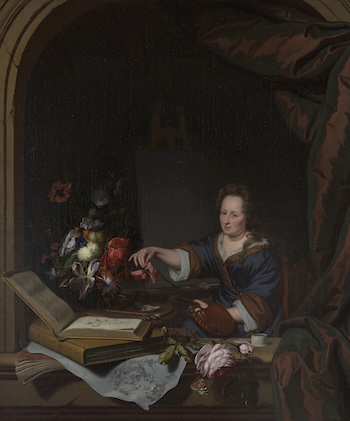
Rachel Ruysch and Michiel van Musscher, “Rachel Ruysch,” 1692. Oil on canvas. Photo: courtesy of the Museum of Fine Arts, Boston
Ruysch’s family was distinguished. Her father, Frederick, was an anatomist and professor of botany at the Amsterdam Hortus Botanicus. Her mother, Maria Post, had architects and artists in her family. His books, scientific instruments, preserved anatomical dissections, and dead insects and amphibians filled his Amsterdam house. Rachel and probably also her sister Anna were trained in still life, a genre suitable for women, by Amsterdam painter Willem van Aelst. Upon marriage, Anna ceased painting, but her early works are skillful and accomplished. Rachel married the portrait painter Jurriaen Pool, and bore ten children, of whom six lived to adulthood. After they won a huge sum in a 1723 lottery, she painted less only for only a short while, and generally turned to smaller works. In 1692, she was portrayed by the established painter Michiel van Musscher at her easel. She added to the image the flower bouquet on the table and the large rose on the ledge. A butterfly perched on a rose suggests the craft involved in creating such an artificial display of blooms that were generally painted not just from flowers, but also from drawings made after the real specimens.
Her paintings fall into four basic categories: the forest floor, elaborate flowers in a vase, casual and simpler loose flowers, and fruit still lifes. Many contain exotic imports and native species in the same painting. Working from drawings, Ruysch was not limited by the seasons; she combined fruits and flowers that ripened and bloomed at different times.
The forest floor pieces and fruit still lifes involve plants, fruit, insects, and reptiles in a naturalistic setting, on a flat area—the ground or a stone slab. They feature heaps of fruit and small creatures. Bunches of grapes lie next to melons, pomegranates, peaches, nectarines, and corn. Beetles, lizards, and butterflies crawl and fly around them. Ruysch does not portray a benign world. One lizard catches a fly, another eats an egg from a nest, and another pursues a butterfly. A grasshopper crawls out of husks of corn, and a bee hovers over the next meal. One painting includes the Suriname toad, whose means of reproduction involve the male attaching the fertilized eggs on the female’s back, where they would hatch. Such exotic imports from the western and eastern hemispheres fascinated elite connoisseurs of art and nature.
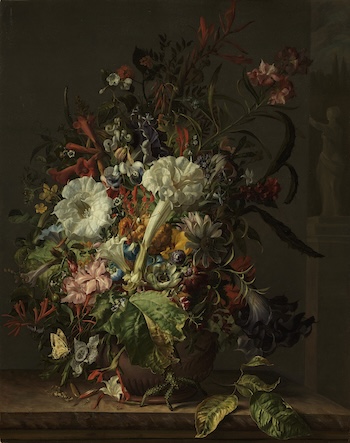
Rachel Ruysch, “Still Life of Exotic Flowers on a Marble Ledge,” about 1735. Oil on canvas. Photo: courtesy Museum of Fine Arts, Boston
The flower pieces involve elaborate staging of an abundance of blooms with a vase and ledge. Ruysch created dramatic patterns of color, shape, and line from blooms that twist and fall in all directions. There is nothing tame here, as petals flop and bend, flowers close and open, and blossoms are seen upright, sideways, and upside-down. A pineapple or eggplant may be set amidst the blooms, the edible and ornamental intermingled. Our supermarkets may offer us such fruits and vegetables as these year-round, but in that period melons, squashes, eggplants, corn, and bananas were newly imported and prized in the Netherlands.
Competition was friendly and fierce among horticulturists in Amsterdam to cultivate the pineapple, native to Brazil, Suriname, and the Caribbean. Agnes Block, a wealthy patron of several women artists who documented the results of her garden, is credited in 1687 with the first successfully grown pineapple in a specially built hothouse. But she was soon followed by a few avid gardeners; among these was Pieter de la Court, who proudly cultivated hundreds of pineapples on his country estates.
One grand painting of a bouquet is diagrammed to show the 21 locations of the origins of its plants, from Australia to North America. These include the passion flower from Brazil, the carrion flower from Southern Africa, the Persian lilac from Australia, the Creeping Cactus from Mexico, the Ceylon swamp lily from India, and the musk mallow from Indonesia. At the center are two white Devil’s Trumpet (Datura metel) flowers from Central America, known in the Netherlands from the 16th century through the journeys of Spanish explorers, but the flowers are given prominence by Ruysch in a number of her paintings.
There are smaller paintings of nosegays, with bunches of blooms lying loosely on a ledge. These were painted during Ruysch’s early and later years. Starting in the 1740s, she preferred to work on a smaller scale, when a lighter palette was the fashion. Less complicated, these pictures are more decorative and less agitated than her earlier bouquets.
Ruysch combined flowers and forest floors in her largest canvas, made in 1714 for Johann Wilhelm, who hung it in his bedchamber. Grapes, melons, peaches, plums, pomegranates, and corn are heaped on the ground in front of a low stone wall. A basket of flowers rests on the wall, its blooms spilling out profusely. A young bird stares out from the nest, a striped iguana chases a butterfly, and snails and dragonflies lurk among the bounty.
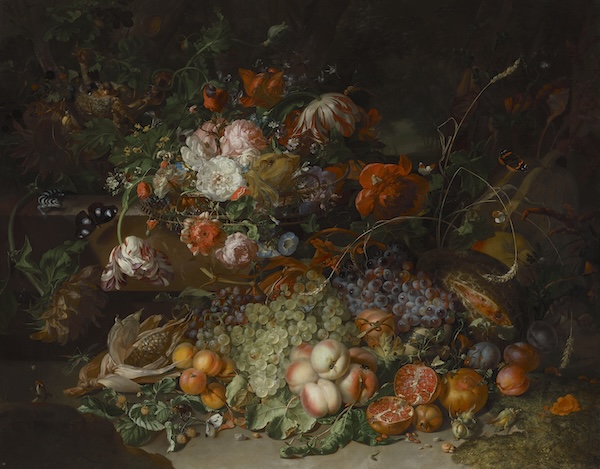
Rachel Ruysch, “Still Life with Fruits and Flowers,” 1714. Oil on canvas. Photo: courtesy Museum of Fine Arts, Boston
This exhibition takes viewers around the world through the specimens brought to Amsterdam by Dutch explorers. It invites close looking, and the museum has prepared a scavenger hunt handout with select bugs and flowers to seek out. The more than 40 exhibited paintings are supplemented by prints and drawings by Maria Sybilla Merian, Alida Withoos, and others, as well as by plant and animal specimens from Harvard University’s Herbaria and Museum of Comparative Zoology.
Flower arrangers may approach these paintings as expressions of over-the-top exuberance, gardeners might regard them as surrealistic, and entomologists may marvel at the delicately rendered insects. At the very least, these paintings deepen our understanding of how nature has been appreciated over time, a glimpse into the vision of flora and fauna around 1700.
Amy Golahny has published widely on art from the Renaissance to the present. She has been president of the Historians of Netherlandish Art. Richmond Professor of Art History Emerita at Lycoming College (Williamsport, PA), she now teaches at Boston College, Cambridge Center for Adult Education, and Beacon Hill Seminars, and reviews for the Burlington Magazine and other journals.
Loved this review—especially the way you connect Ruysch’s restless compositions (those diagonal stems and stealthy insects) to the era’s cabinets of curiosity. It made me look for time in the bouquets, not just beauty. Does the MFA include any close-up or conservation visuals (IR/UV, magnified details) alongside the paintings? I’d love to see how her glazes and tiny critters were built up layer by layer.