
Book Review: Soprano, Queen, Myth — Maria Callas in Jerome Charyn’s “Maria La Divina”
By Jon Garelick
At the very least, Jerome Charyn’s considerable novelistic imagination should send readers back to any number of documentary films and, most important, to the still very real fact of Maria Callas’s vital recorded legacy.
Maria La Divina 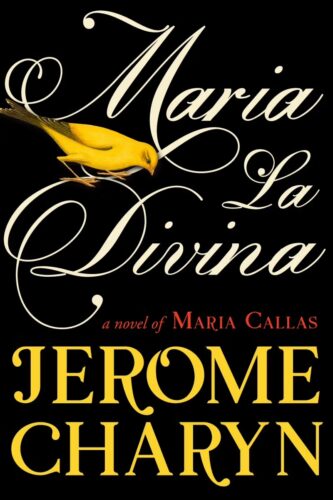 by Jerome Charyn. Bellevue Literary Press, 336 pages, $17.99
Fictional portrayals of real people are always fraught. Whether the subject is Marilyn Monroe or Thomas Cromwell or Doc Holliday, the question always lingers: How does the story match up with the facts? And, of course, with movie biographies, the list (and the potential crimes against fact) are endless, especially when it comes to contemporary figures, musicians in particular: Judy Garland, Ray Charles, Charlie Parker, John Lennon, Bob Dylan. And there’s a further danger: When the lives of individuals are distorted, so is history itself. (A friend of mine disparages Shakespeare’s history plays for that very reason. Richard III got a raw deal!)
So now we have Maria La Divina, by novelist Jerome Charyn — described on the jacket as “a novel of Maria Callas.” If you’re going to fact-check this relatively compact volume (336 pages), good luck. You’ll need to be well versed not only in the personal histories of Callas and, of course, Aristotle Onassis, but also important secondary players like Luchino Visconti and Pier Paolo Pasolini, Winston Churchill and Princess Grace. (For the bulk of the facts, consult Sophia Lambton’s comprehensive The Callas Imprint: A Centennial Biography.)
Charyn covers all the major points: Callas’s New York childhood (Astoria, Queens), her move to Athens with her domineering mother and older sister to study singing with the esteemed singer and teacher Elvira de Hidalgo, her transformation from an overweight, myopic ugly duckling with bad skin and bitten nails into a great beauty, and also into the great operatic soprano of the ages — La Divina.
Charyn — the author of scores of books, including memoirs, crime series, and, among other fictional biographies, The Secret Life of Emily Dickinson (2010) — brings his considerable novelistic imagination and writerly skill to filling out these details, many of them seemingly not only drawn from oft-told tales of Callas’s life, but also from immersive study of his subjects. (There are no acknowledgments of source material.)
Charyn’s previous books have been lauded for their grasp of the Jewish American vernacular of his native Bronx. And, especially in the early New York-set chapters, you can hear the particular transliterated Yiddishkeit twang of Jewish writers like Babel, Singer, and Malamud, particularly in the offbeat rhythm of prepositional phrases — Hildalgo, the former diva, now “a teacher of students without a crisp of talent,” the young Maria understanding with “the clarity of a witch” how to emphasize or elide a particular syllable of music.
And you can hear those other Jewish writers in the vivid descriptive detail — both spare and precise — as in the portrait of Metaxas, the Greek military dictator “who prowled the Old Royal Palace with all his colonels in purple riding boots,” or, more simply, Maria, born with “dark eyes, and a crown of black hair.” Narrative details are summarized in quick, colorful, sometimes comical strokes. Maria’s father, a pharmacist, “managed to get his degree at Athens University, and inherited the chemist’s shop from its owner, a crotchety man who keeled over right in the store on a rainy afternoon.”
Such phrases lend an air of fable to Callas’s story, a bit of stylization that sets you up for the blending of the lived life of a real person with a figure of the novelist’s fancy. (She is a kind of Cinderella, after all.) And maybe the New York connection was yet another way for this Bronx boy to discover the girl from the “Little Athens” of Astoria.
Besides the vitality of Charyn’s prose is his fleshing out of the known details, especially regarding Callas’s musical life. For instance, Callas is credited with almost single-handedly reviving the bel canto opera tradition (Donizetti and Bellini in particular) — “the art of embellishment coupled with the finest phrasing” — to support the long melodic lines of those composers. The “half-forgotten art,” Hidalgo tells her, “was lost a long time ago.”
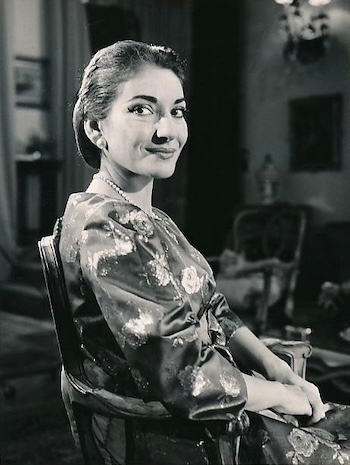
Maria Callas in the 1958 television talk show Small World hosted by Edward R. Murrow. Photo: Wikimedia
But Maria persists and, with Hidalgo’s coaching and her own single-minded study, channels the molten power of her voice and develops her legendary stage presence — despite having to mitigate her myopia with memorized blocking. Callas endures the hostility of fellow singers at the Athens Conservatoire and Greek National Opera, as well as skeptical impresarios and audiences, but conquers Italy, and then all of Europe, one opera house at a time, from the regional theaters in Verona and Genoa to the sacred stages of Venice’s La Fenice, Milan’s La Scala, and London’s Covent Garden.
We get a good profile of Callas’s relationship with an important early mentor, legendary maestro Tullio Serafin, with some embellishment: Serafin was impressed with the young singer, though he found her voice an “unfinished instrument” (in Lambton’s telling). Here, the maestro’s wife has to scold him into working with the girl.
There are other bits of dubious biography — based on Lambton’s description, it’s doubtful that a teenage relationship in Athens became sexual. But most of the invented bits are presented credibly, and nothing is played for cheap thrills. The pursuit of Callas by her husband, the powerful, if cash-poor, opera-loving industrialist Giovanni Battista “Titta” Meneghini (“a maker of bricks,” as Charyn introduces him in the chapter “The King of Verona”), and his subsequent tireless championing of her as manager and advocate, is convincing, as is their romance, despite a nearly 30-year age difference.
So too is the later romance with Greek shipping magnate Aristotle Onassis, portrayed in several scenes taking place on Onassis’s yacht (with the aged, and incontinent, Churchill as a guest) and at his private table at Maxim’s. The voyage of the Christina to Byzantium (later, Constantinople to the Greeks and Istanbul to the Turks) turns surprisingly poignant. Onassis — referred to by Maria as her “sailor,” or as Odysseus — returns to his family’s abandoned villa in Smyrna, from where they were driven out by the Turks (the city now known as Izmir), the house a scarred and stinking shell, because “a sailor must come home at least once in his life.”
Despite my scribbling on page after page, “Did this really happen?,” Charyn gives apt historical flavor to all these various travels and encounters. Not only is Churchill convincingly woven into the narrative (“Lost lads,” he cries in the middle of a meal, still tortured by the guilt of his failure at Gallipoli), but so too the historical context of a self-made Greek tycoon and, for that matter, the deprivations of Callas’s family in the midst of shifting alliances in World War II Athens.
But the heart of the book lies in Callas’s artistic triumphs as she tackles one impossible operatic role after another, redefining them in the process. We see the historic collaborations not only with Serafin and Franco Zeffirelli but also Visconti, whose obsession with casting Callas as Violetta in La Traviata is presented here as the sublimation of his traumatic attachment to his dead mother. “He’s like a doll maker, and you are the doll who will bring her back to life,” a friend warns her.
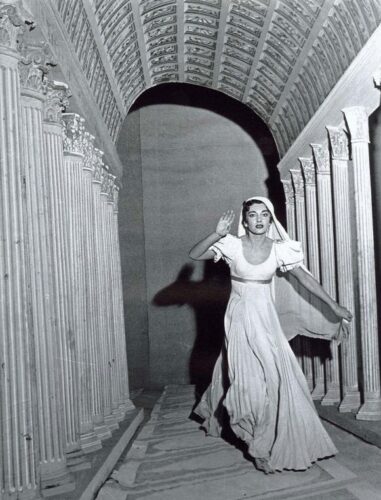
Maria Callas as Giulia in Gaspare Spontini’s La Vestale. Photo: Wikimedia
In Charyn’s rendering, Callas’s characterizations of Violetta, Isolde, Aida, Tosca, Norma, Anna Bolena (Donizetti’s Ann Boleyn), one tragic heroine after another, come from someplace deep within her. When Anna is arrested for adultery, “she shoved the king’s two guards aside with such violence, they nearly toppled into the orchestra.” When she shouts her lines at the audience from the front of the stage, “Judges — for Anna!” — it is a rebuke to Callas’s critics, “attacking her own attackers,” as Charyn writes. “A defiant diva they might demolish, but they couldn’t demolish a queen.”
Charyn’s description of Visconti’s 1955 Scala production of Traviata is equally detailed —as is the dramatization of the often-tense collaboration between the stage director (whatever his neurotic obsession) and the “dangerous diva.” Any opera lover would feel lucky to see a production of La Traviata as good as the one Charyn describes. His rendering also works as synopsis and explication — he gives us more to see and hear, not only of Callas, but of the opera itself.
Charyn covers a whole lot more: Callas’s rivalry with soprano Renata Tebaldi, her disputes with Metropolitan Opera impresario Rudolf Bing (also probably embellished), the decline of her voice, her post-singing career collaboration with Pasolini for his film of Medea, the Juilliard master classes and, of course, Jackie Kennedy and the end of Callas’s relationship with Onassis.
There’s also another appealing fabulation — a mysterious, magical shoemaker who saves the diva’s swelling feet and also rallies the obstreperous loggionisti of La Scala to her cause. He’s also on the run as a member of organized crime.
So what is the moral of this fable of artistic struggle and triumph, of celebrity and of love won and lost? The canary that is a running motif throughout the novel and its cover image (Callas did love her canaries) is clearly Callas herself. A canary trapped in the cage of her own fame? By the end of the novel, Callas has become Violetta, the public persona and the private artist collapsing into one. At the very least, Charyn’s tackling of the Callas myth could send readers back to any number of documentary films and, most important, the still very real fact of her vital recorded legacy.
Jon Garelick can be reached at [email protected].
Tagged: "Maria La Divina", Bellevue Literary Press, Jerome Charyn, Maria Callas, Opera