
Book Review: “Clown Town” — Not Quite as Amusing as Expected
By Clea Simon
Mick Herron’s prose, it must be said, remains top-notch, chock full of puns and timely references, as well as colorful dialogue. But the premise of this successful series of espionage thrillers is beginning to show some wear.
Clown Town by Mick Herron. Soho Press, 352 pp., $39.95
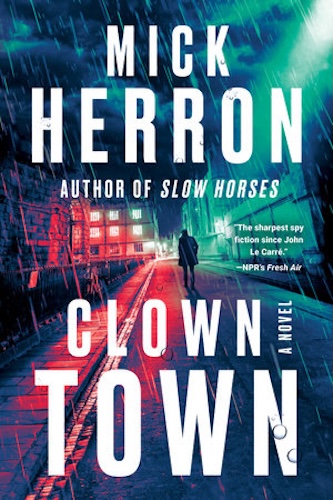 In his often delightful Slow Horses espionage thrillers, British author Mick Herron has created the literary equivalent of a perfect sweet-and-sour sauce. His main characters – the books’ Slow Horses – are failed spies, MI5 fuck-ups who are assigned to the rundown offsite Slough House (from which they derive their derogatory nickname) doing useless paperwork until they willingly quit or meet other ends. And although one or two (notably the series’ quasi-protagonist River Cartwright) just may have been sent to this “drabbest of buildings” because of sabotage (see Slow Horses, the first book in the series), most truly are the “wet brains” and “half-arsed fuckwits” they’re known as, thanks to anger and substance issues, not to mention the occasional distracted but disastrous oversight in the line of duty, such as leaving a disc containing top-secret material on London’s Tube.
Despite their predicament, the Slow Horses still manage to get involved in cases that range from international predicaments to local political flare-ups. These they handle with their distinctive mix of incompetence, dumb luck, and persistence, as well as their overlooked skills and training, managing to triumph despite their collective disgrace.
Louisa, as Clown Town (the ninth in the series) opens, just may be the one exception to the usual Slow Horse dead end. A former colleague is offering her a lucrative job in private security. It’s not a return to MI5, but it would beat the mind-numbing busy work the Slow Horses are tasked with. The only catch would be leaving her less-lucky colleagues behind, and Louisa’s mulling over who she’d miss – and who she already mourns – offers a swift recap of some of the earlier installments.
The main action in this new release, however, involves another former MI5 team, retired after a long and dangerous operation in Northern Ireland that had relied on a source who was as bad as any of the crew’s targets, if not worse. Although Pitchfork, the operation, is long over, the former operatives are still living with the emotional fallout caused by this contact and their time in “joe country” — the undercover netherworld of their fellow operatives. Fallout exacerbated by their truly meager pensions. (“It wasn’t like they were using food banks, but she, at least, was browsing the Reduced to Clear shelf when there was no one around to notice,” Avril, one of the former operatives, notes.) Their situation looks to only get worse until a piece of evidence surfaces that might buy them a little leverage with Diana Taverner, MI5’s First Desk, essentially blackmailing her— and, thus, the service.
But as Slow Horses regulars could have warned the Pitchfork veterans, threatening Taverner is never a good idea: “When Taverner invited you to trust her, count your spoons. And if you didn’t bring spoons, check she hasn’t planted one on you, to have you arrested for theft later.” This is particularly true when she is threatened, resulting in turmoil. But because that bit of damning evidence has turned up in the library of the late David Cartwright, the former MI5 star and River’s grandfather, River and soon the rest of the Slow Horses are drawn in, threatening River’s burgeoning romance with fellow Slow Horse survivor Sidonie, as well as all their lives.
In some ways, this is a heavier book than its predecessors, harkening back to the excellent standalone/prequel book The Secret Hours. Although River is more or less the series protagonist, the books really rely on the full Slough House ensemble, particularly its leader, Jackson Lamb, a survivor of the Cold War whose apparent alcoholic bumbling and atrocious personal hygiene disguise both his extraordinary competence and loyalty to his “joes.” He takes a more active involvement than usual in this outing.
However, it is also a bit less amusing. Not because of Lamb’s deadly serious participation, but because the overall premise is beginning to show strain. We now expect the Slow Horse leader’s perfectly timed farts and his profane and/or insulting aperçus. “Career highlights are for other people,” he informs the Slow Horses in one of his longer rants. “You lot have career landfills. And not the sort some idiot’s buried an old laptop in, with a fortune in bitcoin, but the stinking horrible kind, swarming with gulls.” Later, he advises one Slow Horse to “undo his seatbelt and head for the nearest concrete wall at eighty-five.”
Herron’s prose, it must be said, remains top-notch, chock full of puns and timely references, as well as lots of colorful dialogue. But, by this point, Lamb’s increasingly inventive invective has become predictable, as are Taverner’s tart retorts. Likewise, Slow Horse Roddy Ho’s active fantasy life and his colleagues’ disdain for such have begun to pale, although the novel does finish with something like a rapprochement on that front. And as for River? If anything, he may end this adventure further from professional redemption than before, with more at risk on the personal front as well, ensuring that even if the series has lost some of its initial appeal, it still has enough magic to keep fans reading.
Clea Simon is the Somerville-based author most recently of the novel The Butterfly Trap.
“ Lamb’s increasingly inventive invective has become predictable”
Non sequitur.
Without getting into spoilers, I agree with your assessment that this iteration of the Slow Horses is wearing thin and might have run its course. But, when I reached the end, my mindset shifted, and I had to reconsider everything I’d previously read in light of how the book concluded.
One of the main takeaways from my reconsideration of the book was how many breadcrumbs Herron scattered throughout to help us understand the conclusion. The end of the book was really one big “to be continued.” I really want to read the next book in the series.
Lamb continues to give us a delightful case of quip-lash, but otherwise the book is disappointing. The plot is underdeveloped, and so are the characters. It needs either putting aside or re-reading, because it jumps disjointedly from scene or character to another, and one always needs to backtrack to find exactly where we are. If you haven’t got the other books at hand, you are frequently lost: the OB, for example, is not identified as the Old Bastard. You have to know that already. Herron takes too much for granted. This feels like an off-hand piece that should have been a novella or a short story like Up Against the Wall.