
Book Review” “Trip” — Tour Through an Undiscovered Country
By Peter Keough
A giddily inventive, surreally hilarious, and sometimes profound debut novel.
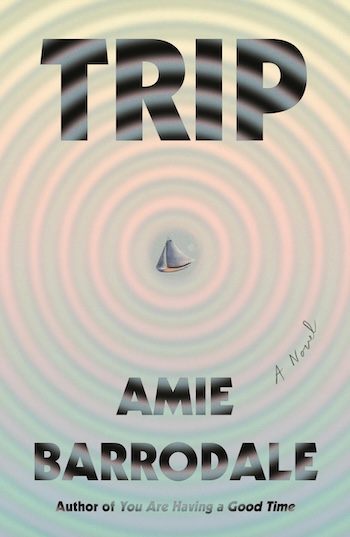
Trip by Amie Barrodale. Farrar, Straus and Giroux. 304 pages. Hardcover. $28
 How can you tell if you’re dead? Let’s say you’re involved in some frustrating, quotidian activity like a meeting with unsympathetic school officials discussing the behavior of your autistic son.
All of a sudden this happens:
“A bloated figure with a blindfold over his eyes, his wet grey clothing clinging to his limbs, stumbled into the room behind Angela. His mouth looked like a puffer fish, his skin pink like bubble gum. […] He reached down and wrapped his fingers around Angela’s face and squeezed.
“Her eyes widened. Her hands went up to his.
“Hey,” she said.
“He dug his fingers in deeper, penetrating her orbital sockets.”
That’s just a milder sample of what goes on in Amie Barrodale’s slow-starting yet giddily inventive, surreally hilarious, and sometimes profound debut novel, an account of the post-mortem misadventures of Sandra, a documentary producer for PBS and the flustered, guilt-ridden parent of the autistic teenager of the title. It is a worthy addition to the small but ancient genre of literary works that explore the afterlife, ranging from The Divine Comedy to George Saunders’s Lincoln in the Bardo (2017).
Sandra has been having qualms about abandoning her high-maintenance son and feckless husband at a trying time to attend a conference in Nepal on “Death and Denouement.” Once there, her assignment proves more involved than anticipated after she and some colleagues venture into a sacred cave reminiscent of the one in Forster’s A Passage to India. A mishap and then a journey through an underworld that is more like an overworld follows, a kaleidoscopic, horrifying blur of time and space that combines elements of Beetlejuice (1988), Hieronymus Bosch, Lewis Carroll, CIA remote viewing, and the animated hit Inside Out (2015).
Meanwhile, Trip undergoes his own picaresque odyssey after escaping “the Center,” the correctional facility for youths with behavioral problems to which his parents had consigned him. The intercession of a Gila monster and the kindness of a stranger – the multiply-addicted, down-on-his-luck, narcissistic but otherwise well-intended Anthony (“like St. Anthony,” he says) – delivers him from this imprisonment. From there, this earthly parallel to his mother’s mystical passage takes him to a decadent Florida mansion in the path of a hurricane, followed by a potentially disastrous yachting expedition. As Sandra struggles to figure out some of the rules of the hallucinogenic, undiscovered country in which she finds herself, she learns of her son’s plight. Driven by a mother’s undying devotion and a guilty conscience, she tries to figure out how to set things right.
First, though, Sandra must get her bearings, and what better place to do so than a convention of experts on dying? Prior to her mishap, the other attendees trade heated arguments about the nature of consciousness (“Yes, yes, everything as an illusion is fine,” one argues. “But it’s for beginners!”) along with passionate opinions on storing mayonnaise. After tragedy strikes, they engage in more fruitful discussions about the afterlife, which Sandra, in her disembodied state, overhears. These gnomic observations, drawn from esoteric sources including Dzongsar Khyentse Rinpoche and The Tibetan Book of the Dead, are dutifully footnoted by Barrodale.
The confab points out certain perks of being in the bardo—the Tibetan Buddhist term for the liminal state between death and rebirth (or enlightenment)—such as the ability to travel through time and space at will, and to visit moments from one’s past and present. (It’s not unlike A Christmas Carol, with Scrooge and the ghosts cruising through the same dimension.) Sandra learns that she can randomly enter the consciousness of others, a kind of super-empathy prefigured earlier in the novel by a computer game that Trip played. But there are inevitable drawbacks, not least the inability, with rare exceptions, to affect the world of the living or contact those still alive.
Other resources Sandra encounters are the other shades, souls of the departed who, like her, have not quite come to terms with their in-between state, though they have grown more adept at it. Some of these fellow travelers are helpful; some are not; some are a little bit of both, like a Chinese travel agent who coaches her on the ins and outs of bodily possession before shamelessly exploiting her attempt to do so in her mission to help her son (a word to the wise: decline the nitrous oxide at the dentist).
Wacky though these excursions into the otherworld may be, Barrodale roots them in precise, mundane details. Some are startling in their evocative exactness, including numerous recitals of food and fashion choices, complete with brand names. But there are also striking similes and descriptions, such as when Anthony confronts police and “flashes the dumb, angry smile of a man about to get into a fistfight.” We’ve all seen that look, and it’s scarier than any haunting.
Barrodale demonstrates a remarkable ear for dialogue that echoes the absurdities of communication, with fragmented non-sequiturs and crosstalk (at one point Anthony even demands “no crosstalk”). And, despite Sandra’s wild travails, her frail, seemingly inextinguishable first person point of view—the irreducible “I”—persists. As does Barrodale’s nimbly ironic omniscient narration. When the two combine, it demonstrates that though love may not be stronger than death, fiction can at least make it mighty entertaining.
Peter Keough writes about film and other topics and has contributed to numerous publications. He was the film editor of the Boston Phoenix from 1989 to its demise in 2013 and has edited three books on film, most recently For Kids of All Ages: The National Society of Film Critics on Children’s Movies (Rowman & Littlefield, 2019).