
Film Review: “Caught Stealing” — A Superior Crime Thriller
By Tim Jackson
Viewers would be wise not to search for a deeper meaning in Caught Stealing — this is an example of entertaining commercial filmmaking from one of our best directors.
Caught Stealing, directed by Darren Aronofsky. Screening at AMC Boston Common, Kendall Square Cinema, Alamo Drafthouse, AMC Assembly Theaters, and more
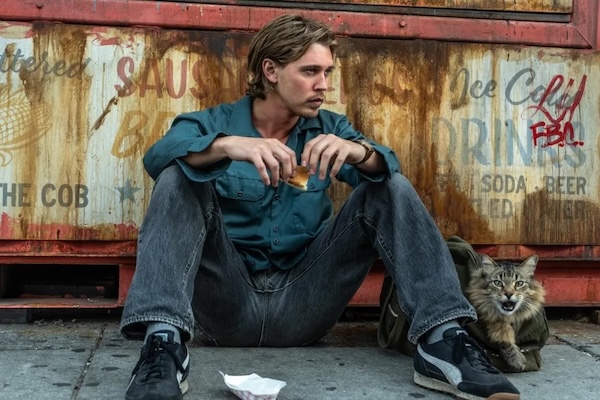
Austin Butler in a scene from Caught Stealing. Photo: Sony
The best films of Darren Aronofsky put his characters through abject duress. To name a few: a drill to the head in his first film, Pi; Requiem for a Dream pounds us over the head with junkie rituals culminating in a close-up on Ellen Burstein’s shock therapy that practically knocked the film out of its projector; Mickey Rourke’s bizarre real-life physical transformation suited the physical and psychological breakdown of Randy “the Ram” Robinson in The Wrestler; Jennifer Lawrence was pushed to her limit as she endured destruction and rebirth as the title character in Mother!; the suffering and redemption of Brendan Fraser as the 400-pound Charlie Morris in The Whale; in Black Swan, nominated for Best Picture in 2011, the transcendence of Natalie Portman’s Nina Sayers reaches surreal proportions. And is it any surprise that Aronofsky also likes to put his audience through the wringer? Unlike his previous films, though, Caught Stealing is a dark and brutal comedy. This crime thriller is sprinkled with humorous moments that grow increasingly ridiculous until the mood turns nearly slapstick.
Austin Butler is Hank Thomson, once the golden boy of high school baseball, now working as a bartender in Manhattan in 1999. Injuries suffered in an earlier auto accident — a passenger was killed — derailed any hope for a career as a professional. Suffering from guilt and lost ambition, Thomson drinks. His other solace is his patient girlfriend, played by Zoë Kravitz. A passionate San Francisco Giants fan, he calls his mother regularly, ending each call with a mutual “Go Giants.”
When his punk neighbor Russ — played by Matt Smith (Dr. Who), sporting a multicolored Mohawk — leaves the country to care for an ailing parent, Hank begrudgingly agrees to watch his cat. Then, returning home one night, Hank’s otherwise calm universe is shattered — he is pummeled by three sadistic Russian mobsters. Unbeknownst to Hank, Russ is also a drug dealer and has crossed a cadre of mobsters and their sadistic Puerto Rican leader, Colorado, who is played with appropriate menace by Bad Bunny. All these no-goodniks want is some missing money, which Hank knows nothing about. But then he stumbles onto a key hidden inside a false rubber cat turd in the critter’s litter box. Not only does Hank not know what the key is for, but, following a drunken relapse, he can no longer recall where he stashed the key.
Thus begins Hank’s odyssey into New York’s seedy underworld. An ethically dubious police investigator, played by Regina King, who walks a fine line between authority and menace, informs Hank that the greatest threat to him will come from the “monsters,” the name she gives to two heartless Hasidic assassins. Behind long beards and wide-brimmed fedoras, Liev Schreiber and Vincent D’Onofrio, as Hasidic gangsters Lipa and Shmully, are barely recognizable. They may be killers, but they honor their mother, played by Carol Kane in full Jewish mother mode. Her advice to the boys: “Troubles are to a man like rust to iron” and “If you can’t, don’t show your teeth.” The sons also obey Sabbath prohibitions, such as not being permitted to drive, which puts a damper on their ability, at crucial times, to command a getaway car during a shootout.
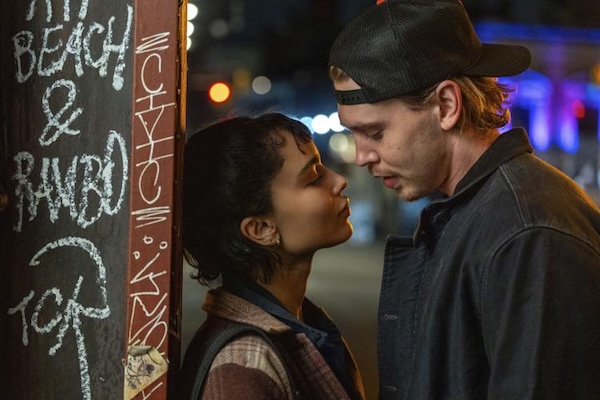
Zoë Kravitz and Austin Butler in a scene from Caught Stealing. Photo: Sony
Another player in this fine cast worth mentioning is the cat Bud, played by a trained feline named Tonic. In a recent interview, Aronofsky said, “His trainer is an amazing cat whisperer. The cat was remarkable. He ran the set; he came in excited to work. He was spectacular.” Though Hank claims to dislike cats, Bud becomes a supportive through line, a kind of talisman. After several lethal missteps, it turns out that saving the cat is the one thing that could salve Hank’s troubled conscience.
It is fitting that Griffin Dunne, the star of the similarly bonkers New York film After Hours, plays Paul, the whiskery, coked-up bar owner of the self-named club, Paul’s, where Hank works. New York has been a setting-turned-character in a number of wild recent films, such as Anora, with its Russian gangsters, Coppola’s sprawling Megalopolis, and Spike Lee’s thriller, Highest 2 Lowest. In this film, Aronofsky and his team capture the chaos and energy of New York’s Lower East Village during the late ’90s, recreating, in detail, the ambiance and décor of the era’s rundown fourth-floor walk-up apartments and seedy bars.
Caught Stealing is an entertaining showcase for Aronofsky’s talents, devoid of the heady religious or mythic overtones found in his earlier films. Butler is perfect for the lead role: he never plays for comedy, which grounds the absurd story in a twisted reality. Credit should also go to Charlie Huston’s book, whose “wrong man” plot was adapted for the film. The author’s screenplay is full of great dry, comic one-liners, and Aronofsky serves them well with a balance of gritty city scenes and snazzy camera work. One remarkable chase scene takes place around the Unisphere, located at Flushing Meadows Corona Park, the site of the 1964 World’s Fair. A stunning drone shot passes directly through the iconic sphere itself.
Aronofsky also shoots, in close-up slow motion, two car crashes, the camera placed on the far side of utility poles where the vehicles collide. These key moments are stunningly designed and could be making a thematic point: the artful explosion of cars into pieces is a metaphor for Hank’s blown-apart life. But viewers would be wise not to search for a deeper meaning in Caught Stealing — this is an example of entertaining commercial filmmaking from one of our best directors.
Tim Jackson was an assistant professor of Digital Film and Video for 20 years. His music career in Boston began in the 1970s and includes some 20 groups, recordings, national and international tours, and contributions to film soundtracks. He studied theater and English as an undergraduate, and has also worked helter-skelter as an actor and member of SAG and AFTRA since the 1980s. He has directed three feature documentaries: Chaos and Order: Making American Theater about the American Repertory Theater; Radical Jesters, which profiles the practices of 11 interventionist artists and agit-prop performance groups; When Things Go Wrong: The Robin Lane Story. And two short films: Joan Walsh Anglund: Life in Story and Poem and The American Gurner. He is a member of the Boston Society of Film Critics. You can read more of his work on his blog.