Film Series Review: “Scary Movies XII” — What Frightens Us Now?
By Steve Erickson
Grief and generational trauma have become the horror movie villains of our time, taking the spot once occupied by masked killers.
Scary Movies XII, screening at Film at Lincoln Center, NYC, Aug. 15 through 21
A survey like Film at Lincoln Center’s “Scary Movies” series allows one the opportunity to take the pulse of the contemporary horror film. While not as extensive as Montreal’s Fantasia festival, the program (revived after a five-year break) features 13 new films in addition to revivals of Jerome Boivin’s 1989 Baxter, Harry Kümel’s 1971 Daughters of Darkness, and Bryan Bertino’s 2020 The Dark and the Wicked. (Although “Scary Movies” is now playing in New York, many of its films have lined up U.S. releases.) This is sufficient to make the conclusion clear: grief and generational trauma have become the horror movie villains of our time, taking the spot once occupied by masked killers. For example, look at Bring Her Back and The Woman in the Yard, both released earlier this year. Each film locates danger in a woman’s reaction to the death of someone she loved. Also, technology may not be malevolent in itself, but in the wrong hands it has increasingly become an integral threat to our well-being. Less obvious are the intimations of mortality, whose increased presence perhaps reflects the aging of the genre’s audience — nothing scares us more than the mental and physical decline of old age.
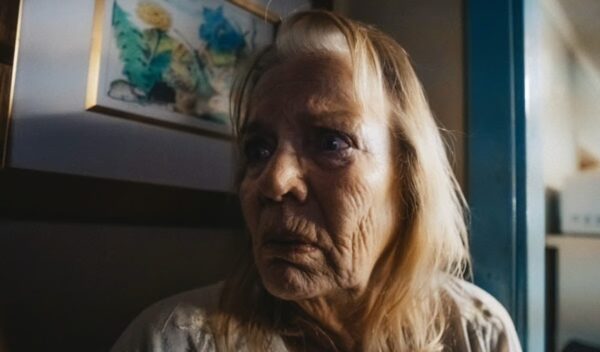
A scene from The Home. Photo: Sara Montoyan and Malin LQ
Matthias J. Skoglund’s The Home sends Joel (Philip Oros), a gay man abused by his late father, back to the town where he grew up, where he finds further torment. His mother, Monika (Anki Liden), has had a stroke, and he needs to place her in a nursing home. His dad’s spirit has returned and is possessing Monika. The demon appears in visions to Joel, insulting him with cracks like “I thought you’d die first, from AIDS.” Joel has a history of drug problems and continues to drink heavily, so he’s understandably rattled. Is this haunting really happening? All this is grim enough, but The Home mines dementia for cheap shock value: Monika masturbates in public and makes inappropriate sexual comments. The result is a film that exploits the experience of seeing a parent change in old age as well as the long-term effects of child abuse. Skoglund relies heavily on jump scares and a soundtrack full of sharp noises to push the audience’s panic buttons.
Diego Figueroa’s A Yard of Jackals takes us back to the real-life horrors of Chilean dictator Augusto Pinochet’s regime. Raul (Néstor Cantillana), a lonely, middle-aged man who lives with his bedridden mother, gazes out his window and witnesses mysterious, violent activity in the house next door. The scene turns out to be a dream, but then he wakes up and experiences the vision again. In the following days, Raul overhears torture and interrogation sessions through his home’s walls. He befriends Laura (Blanca Lewin), a tailor who recorded sound for a documentary made by her husband. Planning to relocate to France, she convinces him to tape the torture as evidence of the dictatorship’s crimes, which she will then smuggle to Europe.
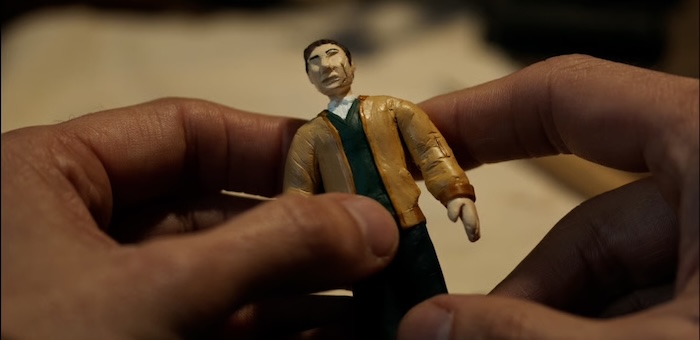
A scene from Diego Figueroa’s A Yard of Jackals. Photo: Film at Lincoln Center
While the first half of A Yard of Jackals may not differ much from other films about hellish life under Latin America’s dictatorships, it also hints that things are not always what they seem to be. Rather than being a model of social realist left-leaning cinema, the narrative delivers a Lynchian immersion in psychological horror. Raul’s job as an architectural sculptor leads him to create miniature dolls based on his bedeviling experiences. The film’s atmosphere is dark and tense: blue and yellow are the only colors visible at night. Figueroa tends to shoot in close-up as Raul experiences phantoms wandering in and out of his apartment. Trapped inside his mind, the protagonist experiences startling, surreal changes of perspective. Harrowing torture — including a rape committed by a dog — is heard but never seen. All this works startlingly well, until the final stretch, when A Yard of Jackals reaches for a twist that falls far short of plausibility. Still, A Yard of Jackals grapples with the violence of the past in ways unsettling enough to ring true in the present — and not just in Chile.

A scene from Kim Soo-jin’s Noise. Photo: Film at Lincoln Center
Kim Soo-jin’s Noise also pivots on the threat of off-screen sound. Factory worker Joo-young’s (Lee Sun-bin) sister Ju-hee (Han Soo-a) disappears from her apartment. After the hearing-impaired Joo-young moves in, her downstairs neighbor posts increasingly unhinged notes on her door, complaining about the noise level — even when no one has been staying there. Because of her diminished hearing, Joo-young needs to rely on her smartphone and Bluetooth speakers to record and play back sound.
The narrative hinges on a series of murders in the building — crimes being covered up because reporting them would threaten the building’s likelihood of being approved for an expensive reconstruction. Thus the horror of Noise is based on the realities of class conflict (heightened by South Korea’s housing crisis), compounded by the fear of living among threatening strangers. But these powerful elements are weakened by introducing a supernatural presence as well, and that proves too much for Soo-jin to handle. It’s far scarier to realize that no one in the building can supply convincing answers. And that the characters are trapped because they are hopelessly terrified by each other. While the sound design is first-rate, befitting the concept, the cinematography is so muted and dark that it saps the film’s power, even though it forces the audience to concentrate harder on its array of noises.
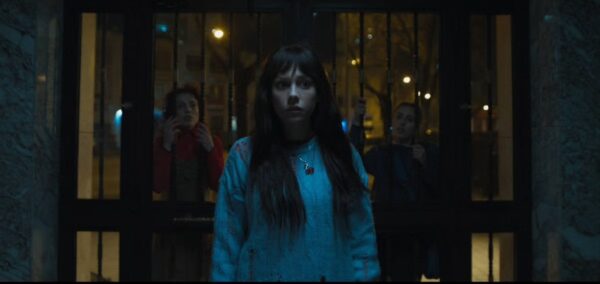
A scene from Pedro Martin-Calero’s The Wailing. Photo: Film Movement
Divided into three episodes, Pedro Martin-Calero’s The Wailing weaves together stories about several women who are being stalked by an invisible man. In Madrid, Andrea (Ester Esposito) is chatting with her boyfriend, who’s away in Australia, when a power outage occurs. During their video call, he sees a hidden image of a man standing in her room. Andrea, who was adopted, learns that her biological mother has just died. Further, she finds out for the first time that her mother was arrested for murder in La Plata, Argentina, and was recently released after serving a 20-year prison sentence. The film then shifts back to the ’90s to relate that story. Film student Camila (Malena Villa) films Marie (Mathilde Ollivier), a stranger she develops a crush on, without her knowledge in the street. She captures the same malevolent male presence haunting Andrea around Marie. Unsure what to do — she even screens the film to her class as an art project — she approaches Marie, who becomes the mystery’s main investigator.
Martin-Calero draws on an art house aesthetic, from slow pacing to a penchant for thickly laden atmosphere. The concept of a monster whose existence can only be proven via technology is frightening. In one memorable scene there’s a fight where the invisible man physically struggles with Marie — a tussle that is only visible in a video monitor. As the film moves around in time, the cinematography changes, becoming grainier in the past. The Wailing’s murderous voyeur, standing in the background and stalking his victims before attacking them, functions as a metaphor for the normalization and invisibility of violence against women. (His female characters are plunged into stark extremes of darkness.) But, for all of The Wailing‘s strengths, it feels derivative, following a bit too closely in the footsteps of It Follows, The Invisible Man, and other films, riffing on the (too) familiar iconography of haunted house and cursed videotapes.
Steve Erickson writes about film and music for Gay City News, Slant Magazine, the Nashville Scene, Trouser Press, and other outlets. He also produces electronic music under the tag callinamagician. His latest album, Bells and Whistles, was released in January 2024, and is available to stream here. He presents a biweekly freeform radio show, Radio Not Radio, featuring an eclectic selection of music from around the world.
Tagged: "A Yard of Jackals", "The Home", "The Wailing", Diego Figueroa, Film at Lincoln Center, Kim Soo-jin, Matthias J. Skoglund, Pedro Martin-Calero, noise