
Film Review: “Monk in Pieces” — An Education of the (Genius) Girlchild
By Debra Cash
What it cost Meredith Monk to be uncompromising! In the early days of her experimentations, the dismissive, often patronizing reviews included lines like her music “made my cats bite each other.”
Monk in Pieces Directed, written, and produced by Billy Shebar and David Roberts, distributed by Zeitgeist Films. Theatrical release includes screening on August 20 on Nantucket. Upcoming screening schedule here.
Interdisciplinarity is hard to categorize, right?
Monk in Pieces, the new feature-length documentary about American genius Meredith Monk, isn’t a funny movie, but I laughed out loud to learn that the New York Public Library had to create a unique call number to classify her. (They have her archives —300 boxes and counting — too.)
Now 82, this dancer-singer-composer-filmmaker-Jew-Buddhist-queer iconoclast is shown backwards, just like in her famous 1972 solo, The Education of the Girlchild. She has been accepted by the cultural powers that be and proclaimed a master — late in the documentary, we see Barack Obama draping her tiny frame with the National Medal of Arts, which almost seems to pin her to earth — but we also glimpse her as an adorable but bullied kid with strabismus. At the age of three, she was sent to study Dalcroze Eurhythmics, absorbing the concept that music could be experienced through the body. Dalcroze’s pedagogy, where music was the body and the body was musical, was the germ of her much-repeated revelation that the voice could have the same flexibility as the spine, that the voice could dance.
Monk inherited a great singing voice from her mother, a busy radio jingle singer (a soap commercial, Muriel Cigars) who took the stage name Audrey Marsh. There’s a sweet episode of time travel in the documentary where Audrey’s voice rises from a recording. Meredith, now an old woman herself, pipes up with musical riffs that have lodged in her memory.
Yet what Meredith did with that three-octave range was 180 degrees from commercial: her compositions and extended vocal techniques are an idiosyncratic mélange of tweets and clucks and growls and yodels, lofting repeated words or no words at all produced with the solfège of an athlete and often an affect of radiant calm. When a clueless interviewer calls her work “primitive” (it’s pretty clear it’s something that he read somewhere), she gently corrects him with a yes/but, adding “futuristic”; her chants nudge up against world music traditions while retaining their own borders. (The 1996 recording Monk and the Abbess drew comparisons between her compositions and the 12th-century liturgical chant of mystic Hildegard von Bingen.)
But what it cost to be uncompromising! In the early days of her experimentations, the dismissive, often patronizing reviews included lines like her music “made my cats bite each other.” She didn’t have money, but live/work lofts in Tribeca — with a bathtub in the kitchen — were cheap, and other performers and nonperformers, along for the ride, were eager to play.
Filmmaker Billy Shebar is married to Katie Geissinger, who has been singing in Monk’s ensemble since 1990, when she was a part of the Houston Grand Opera production of Atlas (a work whose unscored development process and escalating costs panicked the producers but was a smash hit in the end). He has filmed Monk at her most domestic: making coffee (we hear the burr of the grinder and the whistling of the teakettle like hints of inspiration fueling a new work); balancing her pet turtle, Newton, on her hand; closing her eyes during a moment of tai chi in front of a studio mirror; braiding one of her signature swinging braids.
Shebar retreats in the face of Monk’s emotional privacy. She remains guarded in the camera’s presence: with intercuts across time, he shows how her interviews have routinely included the same anecdotes and references. There is a warm, affectionate interview with her early love and collaborator, the director and artist Ping Chong, and photos of her with her later life partner of 22 years, Dutch dancer and choreographer Mieke van Hoek, who died of cancer in 2002. We know that the work she created based on a tune Mieke left behind was a source of Monk’s Impermanence, and that her partner’s death changed her, but she stays mum on the nature of their connection, the shape of her grief, and how, exactly, she feels her life and work changed in its wake. When he captures a truly fresh anecdote, like her delight upon hearing the pulsing sounds generated by an MRI machine, both Monk and the documentary come alive.
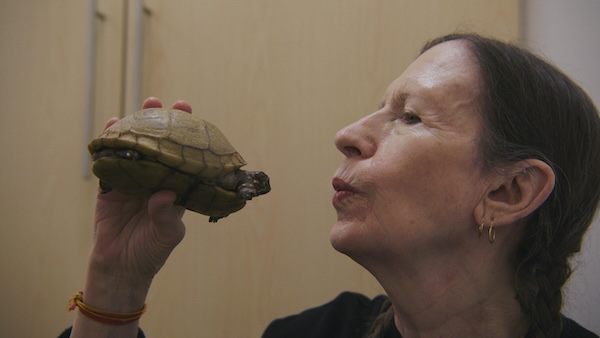
A scene from Monk in Pieces. Photo: Zeitgeist Films
Monk’s oeuvre has been well documented since her earliest days. This is a film built out of wonderful archival materials and comments from the late Merce Cunningham and from a wry David Byrne. We hear Bjork covering an aria from Dolmen Music in a candlelit church and then fangirling Monk at what looks like a reception afterwards. A few of Monk’s dreams, journaled throughout the years, are animated with naïve, hand-drawn images of Monk and her night visions. These open doors without keys.
Being a family insider has its drawbacks. Geissinger is a singer, and Shebar has shaped his portrait as a musical mosaic much more than a theatrical one — while there are compelling segments representing Monk’s theatrical work and filmmaking, these are glancingly referenced. Monk’s potent stage pictures — her polar explorers, her mustachioed couple, Holocaust and plague victims, aging girlchild — are simply a given. Some Tibetan prayer flags at the window of her loft and the titles of some of her works are the only indications of her very serious Buddhist practice. We don’t learn why she has gravitated to make work for special sites — from Juice, the first theatrical event presented at the Guggenheim, to the similarly spiraling Ann Hamilton Tower in Sonoma — although the clips are intriguing, and in a word beloved by contemporary producers, immersive.
Her influence (and the controversy over who influenced whom in those porous days of the New York avant-garde), then and now, never gets its due. Monk was an original but she was not alone. Her work emerged in a rich, contentious creative environment that began in the 1960s and continued well into the 21st century. Jan DeGaetani singing George Crumb and Dawn Upshaw championing new music are part of an aural world that Monk helped make unthreatening enough for the Coen Brothers to use when it came time to score The Big Lebowski. Pulitzer-prize winning composer Caroline Shaw stands on Monk’s shoulders.
If you get a chance to see Monk in Pieces stay through the credits: she explains that she is going to sing an old song about an old woman bargaining with Death. And then, with perfect timing she deadpans: “It’s a comedy.”
Debra Cash is a Founding Contributor to the Arts Fuse and a member of its Board. Meredith Monk and her vocal ensemble once came to her house for lunch, and Monk fed Debra’s dog Kazoo under the table.
Tagged: "Monk in Pieces", Billy Shebar, David Roberts, Katie Geissinger
What a thoughtful and compelling review of this iconic artist. Thank you.
Thank you for a wonderful review of a film about an amazing artist. I wish there were local screenings in Boston. I’m hoping they will happen before long.