Film Review: Resistance Is Feudal in “Harvest”
By Peter Keough
This alternately ecstatic and murky, pointed and obscure allegory is a rare attempt to confront the pathological systems leading us to an uncertain fate.
Harvest, directed by Athina Rachel Tsangari. Streams on MUBI beginning August 8.
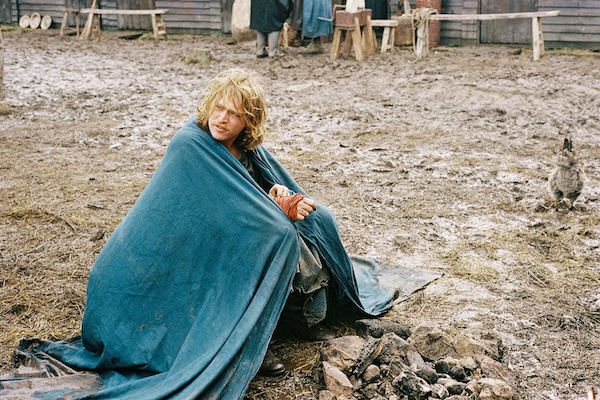
Caleb Landry Jones a scene from Harvest. Photo: Jaclyn Martinez/Harvest Film Limited
Walter Thirsk (Caleb Landry Jones), the erratic protagonist and occasional voice-over narrator of Athina Rachel Tsangari’s Harvest, is mother nature’s son, a simple Wordsworthian soul uncorrupted by civilization. Garbed in the raggedy smock of a medieval peasant or an escapee from an asylum, Walter frolics through the meadow and woods, holding a butterfly on his finger, chewing a bit of lichen, sticking his tongue into a mossy hole in a tree stump, and then skinny-dipping in the loch. In this often visually astonishing film, these images are caught with radiant, epiphanic exactness by cinematographer Sean Price Williams.
Unfortunately, while Walter has been gamboling about, someone has set fire to the barn of the local lord, Master Kent (Harry Melling, whose ambiguous, half-dead eyes were a disturbing presence in Shoshana), burning his prized doves in the process. Walter suspects some of the town delinquents, high on “’shrooms” (one wonders if Walter might have sampled some himself), to be guilty of the crime. But, as he reflects in voice-over, it’s best for the sake of peace not to blame one’s own neighbors, and kindhearted Master Kent agrees. So they scapegoat a trio of outsiders found camping on the edge of the estate. They stick the two men in a pillory (they look like the thieves on Golgotha), cut off the hair of the third, a Black woman, and drive her away. The menfolk lasciviously pocket the shorn locks.
Some watch these events with misgiving and dread. They are also troubled by the sudden appearance of Phillip “Quill” Earle (Arinzé Kene), a Black (race is never mentioned but serves as a signifier of otherness) map maker. He accompanies Master Kent on tours of the fields that Kent ostensibly owns, but which the villagers traditionally have had the right to till as commons. Walter, who is Kent’s closest friend, is less suspicious of Earle. At first, he regards the newcomer as “magical” because he can transform the surroundings, long familiar to Walter, into drawings and ciphers on a chart. Earle likewise is fascinated by Walter’s quasi-mystical interpretation of a landscape that he is in the process of reducing to a two-dimensional map. They form a bond of sorts, but Walter does not suspect — nor is Earle eager to tell him — that the map may not be magical but possesses power that is even more devastating.
The first half of the film ranges in tone from the luminous idyll of an impressionistic painting, to the squalid farce of Monty Python and the Holy Grail (1975), to the growing menace of pagan masks, rituals, and superstitions of Midsommar (2019) or even The Wicker Man (1973). Eventually, it becomes clear that the real danger to the community is not coming from within. The mood and imagery darken once the black-clad, effete, and ruthless Master Jordan and his similarly sinister minions ride into town. Jordan is the cousin of Kent’s late wife, from whom Kent supposedly inherited the property. But Jordan is in fact the legal inheritor, and he has plans to exploit the land that are neither romantic nor sentimental.
Tsangari signals this ominous turn by employing the chiaroscuro palette and compositions of paintings by Rembrandt and Vermeer, with images that evoke the decadence and cruelties of Peter Greenaway’s The Draughtsman’s Contract (1982). As in McCabe and Mrs. Miller (1971), another allegory of economic upheaval, the arrival of these strangers, powerful and entitled, marks the transition from a fraudulent utopia of benevolent feudalism to the wasteland of cutthroat capitalism.
Men like Walter and Master Kent are well-intentioned, but they are ineffectual, misguided, or spineless in the face of these cruel changes. The women, on the other hand, are more attuned to the threat to their security and are willing to act on it, though perhaps no more effectively. Only a scapegoated, trespassing woman, denounced as a witch, possesses any clarity of purpose and is willing to act on it, though her actions also have questionable results.
Tsangari similarly explored toxic male behavior, the patriarchy, and capitalism before in Chevalier (2015), whose narrative was more focused and enlivened by a Buñuelesque absurdity and surrealism. Harvest is more scattered (it is an adaptation of the 2013 Jim Crace novel) than that earlier film, taking on perhaps more themes than it can handle, despite its 130 minute length. That said, this alternately ecstatic and murky, pointed and obscure allegory is a rare attempt to confront the pathological systems leading us to an uncertain fate.
Peter Keough writes about film and other topics and has contributed to numerous publications. He was the film editor of the Boston Phoenix from 1989 to its demise in 2013 and has edited three books on film, most recently For Kids of All Ages: The National Society of Film Critics on Children’s Movies (Rowman & Littlefield, 2019).
Tagged: "Harvest", Athina Rachel Tsangari, Caleb Landry Jones, Frank Dillane, Harry Melling