
Doc Talk: Flickers of Cautious Optimism at the Woods Hole Film Festival
By Peter Keough
There’s bad news and good news at the Woods Hole Film Festival.
The 34th Woods Hole Film Festival. July 26 – August 2.
There are plenty of documentaries about what’s wrong in the world today to be seen at the Woods Hole Film Festival. They include eloquent, affecting, and urgent films like Doug Anderson and Vickie Curtis’s Comparsa (2025; screens July 30 at 5:30 p.m. at the Clapp Auditorium), about 41 girls who were brutally murdered in Guatemala; Brandon Kramer’s Holding Liat (2025; screens July 28 at 8 p.m. at the Falmouth Academy – Simon Center), about hostages held by Hamas in Gaza; and Daniel Straub and Rosanna Xia’s Out of Plain Sight (2024; screens July 29 at 8:15 p.m. and July 30 at 4 p.m. at the Redfield Auditorium), in which a half-million barrels of toxic waste are discovered off the coast of Southern California. I encourage you to see these important films because one of the benefits of watching documentaries at a film festival is being exposed to ideas, issues, and events that, though often dismaying and infuriating, are also illuminating and provocative.
Nonetheless, we all need a break from the gloom, or at least I do, and Woods Hole offers some of that alternative. Sort of. Here are a few equally excellent films with topics that might provide some genuine relief from the relentless litany of depressing news that has been besieging us lately — films that brim with positive energy, a bracing humanity, and even some cautious optimism.
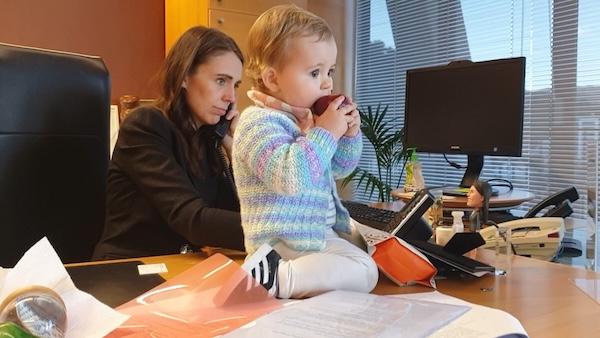
A scene from Lindsay Utz and Michelle Walshe’s Prime Minister. Photo: courtesy of the Woods Hole Film Festival
“Optimism” is a value shamelessly embraced by Jacinda Ardern, the subject of Lindsay Utz and Michelle Walshe’s upbeat and inspiring Prime Minister (2025; screens July 28 at 6:45 p.m. at Redfield Auditorium). Remember just a couple of years ago when a group of young progressive women had taken leadership roles in various countries, a trend that seemed to bode well for a kind of renaissance in world governance? Most of them sadly are no longer in office, including Ardern, who was elected to the title office in New Zealand in 2017, and resigned in 2023 (she currently has a fellowship at Harvard).
Being suddenly chosen to lead her Labour party and winning the election came as a surprise to her and, like many gifted women, she had to resist the patriarchal culture’s pressure to embrace the “impostor syndrome.” She was also criticized for the temerity of having a baby with her unmarried partner while in office. Despite such recidivist attitudes, her tenure was marked for a while by some success in pursuing her liberal agenda.
Then the nightmares struck. In 2019 a heavily armed white supremacist from Australia attacked a Christchurch mosque and Islamic Center, killing 51 and wounding 89. Ardern united New Zealanders in an outpouring of grief and support and, in short order, orchestrated the passage of the kind of assault weapon ban that has eluded the US despite decades of similar tragedies. In 2020 the first case of COVID 19 hit New Zealand, and again, Ardern responded quickly and decisively, imposing a lockdown and restrictions that seemed to end the pandemic. Immensely popular, she led her party to a landslide victory in the general election.
But a new devastating variation of the virus would ravage the nation the following year and her strict policies would be targeted by a different kind of virus — a hateful, antiscience, antivax movement that seemed to have emigrated from the US. In a scene that could be seen as a flashback to January 6, hundreds of demonstrators occupied the grounds outside the Parliament building until they had to be forcibly evicted. Burnt out, perhaps disillusioned, Ardern announced that she would not run for reelection.
With seemingly limitless access, Utz and Walshe achieve an intimate and illuminating portrait of their subject, from her official capacity to her private reflections during moments of doubt and triumph, to her domestic refuge with her partner (now husband) and her daughter. Perhaps the filmmakers could have been more critical in their approach, but the film is far from a hagiography. It is an instructive lesson for any woman with ambitions to change the world.
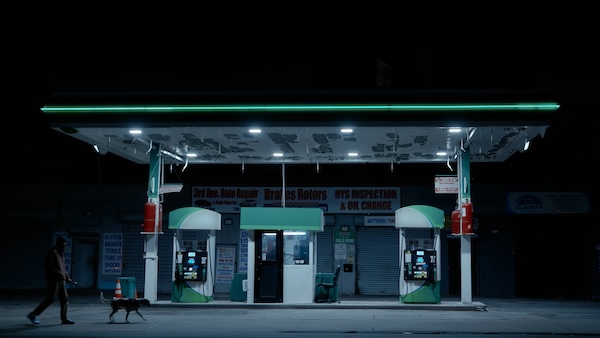
A scene from Karla Murthy’s The Gas Station Attendant. Photo: courtesy of the Woods Hole Film Festival
The subject of Karla Murthy’s poetic and moving The Gas Station Attendant (2025; screens July 28 at 8 p.m. at Clapp Auditorium) — her father H.N. Shantha Murthy — had no grandiose ambitions, though he was afflicted with a variation of the American dream. As the film begins, he is down on his luck, calling her in New York as he works at the title job, which he had to take to cover his debts after his gift shop venture didn’t pan out. But, as he notes, things have been worse, when he was a kid growing up in poverty in post-Partition India. That’s when he was near starvation, living on the streets in the slums of various cities, taking up whatever job he could. Perhaps that early brush with poverty and transience set up what Murthy sees as her father’s inability to commit to any single project or job for long enough to achieve lasting security.
But he must have done something right to have raised a large family and treated them, as the home movies Murthy includes show, to festive Christmases and Thanksgivings and some ambitious world traveling. And his life certainly had its moments of Dickensian good fortune. He recalls how, as a youth, he finally managed to land a great job at a luxury hotel, where he showed his characteristic kindness and generosity to strangers when he put together a hot meal for a hungry, late-arriving American couple. They were so moved that they arranged to get him US citizenship and a plane ticket to Texas where they invited him to live in their home. They sent him to college, where he met his first wife.
There were inevitable tragedies and setbacks, but he always managed to bounce back. But, at this point, time was running out, as was his daughter’s patience. Nonetheless, she spent her time with him well, compiling many years’ worth of videos and recordings which she has deftly woven together into an evocative collage. Was his life a failure? That it resulted in this film suggests it was not.
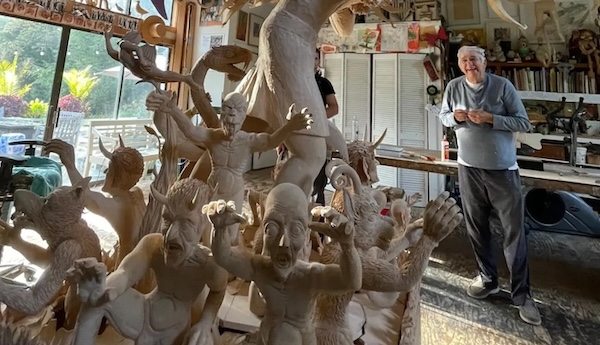
A scene from Cindy Meehl’s Jimmy & The Demons. Photo: Tribeca Film Festival
I was first exposed to the work of James Grashow with the cover of Jethro Tull’s 1969 Stand Up album, whose cover featured his funky, feral, and highly detailed woodcut image of the band. As seen in Cindy Meehl’s Jimmy & The Demons (2025; screens July 26 at 3 p.m. at Clapp Auditorium), the now octogenarian artist has come a long way from when he was one of the country’s busiest graphic designers and illustrators (he remembers how he did an illustration every three weeks for 30 years for The New York Times). For some time now he has been free to indulge his first love, sculpture, turning out surreal, whimsical, disturbing, and hilarious pieces — a Boschian garden of delights ranging in size from gigantic to miniature, including a full-sized replica of the Trevi Fountain made of cardboard and troupes of cavorting monkeys forged from bronze.
Now he is about to undertake his magnum opus: a figure of Christ bearing a cathedral on his back. This he carries through a hellscape of demons and dragons, all rendered with the delight and meticulous craft Grashow has brought to his creations since childhood. Though old now, and beleaguered like his Christ figure with intimations of death and evil, he still draws on the primal impulse of play that has inspired him throughout his life — a spirit this film celebrates and shares.
Peter Keough writes about film and other topics and has contributed to numerous publications. He was the film editor of the Boston Phoenix from 1989 to its demise in 2013 and has edited three books on film, most recently For Kids of All Ages: The National Society of Film Critics on Children’s Movies (Rowman & Littlefield, 2019).
Tagged: " Comparsa", "Jimmie & the Demons", "Out of Plain Sight", "Prime Minister", "The Gas Station Attendant", Brandon Kramer, Cindy Meehl, Holding Liat", Jacinda Ardern, James Grashow, Jimmy & The Demons, Karla Murthy, Lindsay Utz, Michelle Walshe