
Concert Review: Tanglewood Music Center Orchestra Plays Prokofiev and Berlioz
By Jonathan Blumhofer
Mother Nature provided singular and poetic assistance during Sunday’s afternoon outing at Tanglewood.
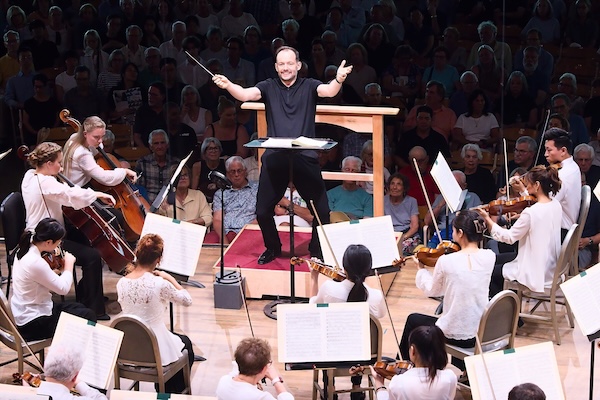
Andris Nelsons conducting the Tanglewood Music Center Orchestra. Photo: Hilary Scott
“Art,” Dante Alighieri once offered, “follows nature.” He should have been at Tanglewood on Sunday afternoon when the elements decided — and with impeccable timing — to test (or, rather, invert) his thesis during the Tanglewood Music Center Orchestra’s account of Hector Berlioz’s Symphonie fantastique.
Mother Nature could hardly have chosen a better canvas on which to expound, though Berlioz’s semiautobiographical 1830 fantasy hardly needs help. The Symphonie, with its program of obsession and hellish, opium-induced visions — as well as its entirely fresh treatment of both the genre and the orchestra — remains, after nearly two centuries, one of the most outlandish and evocative entries in the canon.
Still, the assistance Sunday’s outing received was singular and poetic. There was the chorus of birds suddenly, loudly twittering during the first movement’s devotional coda. Then, automated weather alerts went off during its unsettled “Scène aux champs” (which ends with the threatening rumble of a distant storm). A bit later, a literal peal of thunder accompanied the downbeat of the finale’s first “Dies irae” iteration, and the whirling tempest let loose during the section’s depiction of a Witches’ Sabbath. No doubt Berlioz, whose sense of theater was exceptional, would have loved every minute of it.
It’s likely, too, that he’d have been thrilled with the performance, which was led by Andris Nelsons and formed the second half of the summer’s annual Leonard Bernstein Memorial Concert. Despite all the distractions, the TMCO turned in a crackling interpretation of this favorite.
Comprising fellows from the Tanglewood Music Center, the TMCO is, effectively, a top-notch, college-aged pickup band. At times, they let slip that they’re not a long-standing ensemble: certain of the first movement’s devilish rhythmic textures were blurry, and the finale’s busiest moments weren’t always crisp.
But, on the whole, Sunday’s Symphonie was rousing. The first two movements were beautifully shaped, the end of the last driving with conspicuous élan. Abigail Hope-Hull’s third-movement English horn solos sang with plangent beauty. That larger section, even with its bustling choreography of patrons streaming to the exits in hope of escaping the impending deluge, was a model of tonal focus and emotional depth.
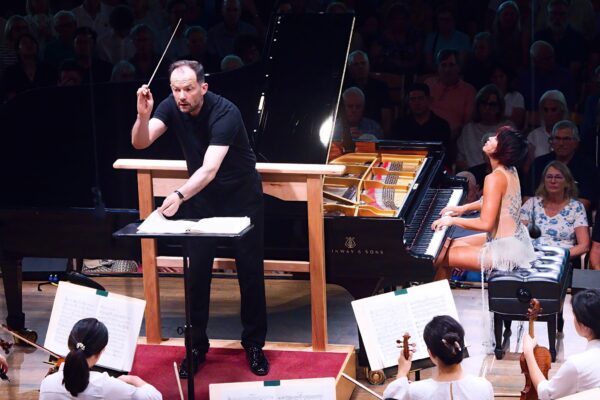
Andris Nelsons conducting a performance of Prokofiev’s Piano Concerto No. 2 with the Tanglewood Music Center Orchestra and pianist Yuja Wang. Photo: Hilary Scott
Wind and rain ensured that the finer details in the last two movements didn’t always emerge. But the music’s tough, brash gestures — including the finale’s culminating mashup of the “Witches’ Round Dance” and “Dies irae” — proved exhilarating.
More thunder and lightning, though of an exclusively musical sort, obtained over the concert’s first half, which involved Yuja Wang assaying Prokofiev’s Piano Concerto No. 2.
By turns sassy and defiant, the Second plays to Wang’s enormous technical arsenal. Pages of knotty chords? No problem. Each hand spanning intervals of tenths, elevenths, and twelfths? Child’s play. Unending acrobatic runs? Kid stuff.
Its subtler dimensions, too, highlight her strengths. On Sunday, Wang mined an unexpected degree of introspection from the opening Andantino and leaned into the finale’s recurring, folksy theme with impish style.
But, likely thanks to limited rehearsal time, the afternoon’s reading didn’t quite achieve liftoff. The first movement felt much like the experience of sitting in sweltering weather: glacial, languorous, and ready to kill for a glass or two of ice water.
Any hoped-for boost didn’t quite arrive in the Scherzo. Despite lively tempos and spicy pianism, textures were muddled, and Wang and the orchestra never settled into a groove. While the last two movements were generally better coordinated and the TMCO’s brass spoke impressively, balances and intonation were periodically spotty.
Nevertheless, all hands reaped a boisterous ovation, and Wang rewarded the applause with a generous triptych of encores: Sibelius’s Étude (Op. 76, No. 2), Liszt’s arrangement of Schubert’s “Gretchen am Spinnrade,” and Vladimir Horowitz’s Variations on a Theme from Carmen.
Jonathan Blumhofer is a composer and violist who has been active in the greater Boston area since 2004. His music has received numerous awards and been performed by various ensembles, including the American Composers Orchestra, Kiev Philharmonic, Camerata Chicago, Xanthos Ensemble, and Juventas New Music Group. Since receiving his doctorate from Boston University in 2010, Jon has taught at Clark University, Worcester Polytechnic Institute, and online for the University of Phoenix, in addition to writing music criticism for the Worcester Telegram & Gazette.
Tagged: Andris Nelson, Boston Symphony Orchestra, Leonard Bernstein Memorial Concert, Tanglewood Music Center Orchestra