
Theater Review: “The Heron’s Flight” — Double Edge Theatre Soars
By David Greenham
The Heron’s Flight is, in many ways, a hopeful antidote for the fear generated by these difficult times.
The Heron’s Flight. Conceived and directed by Jennifer Johnson and Travis Coe. Created with the Double Edge Theatre Ensemble and Company. Music composition by John Peitso with Amanda Miller and Manuel Uriona; choreography by Milena Dabova and Victor Rafael Figueroa; aerial choreography by Cariel Klein and Stacy Klein; design and scenography by Stacy Klein; costume design by Tadea Klein; lighting design by John Peitso; sound design by Manuel Uriona and John Peitso. Staged by Double Edge Theatre at the Double Edge Farm Center, Ashfield, through August 3.
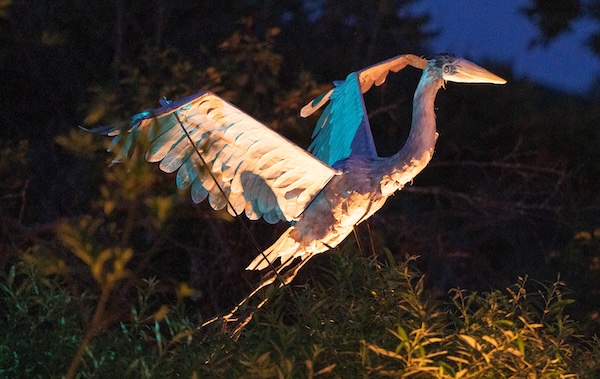
The Heron takes wing in Double Edge Theatre’s The Heron’s Flight. Photo: David Weiland
“Tonight, we choose to be who we want to be,” our Deer narrator (the majestic Daina Robins) informs us, as the audience of just under 100 playgoers is escorted from the courtyard to the pond amphitheater at the beautiful Double Edge Theatre Farm Center. It’s the summer solstice, she explains — our longest day.
It seems there are fewer and fewer perfect weather evenings here in New England these days. It’s either too hot, too chilly, too buggy, or some kind of sudden (and threatening) combination of rain or wind that makes things quite unpredictable. But last Friday night it was truly magnificent in Ashfield at the edge of the Berkshires.
As the audience sits on a semi-circle of benches, the bushes and trees around the pond begin to come to life with music, voices, and glimpses of color. A Winged Serpent (Milena Dabova) emerges, flicking her tightly wound ponytail as if she’s swatting flies. A bright red Phoenix (Victor Rafael Figueroa) bounds across the view, flipping and dancing, while a mischievous Fox (Tricia Trinh) sneaks through the brush in search of an adventure. A Beaver (Robert Carlton) snakes through the water dragging branches and weeds for his dam. A bright light shines high into a tree where the beautiful Heron (Cariel Klein) sits on a branch, her large wings extended. Soon the Heron takes flight and releases her wings as she falls into the pond. She (Hannah Jarrell) emerges from the water. Tonight, we’re told, she will transform into a human.
The action then shifts as the audience is led by the many characters to an indoor theater space where a five-piece band generates a party out of lively sound. Characters dance and sing around a tent placed in the middle of the room. The transforming Heron/Human is delighted and enchanted at the sight as the tent slowly rises to reveal Chiron (Carlos Uriona), the half man/half horse centaur of Greek Mythology. Meeting the Heron, he predicts, “You will know the dilemma of being human.”
As Chiron prances proudly around the floor, other animals — a Bull (Karol Matuszak), Goat (John Peitso), Bear (Amanda Miller), Rooster (Manuel Uriona), Coyote (Mica Farais Gomez), Rabbit (Ewa Timingeriu), and Porcupine (Dylan Young) — whip up a frenzy of music, song, and dance. The Deer assures us, “each person needs a little wildness.”
The festivities continue as the audience is again led outside to a ledge surrounded by a stone wall where a small fire is roaring. Wine is flowing and the satyr play of dance and singing reaches its crescendo. “This is true happiness,” Chiron shouts. “The stars, the land all around have become in your heart a fairytale!”
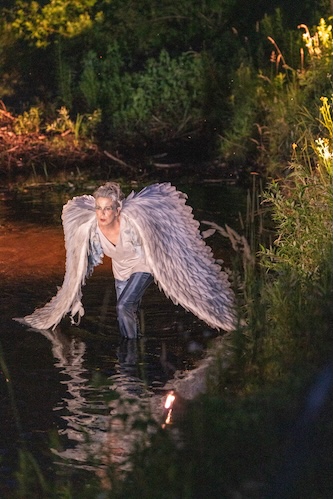
Jennifer Johnson (as Heron) in The Heron’s Flight. Photo: David Weiland
When the music and movement stop, the red robe of the Phoenix is discovered on the ground in front of the raging fire. He has incinerated himself. The Bull is devastated. He roars with sorrow and runs to the field in search of his friend, but the Deer explains, “There are places things go to be forgotten.”
Joy, sorrow, and reflection are the themes of this Double Edge meditation. The five performance locations for The Heron’s Flight create a kind of living garden at their farm, beautifully presented and meticulously appointed. Every step has been considered as audience members are transitioned from place to place, with animal figures sneaking around every natural nook and cranny. Everywhere you look provides an arresting view: the performers’ movements are choreographed and layered in such an adroit way that the dramatic action seems to slowly pulsate with gentle movement.
The cast members are in tune with each other and maintain ecological/mythological character. There are also several technically complicated elements, such as zip lines and trapeze contraptions, which are expertly balanced to work along with the musicians and singers who are placed far apart as the actors navigate water, wet banks, and horticultural elements. Despite all of that eye- and ear-filling complication, the elegant, elemental vision of directors Jennifer Johnson and Travis Coe is on clear display — the focus on the story is never lost.
Composers John Peitso, Amanda Miller, and Manuel Uriona have not created a conventional score, but a soundscape that pulsates as the story’s heartbeat. Whether it is frenzied or solemn, the music is always compelling, serving the narrative demands of the production.
The Heron’s Flight is, in many ways, a hopeful antidote for these times. It takes in our challenging past, looks at the present, and offers a promise for our future. In the final scene, Chiron sums up our current leaders: “Men fear uncertainty. They think only what they think they know. They destroy all else.” In contrast to that conclusion, the luminous aged Heron (Jennifer Johnson) proclaims “My way was long, and I’m only just beginning.”
As our country denigrates the value of immigration, Chiron suggests we think of increasing movements of people around the globe differently. Migration, he believes, simply means that people leave and go to other places, and then, if necessary, leave again. They’re all searching for a home. Chiron adds, “I hope that someday this world emerges from its present trouble, and I just keep walking. Soon, I will know who I am.” These last several months have been marked by the shocking rise of xenophobia, and the violence that inevitably accompanies it. There is fear of what’s to come — The Heron’s Flight offers hope. “Remember,” the Deer promises on the summer solstice night, “that even the longest day comes to an end.”
David Greenham is an arts and culture consultant, adjunct lecturer on Drama at the University of Maine at Augusta, and is the former executive director of the Maine Arts Commission. He can be found at https://davidgreenham.com/
Tagged: "The Heron's Flight", Double Edge Theatre, Jennifer Johnson
Thank you David and Thank You The Arts Fuse. From everyone here at Double Edge Theatre!
I’ve been an avid fan of Double Edge productions since I saw the Firebird years ago, and visits to Ashfield have been a high light of my summers ever since. As a life long theater devotee I have delighted in DE’s rich and eclectic mix of fantasy, myth, progressive politics, humanistic values, social justice, arial acrobatics, visual spectacle, drama, humor and tragedy, ingenuity, creativity and site specific ecologic sensitivities, and substantive community engagement.
However, unlike David Greenham, I found this summer’s production to be one of their weakest. In the sprit of hoping for many more years of the pleasure, delight, and substantive, thought provoking performances, I offer my reactions to what I feel were some real missed opportunities in this season’s performance. This production was a lukewarm repeat of what I recall of last summer’s spectacle which was their weakest to date. Based on what I have come to expect both productions suffered from a lack of a powerful frame and connection to our current political crisis. What I had hoped for was some creative metaphor –– visual and intellectual –– that would offer hope in these dark times when all humanistic values are being threatened and ignored; that would illuminate the folly of the “othering” that is trying to snuff out human decency; and of how to grow and nurture a wave of resistance. Instead, I felt the production was fundamentally formless, lacking in any real story or narrative that would have given it dramatic tension, and even the spectacle seemed visually lacking –– all stuff we have seen before –– and the theme (again a retread from last summer) of “Who am I?” felt flat and off the mark. The real question –– and it’s been the real question for years –– seems to me to be not “Who am I?” but “Who are WE?” and “Who do WE want to BE?”The metaphor of animal to human and human to animal and part animal part human was so superficial and underdeveloped, even glib, that it barely registered.
We human beings need stories and narratives to help us make sense and meaning of what is happening to us, to our society, and to our fragile planet, and theater –– especially the kind at which DE excels, where we enter, even for a brief time, into an alternate reality –– is one of the major, even sacred, tools at our disposal for creating an essential communal experience of possibility, empathy and emotional connection. We desperately need companies like DE, with all it can offer, so I hope that when I go again next summer, they will have connected the dots in a more visually and intellectually more substantive way. By then, our need for hope and focused collective action will likely be more urgent than ever.