Film Reviews: The Boston French Film Festival Offers Cinema’s Crème de la Crème
By Peter Keough
The Museum of Fine Arts screens some ripples from the New Wave.
The Boston French Film Festival. At the Museum of Fine Arts, July 25 through August 24.
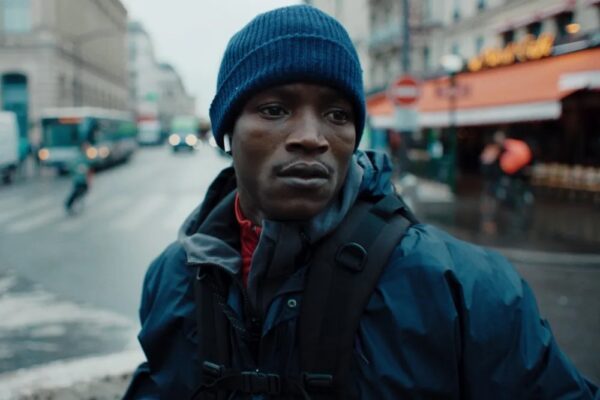
Abou Sangare in a scene from Boris Lojkine’s Souleymane’s Story. Photo: Cannes Film Festival
Some of the most original and accomplished films I have seen so far this year are playing at the Boston French Film Festival. Two of them — Alain Guiraudie’s twisty and empathetic Misericordia (2024; screens July 27 at 2:30 p.m. and August 9 at 11 a.m.) and François Ozon’s polymorphously perverse and deeply humane When Fall Is Coming (2024; screens July 27 at 11 a.m. and August 2 at 2:30 p.m.) — I have previously written about. I would also like to single out Louise Courvoisier’s Holy Cow (2024; screens August 10 at 2:30 p.m.), the best film about bad male behavior and purloined dairy products since Kelly Reichardt’s First Cow (2019).
Here are three others that might appear on a future 10 best list. They are all superlatively crafted, highly entertaining works that engage with today’s most urgent and resonant issues.
One of the most compelling elements of Boris Lojkine’s sublimely frenetic, emotionally grueling Souleymane’s Story (2024; screens August 15 at 7 p.m.) is the fabricated narrative that the desperate Guinean immigrant Souleymane (Abou Sangare, in a screen-seizing performance) must frantically memorize to persuade French authorities to grant him asylum. This harrowing, if somewhat formulaic, tale of oppression, political activism, incarceration, and torture — crafted by a pricey consultant — becomes Souleymane’s lifeline. He rehearses it relentlessly while navigating the perilous streets of Paris as a food delivery worker.
He rushes from one usually rude client to the next on his battered bicycle, captured in a stressful, razor-sharp montage. The sequence unfolds as a series of frustrations, false hopes, and inevitable humiliations, echoing the plight of the tragic pizza delivery man in Jafar Panahi’s Crimson Gold (2003). Meanwhile, fragments of Souleymane’s true story surface in broken phone calls and fleeting conversations with fellow immigrants: his mother is sick in Guinea, his fiancée grows anxious about their uncertain future and considers marrying an engineer, and the man whose delivery route he rents remains evasive about owed payments. Souleymane’s struggle is existential rather than ideological, though decision-makers often prefer the latter narrative.
As dire as his situation is, one can only imagine how much worse it might be if Souleymane were forced to survive in the United States. In one tense sequence, he delivers food to a group of policemen who interrogate him about his papers; if this encounter had involved ICE, the outcome would likely have been far grimmer. And when Souleymane finally has the chance to tell his story, it seems that in France, at least, he stands a real chance of being believed — and of that belief making a difference.
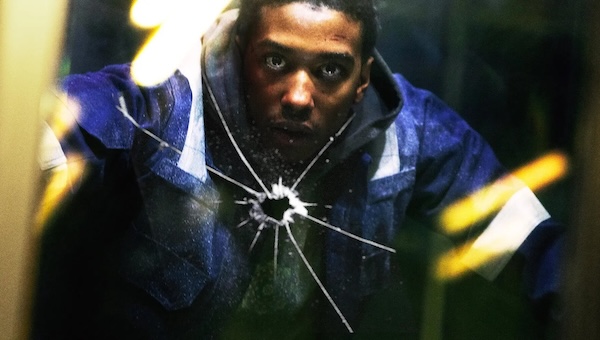
Jonathan Feltre in Michiel Blanchart’s Night Call. Photo: Mika Cotellon/Magnet
Meanwhile, in Brussels, in Michiel Blanchart’s expertly crafted debut Night Call (2024; screens August 1 at 7 p.m. and August 10 at 11 a.m.), another young Black man, Mady (Jonathan Feltre), endures some anxious moments on the job. The film opens with a close-up of a formidable dog barking while an off-screen drill grinds and the cylinder of a lock slowly emerges from a door and drops to the floor. Is it a thief breaking in? Should we fear for the dog, or for the person wielding the drill? As it turns out, it’s Mady coming to the rescue of another locked-out customer — demonstrating his honesty (or caution), his skill (which comes in handy as the night turns ugly), and his affection for dogs.
When Mady drives off, Blanchart indulges in a tilting, rolling drone shot of the city at night before cutting to Mady driving past the ongoing Black Lives Matter demonstration that will roil through the next 24 hours and parallel Mady’s own chaotic ordeal. That ordeal begins lyrically enough when he takes a call from Claire (Natacha Krief), an attractive young woman who flirts with him over his liking for Petula Clark’s version of the moody old pop song “La Nuit n’en Finit Plus.” Normally cautious, Mady lets his guard down and allows her to give him the slip, disappearing with a bag full of money while he is left to confront the enraged brute who actually lives in the apartment. (A quick glimpse of a swastika armband is an indication that these are not nice people.)
Mady escapes — if only briefly — and the rest of the film involves him desperately trying to track down Claire while eluding and/or placating the gangsters, led by a psychopath (Romain Duris) who unnervingly resembles Dennis Miller.
Blanchart plays with the familiar Hitchcockian conventions of the innocent man drawn into criminal intrigue while alternately aided and endangered by a woman who may or may not be a femme fatale. But he also tries to add depth and context to the intrigue by including the BLM turmoil in the streets. Though, unlike Souleymane, Mady’s citizenship is not in doubt, he need only take a look at broadcasted reports of police beating demonstrators to realize that confiding his troubles to the authorities might not be a good idea. Nor is joining the protests himself, though on occasion he will use them as cover for a getaway attempt. Is Blanchart also using the demonstrations as a ploy, a kind of politically loaded MacGuffin? The clever, open-ended final twist suggests otherwise.
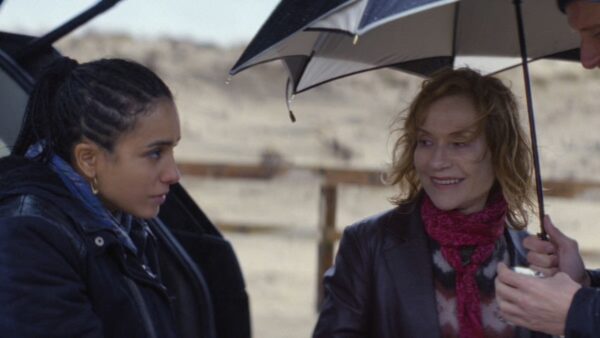
Hafsia Herzia and Isabelle Huppert in a scene from Patricia Mazuy’s Visiting Hours. Photo: Facebook
Patricia Mazuy’s Visiting Hours (2024; screens August 16 at 2:30 p.m.) also complicates a sociopolitical scenario with the generic conventions of a heist film. Like Night Call, it opens with a striking opening image: the impressionistically hued reflections of a florist seen in ceiling mirror panels. Alma (Isabelle Huppert) desultorily roams the aisles gathering a large, lush bouquet. It is for herself, as are the boxes of pastries (a former ballerina, she nonetheless remains whippet thin), and the expensive bottles of wine, and she gathers them all into her overlarge, gated chateau, where she lives alone, her neurosurgeon husband in prison for a fatal hit-and-run.
Dutifully, and unappreciated, she visits him regularly. In the prison waiting room she watches with amusement as Mina (Hafsia Herzi), a North African woman from a much different social class whose husband has been incarcerated for a jewelry store robbery, learns that she has come a day early for her visit. Unable to return on the scheduled date, she begs to see her husband anyway. Refused, she pretends to faint. Ignored, she leaves, goes to wait at the bus stop and is surprised when Alma drives by in her Range Rover and offers her a lift to the train station. That favor expands to an invitation to join her for dinner, then to stay overnight, then to bring her two kids over to live in the chateau with Alma indefinitely.
And so the story might have continued, an Odd Couple-like scenario in which Alma’s jaded, melancholy privilege contrasts with Mina’s non-white, working-class desperation and resourcefulness to comic and possibly enlightening effect. Instead, Mazuy switches genres and introduces a boorish psychopath, Mina’s husband’s at-large accomplice, who starts pressuring Mina for some watches still missing from the heist. Again, as with Mady in Night Call, one wonders why Mina doesn’t just tell the authorities what’s going on. And then one realizes why she doesn’t.
Still, it does seem ill-advised to cast the savior figure as an idle, rich white woman, however engagingly played by the insouciant and self-effacing Huppert, and the villain as an angry Black man. By the end, though, it becomes clear that both women are seeking salvation and might achieve it together.
Peter Keough writes about film and other topics and has contributed to numerous publications. He was the film editor of the Boston Phoenix from 1989 to its demise in 2013 and has edited three books on film, most recently For Kids of All Ages: The National Society of Film Critics on Children’s Movies (Rowman & Littlefield, 2019).
Tagged: "Holy Cow", "Misericordia", "Night Call", "Souleymane's Story", "Visiting Hours", "When Fall Is Coming", Abou Sangare, Alain Guiraudie, Boris Lojkine, Francois Ozon, Hafsia Herzia, Isabelle Huppert, Louise Courvoisier, Michiel Blanchart, Patricia Mazuy, The Boston French Film Festival 2025