
Film Review: “To a Land Unknown” — The Palestinian Refugee Blues
By Steve Erickson
No one argues about Israel or Hamas, or even mentions the words. All the same, caring this much about Palestinians’ lives is inherently political.
To a Land Unknown, directed by Mahdi Fleifel. Screening at the Lexington Venue starting on July 18 and at the West Newton Cinema on August 1
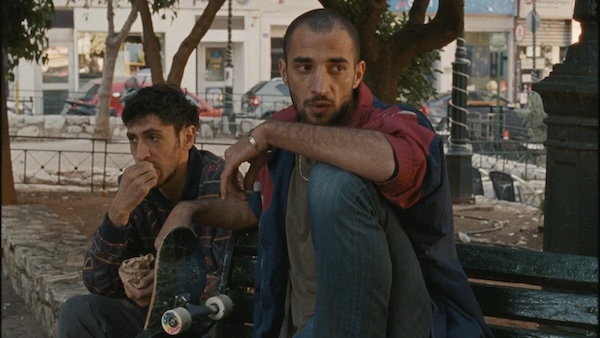
A scene from To a Land Unknown.
To a Land Unknown is a road movie about people deprived of a home. It’s set in a milieu of Palestinian refugees living amidst dirty, graffiti-covered streets in Athens. Many have come from refugee camps in Lebanon, and Greece serves as a way station rather than a final destination. With no way to earn a living legally, the film’s characters are forced to turn to petty crime in order to survive. Their collective dream: to move further west into Europe, especially Germany. The mythical baggage of Greece – the perception of the country as the birthplace of “Western civilization” — lingers in the distant background.
Reda (Aram Sabbah) and Chatila (Mahmood Bakri) stage an accident in an Athens park, a scam that gives them a chance to steal a woman’s purse and run away. The proceeds turn out to be meager: just five Euros. In the midst of the crime, they meet and befriend Malik (Mohammad Alsafura), a 13-year-old boy who asks if they’re Palestinian. It turns out that the kid is a refugee from Gaza. Struggling with a heroin addiction he can’t kick, Reda does sex work to get by. Their ultimate goal is to escape to Germany so that Chatila can open a café. Despite being cousins, under different circumstances the pair would not have been so dependent on each other. But, in exile, they’re all they have. At one point, Chatila meets Tatiana (Angelika Papouli), a Greek woman with a drinking problem, and he seduces her. The cousins plan to buy counterfeit passports, but Reda ends up spending all their money on drugs. This setback propels a desperate plan for the cousins to procure more cash, which results in complications that lead to danger and cruelty.
The first half of To a Land Unknown resonates with Italian neorealism, but the narrative eventually transforms into a thriller. In addition, Fleifel pays tribute to New Hollywood buddy films. The most startling aspect of the once-controversial Midnight Cowboy today is that Hollywood was once willing to produce films about poor people. Despite being set in a very different time and place, the film’s fantasy of a life in Germany serves as the equivalent of Midnight Cowboy‘s American Dream. To a Land Unknown’s final scenes lift directly from the latter film.
Fleifel examines how the occupation of Palestine has torn its people away from their families. Reda and Chatila form a makeshift couple who love and take care of each other. But their connections to their families in the Middle East are distant, conducted only through phone screens. Chatila has left his wife and daughter behind. Malik has been severed from his parents: his mother is dead, his father abandoned him, and smugglers who promised to take him to Italy (where his aunt lives) dropped him in Greece. The only family possible is of the makeshift kind.
Like many arthouse films that flirt with genre, the attempt to mix-and-match brings haphazard results. Both Bakri and Sabbah deliver believable performances, with the latter fully embodying his character’s dazed state of mind. Still, the narrative hews too closely to standard tropes: the crook with a heart of gold, the poor child in danger, and a scheme to get some much-needed money that turns out to be a deadly trap. On top of that, the film falls short of its female characters — it never quite gets a grasp of Tatiana’s life. Thodoris Mihopolous’ 16mm cinematography, which manages to be both careful and spontaneous, makes some of To a Land Unknown‘s contrivances go down smoother.
While Fleifel admits he now lives comfortably in Copenhagen, his father was born in a Lebanese refugee camp. This is a story the director’s been trying to make since 2011, before his documentary A World Not Ours was released. It avoids topical discourse: no one argues about Israel or Hamas, or even mentions the words. All the same, caring this much about Palestinians’ lives is inherently political. Fleifel never idealizes his characters, who wind up harming other Arabs. As grim as To a Land Unknown becomes, Reda and Chatila’s tender care for each other testifies to how much less dangerous and more fulfilling their existence could have been if they had the same rights and control over their lives as Israelis.
Steve Erickson writes about film and music for Gay City News, Slant Magazine, the Nashville Scene, Trouser Press, and other outlets. He also produces electronic music under the tag callinamagician. His latest album, Bells and Whistles, was released in January 2024, and is available to stream here. He presents a biweekly freeform radio show, Radio Not Radio, featuring an eclectic selection of music from around the world.