Film Review: “Cloud” — Death by Capitalism
By Steve Erickson
Kiyoshi Kurosawa’s return to form might be explained by his looking backward: the director has chosen to grapple with the fact that many of the pessimistic prophecies of his earlier films have come true.
Cloud, directed by Kiyoshi Kurosawa. Screening at the Kendall Square Cinema and at the Brattle Theatre beginning August 1
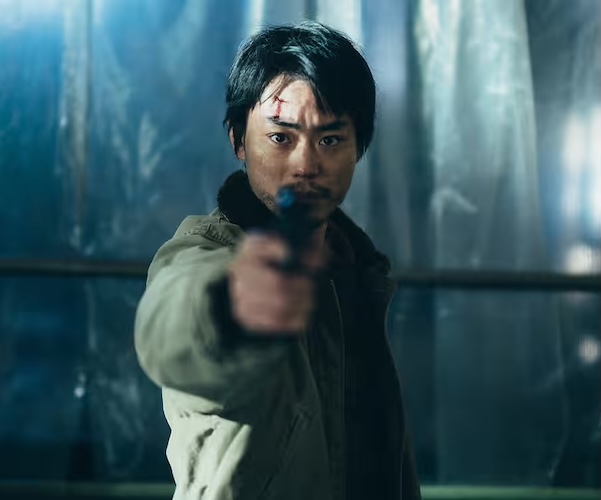
A scene from Kiyoshi Kurosawa’s Cloud
Kiyoshi Kurosawa has a clear vision of modern Japan: it is a land populated by alienated, lonely, often violent people. He’s perfected a visual and aural vocabulary to express his perception: crumbling industrial locales infused with unsettling offscreen noise. Most of his best work resonates with horror and science fiction, but the same worldview persists even when he makes dramas. If Cloud fits neatly into any genre (which it doesn’t), it would be an action film, but it’s also a spiritual continuation of his ghost story about Internet-driven isolation in 2001’s Pulse.
Wanting an escape from his day job, Ryosuke Yoshii (Masaki Suda) starts up a business selling goods online. Initially, he drastically underpays elderly people for used medical equipment. A friend persuades him to make a full-time go of this side gig and we watch as his life is eaten up by this pursuit. Glued to his computer, Yoshii stares at flickering screens filled with bids on his products. At first, his new line of work is profitable. He hires an assistant, Sano (Daiken Okudaira), and moves to a condo in the suburbs with his girlfriend Akiko (Kotone Furukawa). (Throughout the film, she acts like she can barely tolerate Yoshii’s presence.) Eventually, his reputation for selling counterfeit goods spreads on online forums. He uses a pseudonym, but he gets doxxed. He becomes the target of threats; in one of Cloud‘s early scenes, he finds a dead rat wrapped in newspaper left on his doorstep. By the second half of Cloud, every single person Yoshii has angered joins up to attack him. They kidnap him and take him to a warehouse, where they plan to torture him to death in a livestream.
Kurosawa’s preoccupation with objectification and dehumanization is epitomized in his short Chime, released last year as an NFT. In it, the human race seemed barely more alive than the metal objects that fill up the film. The notion of violence as a contagious disease, always lingering under the razor-thin skin of civilized society, runs throughout his films. His return, again and again, to apocalyptic narratives suggests the flimsiness of our defenses.
No one in Cloud is entirely sympathetic. Even the least evil character here exposes a dark side in the story’s epilogue. With one exception — Sano turns up to help save Yoshii’s life — the emotions of these characters are usually negative: fear, anger, and pleasure in cruelty. Yoshii’s initial desires are comprehensible, even reasonable: a more fulfilling job, a rewarding relationship. But characters come off as utterly disconnected from their feelings, unable to control their need for revenge. Still, they didn’t create a system in which it’s impossible to earn a living without harming others. Capitalism turns out to be Cloud’s ultimate Big Bad.
In another director’s hands, the script for Cloud would have become a standard action movie. Kurosawa is different. Cloud finds nothing exciting about violence, and he doesn’t direct “action” to look kinetic. He refuses to see any value in getting even, even when the machinations are aimed at a worthy target. That can be purposely tiresome: the film’s last third is a draining chain of murder followed by murder. Rather than noble victims enforcing karma at gunpoint, the killers in Cloud gather solely for schadenfreude. Still, the film cares enough (or is curious enough) about them to supply a close-up of the death throes of one. Yoshii and Sano cannot save their lives without committing murder, but these acts of self-defense are likely to lead to long-term PTSD. That said, Yoshii winds up learning a lesson: the terrified man he becomes is a far cry from the one who starts the film eager to make money the quickest way possible.
Cloud’s two main settings mirror each other. The house Yoshii buys outside Tokyo is quickly turned into a warehouse, stocked with box after box. Its gray walls are filmed in metallic cinematography — the space is more industrial than cozy. Still, unlike many of Kurosawa’s sets, it’s clean. The space offers no protection to Yoshii and his girlfriend. A man uses their glass windows as a vulnerability, throwing an enormous automobile part into their bedroom. Later, Yoshii is held in a decrepit warehouse, dominated by a labyrinthine staircase. Here, distant abuses of power are suggested, even though their links are concealed.
Kurosawa’s 2010s were a confused creative period — not without worthwhile work, but he seemed troubled by what was expected of him. Sometimes he took directions that didn’t suit his talents. Chime, Cloud, and Serpent’s Path all premiered last year, marking a return to the Kurosawa of his admired 1997-2008 period. (Serpent’s Path is a remake of his 1998 version of the story.) The director’s return to form might be explained by his looking backward: he has chosen to grapple with the fact that many of the pessimistic prophecies of his earlier films have come true. In Pulse, the Internet brings about the end of the world. Cloud diagnoses social meltdown as well, but it takes place in a far slower, more banal fashion. Its characters’ murderous coldness is a symptom of late-stage capitalism, the blight of the creed of individualism, and expecting financial rewards with no concern for the future.
Steve Erickson writes about film and music for Gay City News, Slant Magazine, the Nashville Scene, Trouser Press, and other outlets. He also produces electronic music under the tag callinamagician. His latest album, Bells and Whistles, was released in January 2024, and is available to stream here. He presents a biweekly freeform radio show, Radio Not Radio, featuring an eclectic selection of music from around the world.