
Film Review: “Eddington” — Grifter Nation
By Steve Erickson
The story’s surprising degree of feeling for Joaquin Phoenix ‘s Joe saves Eddington from simply serving as fodder for overheated social media discourse and crusading op-eds.
Eddington, written and directed by Ari Aster. An IFFBoston presentation screening will be at the Brattle Theatre on July 16. Wide release will follow on the 18th.
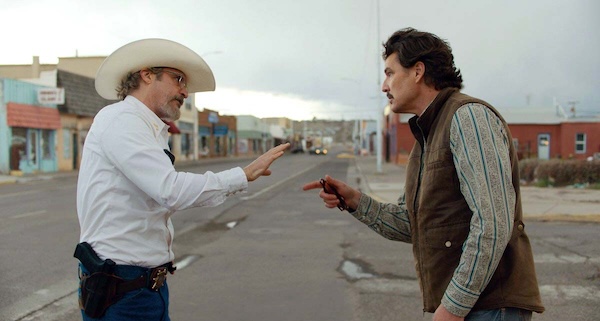
Joaquin Phoenix and Pedro Pascal in a scene from Eddington.
Ari Aster is a masterful manipulator, bold enough to lay out the entire story of Midsommar in a tapestry before it happens. There is no way his characters could claim control over their lives, find ways to move them in a happier direction.
His first feature, Hereditary, toys with its audience and characters alike through acts of relentless cruelty. His first three films share a common existential theme: the inescapability of fate, our lack of control over our personal destinies. As in the films of Lars von Trier, there is more than a tincture of the sadistic: Aster appears to identify with his characters’ pain even as he relishes creating it. Eddington leaves the horror genre behind: it is a mix of Western and darkly comic satire. But the director’s fixation on victimhood and passivity is as strong as ever.
The film kicks off with a montage of Covid conspiracy theories, establishing its May 2020 timeframe. Joe Cross (Joaquin Phoenix) is the sheriff of a small town in New Mexico. The social changes wrought by Covid are sinking in, and he finds himself having to defend an elderly man who wants to enter a grocery store without wearing a mask. Citing his asthma, Joe never wears one himself. The sheriff’s rival is the town’s mayor, Ted Garcia (Pedro Pascal). Compounding the contest for power: their families are intertwined in painful ways, making their conflict very personal.
The conflict is also very cultural. Joe drives around in a car decked out with conspiratorial slogans — which, of course, spell “you’re” as “your” — as advertising for his political campaign against Ted. Meanwhile, the town’s young people rise up during antiracist protests, blocking the streets and clashing with police. Joe can’t see any evidence of bigotry or systemic problems in the town. He uses the presence of Michael (Micheal Ward), his Black trainee, as a defense against possible accusations of racism, eventually turning on him. The film’s ambient malevolence grows even stronger with the arrival of Austin Butler as a radical cult leader (who is adored by Joe’s wife, played by Emma Stone).
Both the script and Aster’s direction of the actors tilt toward caricature. Phoenix deserves most of the credit for making Joe feel more real than anyone else in the film. His stoic, weary demeanor might make the character appear to be an old-fashioned Western antihero. But, under his skin, Joe is as anxious as the ultraneurotic figure that Phoenix played in Beau Is Afraid. That said, Eddington captures something new — a fresh manifestation of loneliness. Characters lie in a dark bed alone, scrolling through bad news and batshit conspiracy theories on Instagram and YouTube, their faces lit by a phone’s alien glow. Darius Khondji’s cinematography offers a vision that’s equally melancholy, if grander, with its views of empty vistas of the desert at night.
Aster’s Hereditary was rarely seen as a political film, but this 2018 effort was an accurate diagnosis of American loneliness and absence of community. It also examined the danger posed by false prophets who claim they have a solution. Both it and Midsommar suggest our current culture is fundamentally sick, to the point that it pushes people toward mental illness and suicide. Predictably, this vision of contamination leans conservative. There are no reasonable answers to the enormous problems raised.
Given its topical themes and direct engagement with the recent past, Eddington is likely to be greeted as Aster’s first political film. Both the ideological left and right will end up taking issue with its message, which condemns both sides as a collection of dumb, dangerous grifters. (Eddington has already been accused of racism.) To a limited extent, the narrative’s mockery of the performative politics of well-off white people is witty and well targeted. Eddington puts the privileged (within the film, their own favorite word) on self-serving, even masochistic bandwagons they don’t really understand, with kids mouthing slogans about “destroying whiteness” to their parents as they eat dinner in comfortable homes. As for the conservatives, they’ve been ravaged by a brain-rotting degree of paranoia that’s removed them far from reality. It is a world in which horrors such as pedophilia and deadly diseases can only be explained by conspiracy theories.
The limitations of this heavy-handed analysis become clear with the film’s criticism of 2020’s Black Lives Matter protests. It can only work by leaving actual Black people out of the picture. Sure, Aster is making the point that many whites congratulated themselves at the time for condemning “micro-aggressions” and adopting rhetoric gleaned from Robin DiAngelo and Ibram X. Kendi. But how can you meaningfully critique activism as ludicrous posturing when the ones engaged in it are suffering from the oppression they are condemning? Additionally, the hypocritical progressives Eddington depicts are now out of fashion and political power, while right-wing conspiracy theorists are sitting in high-ranking jobs in the Trump administration and are exercising (vigorously) unprecedented media clout.
Eddington doesn’t attempt to finesse the difference between satirizing people who are acting in bad faith and seeing values in the causes they champion. The film’s only major Black character — essentially a plot device — leaves a bad taste in one’s mouth. In that sense, Eddington never goes beyond both-sides-ism, embracing a South Park-style cynicism. It’s smug about everything, from facile political provocateurs to their targets. Depending how you read it, the final scene might offer the first sign in an Aster film that real change is possible. More likely, the finale is a sign that the world is fated to continue to disintegrate, violently.
Eddington’s surprising degree of feeling for Joe saves the film from simply serving as fodder for overheated social media discourse and crusading op-eds. Just as Midsommar’s villainous boyfriend was named Christian, Joe’s last name is a clue to the agonizing degree of suffering he’ll undergo. Many of the sheriff’s actions are despicable, yet the film never stops us from empathizing with him. He commits acts of mayhem, but Joe remains a sad sack with a gun, wheezing away as he battles it out. John Wayne would never have let himself be shown in such a degree of physical decay as Phoenix does. This hapless lawman is not going to go down in a blaze of glory; he is continually humiliated by most of the people around him. Aster suggests that Joe deserves this derogatory fate. Yet there is pathos in his end, though no catharsis — for Joe or us.
Steve Erickson writes about film and music for Gay City News, Slant Magazine, the Nashville Scene, Trouser Press, and other outlets. He also produces electronic music under the tag callinamagician. His latest album, Bells and Whistles, was released in January 2024, and is available to stream here. He presents a biweekly freeform radio show, Radio Not Radio, featuring an eclectic selection of music from around the world.
Tagged: "Eddington", Amélie Hoeferle, Ari Aster, Austin Butler, Clifton Collins Jr, Deirdre O'Connell, Emma Stone, Joaquin Phoenix, Luke Grimes, Micheal Ward, Pedro Pascal