
Film Reviews: Three Fine Docs at the Tribeca Film Festival — “Natchez,” “Underland,” and “I Was Born This Way”
By David D’Arcy
A trio of worthwhile docs at this year’s Tribeca Film Festival tour a city, stroll beneath the surface of the world, and stride through an inspirational life.
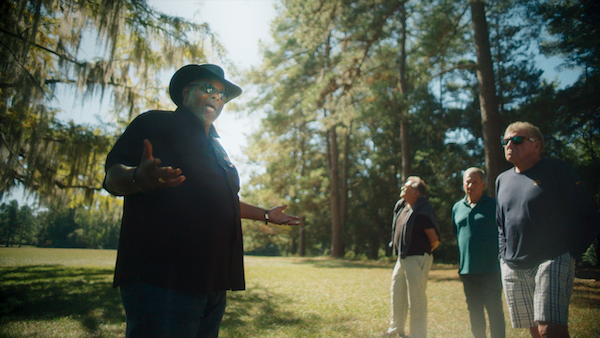
A scene from Suzannah Herbert’s Natchez. Photo: Tribeca
Natchez, which won the top documentary award at Tribeca, is a tour — a series of tours, literally — of the city on the Mississippi, once a capital of cotton, a crop that required legions of slaves to be harvested.
Today, thanks to architectural facelifts, some in Natchez are thriving on the kindness of strangers who travel there for glimpses of what once was.
Natchez, the documentary by Suzannah Herbert, shows us what you might expect from a tourist-savvy Architectural Digest — hoop skirts and other props from Gone with the Wind, table settings, genealogies, burnished wood interiors, somewhat naughty hosts, lots of alcohol, and polite talk of the “servants” (slaves) who worked in the homes. But the film doesn’t stop at the sanitized South.
Once you get beyond the city’s Garden Clubs, groups of women crucial to preserving the grand houses of Natchez, you are placed into the hands of tour guides, mostly African American, who remind you of just how the wealth of those who inhabited the grand homes was built. First there is “Rev.,” Tracey Collins, a convivial minister who preaches during the weekend in a nearby county. His day job is to drive tourists around from one house to another, with plenty of time to supply a reality check. Subjects range from the role Natchez played in the global textile economy to the persistence of Jim Crow laws, until 1964, more than a century after the Emancipation Proclamation.
African-American guides, including a self-styled prophet in a long multicolored robe, say that they are determined to keep the real story of slavery from being “lost to time.” A white guide identifies another political problem: “Because of tourism, Natchez swallowed a master narrative about the Old South. We all want to be rich, and we want to be princesses and live in palaces. If it’s a fairy tale, that’s one thing, but if it’s what you then decide is truth, then that can be much more dangerous.”
Visitors with Rev. see a lot of Natchez, and hear a lot more about the real place. Almost all of those in his charge are white and seem well-meaning as they listen to the city’s friendly (white) mayor say that Natchez leaned pro-Union during the Confederacy and that “everyone’s” stories should be told. The place has plenty of open secrets. One is that gay men led the efforts to restore Natchez’s houses. “If the gay population left Natchez, this town would fold,” says one. “Half the houses are owned by gay guys. We’re the only ones who have the money and the taste.”
But we’re still in today’s Mississippi, so Bible-thumping demonstrators around town remind those same gay men that they will “burn in hell.” Proper men in Natchez society wore Confederate uniforms to special functions until recently. We watch one of them stumble as he tries to explain why they stopped. And just across the street from what once was the second largest domestic slave market in the United States — a site marked by a memorial that Rev. and others would like to expand — a man fixing exhaust systems yells insults at the tourists and their guide. He swears to anyone listening that he’ll never sell his land. He has company. You may (or may not) be surprised when racist jokes come out of the mouth of a sublimely genteel house-owner after he’s had a few drinks. Is it the booze or the camera or the weight of the dominant culture? Probably all of the above.
Natchez is a portrait of what has changed and what hasn’t. It will play on PBS (Independent Lens) in 2026. I couldn’t help but wonder whether its discourses on the horrors of slavery were examples of why the Trump administration was so eager to defund public television. Too late for stopping work on this doc full of unflattering history. The film is funded and finished and should be seen. Good luck next time.
I was also puzzled at how pleasant and agreeable the tourists were, even when guides pointed out how deeply ignorant they were of American history. I’m not exaggerating. Unfortunately, we don’t see enough of the locals who miss the good old days and don’t bother to take the city’s tours.
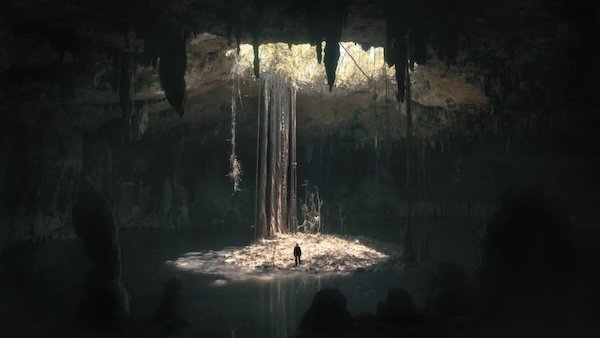
A scene from Underland. Photo: Tribeca
You could see Underland, directed by Robert Petit, as offering another set of tours. Inspired by the widely read 2019 book by Robert Macfarlane, the film is a series of journeys below the surface of the world, where newcomers are forced to reconsider their notions of time and space.
“Into the Underland we have long placed that which we fear and wish to lose, and that which we love and wish to save,” writes Macfarlane in the introduction to his book. Of course, Robert Petit — who is credited with writing the script along with Macfarlane — can’t be expected to put the volume’s 400 pages into his film.
He takes the audience on tours of his own. We go downward through the trunk of a tree and into a dreaded cenote (or sinkhole) in the Yucatan, where the Maya threw their victims. We go far below the frozen tundra of northern Canada. We also travel through the concrete storm tunnels beneath Las Vegas in an ambiance that will remind you of The Third Man. Light, necessary for any film, is minimal in this exercise in going down under.
You would think that cinema was entering a new frontier. Well, sort of. In the travels that the film records, explorers come upon some underground realms that had visitors eons before. In Las Vegas, the detritus of history is more recent. Vast underground chambers contain expanses of trash; there are so many cars the sites look like parking lots. In Mexico, where the Maya moved on foot, the cenotes are repositories of lives lost.
Underland takes fresh cinematic steps into unknown territory. What you see can feel magically new. Yet this magic would be hard to convey on a television or computer screen, and that is where this film is likely to be streamed. Best to see this doc on a big screen at the next festival.

A press photo of Carl Bean. Photo: Tribeca
In the documentary I Was Born This Way, a biopic directed by Daniel Junge and Sam Pollard, the singer and narrator Carl Bean (1944–2021) endures a wrenching childhood that would demoralize anyone – an abusive uncle, shock treatment, a teen peer who informed on his same-sex adventures, and a once-absent mother who, when she reappears, dies after an illegal abortion. Self-aware and frank, Bean knew he was gay early — another liability — but he could sing, and he sang in groups once he left Baltimore for New York.
His gospel troupe took off, and that led to a new dilemma. Bean recalled that, if you could sing, everyone, male or female, wanted to have sex with you. That’s a problem most people might welcome, but it led him to leave New York for Los Angeles.
Bean had one hit, “I Was Born This Way,” written by a New York beautician, a gay self-affirmation song which became a disco success for Motown in 1977. The label hoped Bean would fill the void left by the drug-addled David Ruffin abandoning the Temptations. Who knows about the song now? Questlove, for one. “It’s beyond a hit, it’s an anthem, and anthems never die,” he says in the doc. “This was probably Motown’s most revolutionary single since ‘What’s Goin’ On?’” Lady Gaga, singer of the hit with the same title, acknowledges her huge debt to Bean.
In Los Angeles, Bean continued writing songs. Later, he watched his friends get sick and die from HIV. He became a counselor to dying men, and found that their families would be more open to him if he had a religious title, so he became a minister. Weekly services at L.A.’s first gay congregation for people of color soon drew crowds, as if the makeshift church were a pilgrimage site, which it became. Bean eventually became a bishop, yet spent the last few years of his life immobilized. Scant details of his illness and death in 2021 are provided in a film that tells so much about so much else.
The voluble Bean is a compelling presence on screen. Besides archival footage, animated sequences revisit his troubled childhood. The Lady Gaga connection — she sings his praises — should help get this film onto a platform (it doesn’t hurt that the doc is represented by CAA). But Bean’s life story is the inspirational saga here.
David D’Arcy lives in New York. For years, he was a programmer for the Haifa International Film Festival in Israel. He writes about art for many publications, including the Art Newspaper. He produced and co-wrote the documentary Portrait of Wally (2012), about the fight over a Nazi-looted painting found at the Museum of Modern Art in Manhattan.
Tagged: "I Was Born This Way", "Natchez", "Underland", Carl Bean, Daniel Junge, Robert Petit, Sam Pollard, Suzannah Herbert