Documentary Film Review: “The Atomic Bowl” — The Catastrophic Game Is Still On
By Robert Israel
The at times chilling narrative of The Atomic Bowl raises probing and vexing questions about why we continue to face the threat of nuclear peril today.
The Atomic Bowl: Football at Ground Zero – and Nuclear Peril Today. Directed by Greg Mitchell. Narrated by Peter Coyote. Produced by Lyn Goldfarb. Streaming at PBS.org and via PBS apps and public TV stations on July 12. Broadcast on New Hampshire PBS on August 4 and 7, 2025.
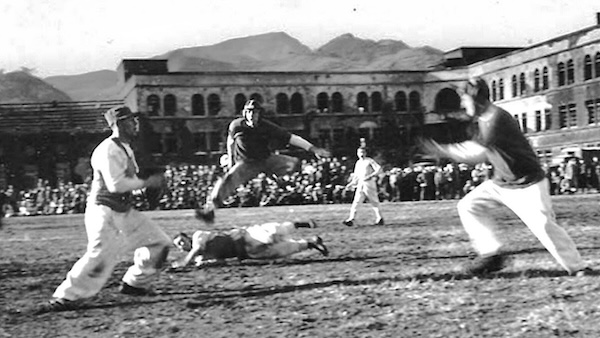
A scene from the documentary The Atomic Bowl.
Nagasaki, destroyed by the second atomic bomb dropped by the United States on August 9, 1945 — three days after the atomic destruction of Hiroshima — is the subject of Greg Mitchell’s engrossing and insightful documentary film. Broken into succinct chapters that explore the city’s history before and after the bombing, The Atomic Bowl is not by any means a historical drama. The at times chilling narrative raises probing and vexing questions about why we continue to face the threat of nuclear peril today.
I traveled to Nagasaki on two reporting trips years ago as a visiting reporter for the Montreal Gazette. While there, I heard (and read) stories about the Occupying Forces orchestrating football games in a field at Ground Zero. But the details shared in Mitchell’s film propelled me to take a fresh look at the city and its atomic legacy. I learned, for example, that the football field, located near Ground Zero, was so “studded with atomic debris” that teams were admonished not to tackle one another during the game, lest someone be seriously wounded. I knew about the press censorship imposed throughout Japan, as required by its American conquerors until 1952. But, to his credit, Mitchell examines just how those decrees worked; he shares previously suppressed A-bomb-related material, including a snippet of color footage that had been withheld for decades. And I learned about several examples of the American propaganda effort that went beyond hosting football competitions. These included a crass “Miss Atom Bomb” contest, where local women were put on display and judged along the exhibitionist lines of a “Miss America” pageant back in the United States. There were also attempts at “atomic tourism,” narrated visits to key sites of destruction with a voiceover supplied by an Armed Forces officer. Taken collectively, these tours, sporting events, and even the sponsored dances (between US enlisted men and Japanese women) amplified the moniker “Ugly American.”
I was previously familiar with the threat of radioactive exposure that the Armed Forces personnel faced during the early days of the occupation. Little was confidently known about the devastating effects of radioactive exposure at the time. There is no doubt that Americans drank contaminated water and consumed tainted local produce. Despite mountains of evidence supplied by these soldiers, who over the decades suffered radioactive sickness (various cancers, hair and tooth loss, and, later, loss of life), it took until 1988 — with the passage of the Radiation Act — that these men (or their surviving families) were compensated for their suffering.
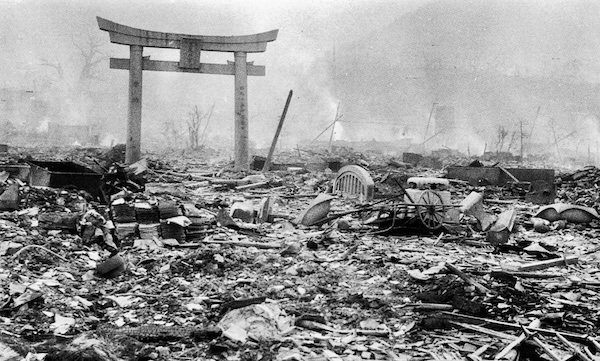
Devastation in Nagasaki, August 10, 1945. Photo: Yamahata Yosuke
The Atomic Bowl focuses on the deaths of children during the bombing, offering a poignant reminder that, during wartime, civilian deaths usually far outnumber military casualties. During my visit in Nagasaki, I interviewed Sakue Shimohira, an adult survivor (known as hibakusha in Japanese), who was only eight years old when she crawled out of a bunker to discover her hometown had been destroyed. “When I found my mother, I knew her only by her gold tooth because when I touched her body, she turned to ash,” she told me.
Missing in the documentary is any mention of the contrarian views of Nagasaki’s mayor, Hitoshi Motoshima, whom I met at a reception he hosted at City Hall during my first visit to Japan. Motoshima made international headlines by speaking out about what he saw as the culpability of the nation’s revered emperor: “Forty-three years have passed since the end of the war, and I think we have had enough chance to reflect on the nature of the war,” Motoshima reflected. “From reading various accounts from abroad and having been a soldier myself, I do believe that the emperor bore responsibility for the war.” In 1990, Motoshima was targeted by a right-wing extremist and narrowly survived being shot in the back during an assassination attempt.
The Atomic Bowl is an important addition to our understanding of a perilous time whose apocalyptic vision of catastrophe persists today. We are in a period when volatile nations like Iran and Turkey are convinced that developing atomic bombs is a matter of ensuring their long-term security; when the hibakusha in Hiroshima, Nagasaki, and Tokyo, who now number under 100,000, are facing their final days. The shock value of first-hand testimony and visuals, even graphic archival evidence and grainy black-and-white newsreels, may not stand the test of time, and amnesia — the strategic tool of bellicose leaders — may prevail over invaluable warnings, such as those issued by this powerful documentary.
Robert Israel, an Arts Fuse contributor since 2013, can be reached at [email protected].
Tagged: "The Atomic Bowl – Football at Ground Zero – and Nuclear Peril Today"