
Concert Review: Boston Symphony Orchestra plays Rachmaninoff
By Jonathan Blumhofer
Pianist Daniil Trifonov’s no stranger to playing Rachmaninoff with Nelsons and the BSO—they delivered a memorable outing of this very piano concerto in 2019—and, while Saturday’s traversal was periodically rusty, it built in spirit and tightness as the evening proceeded.
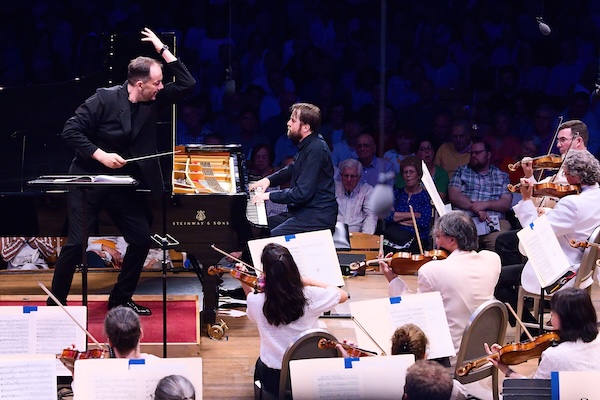
Andris Nelson, Daniil Trifonov, and the Boston Symphony Orchestra at Tanglewood. Photo: Hilary Scott
‘Twas the weekend for all kinds of fireworks: Friday’s spectacle on the Esplanade was hardly cold before the phenomenon shifted west by 130 or so miles and took up residency in Lenox, in the form of the Boston Symphony Orchestra’s Saturday-night season-opener at Tanglewood.
For the occasion, the ensemble didn’t hold back. Daniil Trifonov, perhaps the most electrifying pianist among a generation of brilliant keyboard artists, was on hand. So was BSO music director Andris Nelsons. The fare—Sergei Rachmaninoff’s Piano Concerto No. 3 and Symphonic Dances—promised audience appeal and played to the pairing’s musical strengths.
A broken foot prevented me from making the trek out to the Koussevitzky Shed, but CRB’s broadcast of the event took care of the rest. Fear not: if the sound quality over the airwaves wasn’t as pristine as at Symphony Hall, that standard isn’t the norm even at Tanglewood. At any rate, the stream was at least as clear as the one from my usual perch on the lawn—and minus the mosquitoes.
What it captured, even from a distance, was pianism of extraordinary dynamism and feeling. Trifonov’s no stranger to playing Rachmaninoff with Nelsons and the BSO—they delivered a memorable outing of this very work in 2019—and, while Saturday’s traversal was periodically rusty, it built in spirit and tightness as the evening proceeded.
Now 34, Trifonov proved his usual explosive self. His take on the Allegro’s deceptively simple opening theme was charged with the same sort of careful phrasing and seething urgency that helped him make sense of the movement’s endless passages of busywork and also fired the pianist’s shapely account of the stormy cadenza (in which he played the ossia part, for those keeping score).
In the Intermezzo, clarity of voicings and character held sway, Trifonov lending the music a grandly tempestuous air. Though the transition into the finale—and opening part of that section—were a hair frenzied, pianist and orchestra eventually fell into a nice groove together. A spirit of friendly conversation between the two units marked much of this movement, which was, on the whole, warm and well-directed.
Afterwards, Trifonov provided a full-throated encore in the form of Mikhail Pletnev’s arrangement of “The Wedding” from Tchaikovsky’s Sleeping Beauty.
In both the Concerto and the Symphonic Dances, Nelsons and the orchestra took a little while to hit their stride. The former’s first movement was tonally muddy and commensurately soupy, though the second’s lyricism never felt bogged down. Whatever choppiness emerged in the finale owed more to the composer than his champions: the climactic statement of its big tune evinced a sumptuousness that you could almost swim in.
The last is perhaps not so common to performances of the Dances—maybe thankfully, given the score’s allusions to the River Styx (or, at least, the finale’s iterations of the Dies irae chant). Saturday night’s statements of that motto tended to emerge pertly, which made for a welcome contrast with Nelsons’ sometimes gooey, sometimes plodding take on the rest of the movement.
The Non Allegro, on the other hand, was rhythmically punchy, though dogged by moments of spotty woodwind intonation. Once Thomas Martin claimed the spotlight for his saxophone solos, however, everything fell into place and his section’s playing over the movement’s second half was conspicuously dulcet.
A similar breed of characterful finesse was the rule for the larger ensemble in the central Andante, whose beguiling play of light, shadow, and dance at times bordered on the spacious. But with Nelsons and Co. keeping its lilting impetus firmly in sight, the reading never turned stiff or dogmatic.
Jonathan Blumhofer is a composer and violist who has been active in the greater Boston area since 2004. His music has received numerous awards and been performed by various ensembles, including the American Composers Orchestra, Kiev Philharmonic, Camerata Chicago, Xanthos Ensemble, and Juventas New Music Group. Since receiving his doctorate from Boston University in 2010, Jon has taught at Clark University, Worcester Polytechnic Institute, and online for the University of Phoenix, in addition to writing music criticism for the Worcester Telegram & Gazette.
Tagged: Andris Nelsons, Boston Symphony Orchestra