
Arts Commentary: Essential Inquiries — “40 Questions About a Political Play”
By Dan O’Brien
“A play is political if its subject is taboo and its story mirrors, exposes, and critiques the suppression and repression that interferes with the treatment of a cultural disease. A political play is a problem that is ignored, denied, maligned. A political play is, by definition, unpopular.”
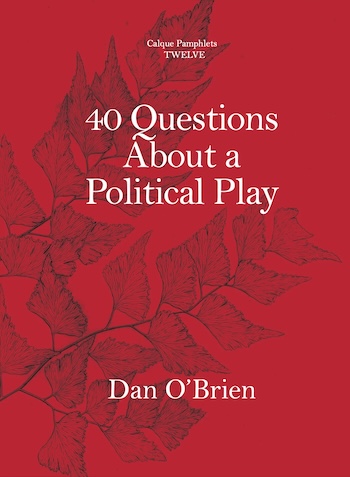 Every year since finishing cancer treatment in 2017 I’ve written a long essay about playwriting (essays from the first four years were published in 2021 as A Story That Happens). This practice began in the wake of trauma, when I didn’t quite know who I was anymore, or how I wanted to live—and write—in the months and years ahead. I conceived of these essays as deeply personal reappraisals of who I am as a playwright, why and how I wrote plays in the past, and why and how I want to write plays now. The following excerpt is from my most recent essay, 40 Questions About a Political Play, published as a pamphlet by Calque Press in Cambridge, England, in July. The subject is political plays: what they are, and how and why we write them. I wrote the essay in the summer of 2024, not long after the premiere of Newtown, my play about the 2012 Sandy Hook Elementary School shooting, and when questions about the artist’s responsibility in response to the Gaza war were weighing heavily on me. The specter of rising fascism makes only a brief appearance in the pamphlet (not excerpted here), but I suspect that much of what I’ve written in 40 Questions About a Political Play remains, sadly, pertinent to our ongoing sociopolitical crisis.
[Editor’s Note: The magazine interviewed O’Brien about the 2024 premiere of Newtown at the Geva Theatre in Rochester, NY. I didn’t see the production, but read the play and wrote that I found it to be “a powerful psychological study of the nature of denial and forgiveness.” I wished that more political plays of that quality would come along in 2025. I have been deeply disappointed so far. Even the approach of authoritarianism isn’t pushing American theater’s reluctance to offend aside.]
40 Questions About a Political Play
1) Does anybody truly want to see a political play?
2) In the fall of 2023 I flew to Rochester, New York, for a workshop of my play about the 2012 massacre of twenty children and six teachers at Sandy Hook Elementary School in Newtown, Connecticut.
We did our tablework. Rain and wind, blood-coppery leaves whipped from limbs into the street outside the windows while the actors read aloud my distressing dialogue. The director, the dramaturg, the actors—all paused the script frequently to ask questions, and I’d answer without answering exactly (playwrights like psychotherapists know that we are most helpful when we let people arrive at their own conclusions, make their own choices). There were digressions about a father’s .22 Savage Mark II, an aunt’s Glock 20 Gen3, a cousin’s AR-15 . . . Nobody at the table owned a gun, or so we assumed.
That week my daughter was at school in Los Angeles where we live, where the teachers were instructing the students to lock the doors, pull the blinds, crouch beneath desks and try to make themselves as small as birds, quieter than birds, in the event that a prowling coyote should slip into the corridors. These students are smart; they know that coyotes don’t kill children. My daughter asked me on the phone that night: “Why won’t they tell us the truth?”
3) How do I define a political play? It’s not necessarily a play about policy or political history. Not a meme or a stump speech brought to life by underpaid actors.
Not a particular political party’s talking points in the mouths of characters in conflict with characters spouting the opposition party’s talking points.
A play is political if its subject is taboo and its story mirrors, exposes, and critiques the suppression and repression that interferes with the treatment of a cultural disease. A political play is a problem that is ignored, denied, maligned. A political play is, by definition, unpopular.
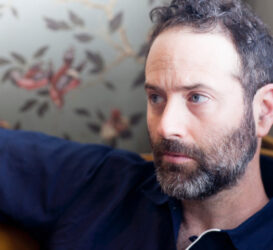
Writer Dan O’Brien. Photo: courtesy of the artist
4) Lunch break in Rochester on October 7, 2023, and I was giving an actor a lift. I switched off the ignition, checked my phone—“Oh no.” I showed him the news from Gaza and Israel. He asked a question—the question I asked myself after my wife and I were both diagnosed with cancer several years ago, and after my brother attempted suicide by throwing himself from our attic window when he was seventeen and I was twelve; the question everybody asks after any trauma, and after experiencing a work of art that has changed us: “What do we do now?”
5) I have a brother born a decade after me. I did my best to raise him like a father, or a fatherly uncle at least, as our regrettably present father was a bully and in all ways useless. This brother is the only member of my family who speaks to me. I was disowned by my parents for writing about my childhood. In 2023 my older brother killed himself, after a lifetime of suffering with depression and who knows what else, and for a while I would call my younger brother to ask how he was feeling. To listen and to console, if I could. We had never been so close, I thought.
More recently he has concluded that I am “a lib”—his words—because I haven’t yet published or produced onstage anything in condemnation of the genocide in Gaza. I am morally “gross,” he says, because I have believed in a two-state solution. He is forty years old and has never expressed a passionate political opinion about anything, as far as I know. Whereas I have written in multiple genres about various political issues over many years. I have told him that I am disgusted and outraged by Israel’s war crimes, but he remains unconvinced. We haven’t spoken in months.
Am I failing my brother?
6) Is an artist an activist? Sometimes. Maybe concurrently, usually secondarily. Social media is a forum for political activism, I suppose, but I don’t think that my posts have ever meant much: posting is like pissing in a hurricane of mis- and disinformation, hate, and pornography.
I have little talent for activism. I march, I vote. I’d rather be writing a political play.
7) A political play is about something. Of course every play is about something—several somethings intertwining—but political plays are primarily about their themes.
Theme is more than the subject of war, environmental degradation, racism, etc. A political play’s theme is its point of view, an implicit or explicit opinion on its subject.
Some political plays present a thematic problem and argue the issue dramatically until the play’s climactic sequence produces a resolution or solution, a QED. These political plays may be perceived as reductive and didactic, or virtuous and necessary, depending on the playgoer’s political persuasion, or depending on the play’s persuasiveness.
Then there are political plays that dramatize a thematic problem without imparting any answers. These plays “ask questions,” “explore,” or in the modern parlance “interrogate” their themes. Question Plays are generally more effective than plays that teach, as few playwrights also happen to be sociologists or political scientists. But a political play without answers will strike many as wishy-washy and ultimately an affirmation of the status quo.
This essay about political plays is asking questions. Am I asking because I am afraid to answer?
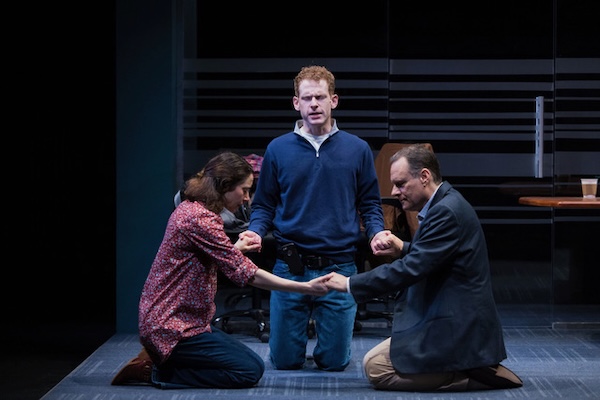
L-R is Kate Abbruzzese, Max Chernin, and Jonathan Walker in the world premiere production of Newtown at the Geva Theatre. Photo: Ron Heerkens Jr // Goat Factory Media Entertainment
8) A dictum of the writing workshop: write with specificity about your experience of living. Attempting to write universally only renders imprecision and blandness. Write specifically, and paradoxically you will reach a wider audience.
Political plays with generic characters and stage-managed action are the dramatic equivalent of rhetoric. But there are periods in history when a rhetorical theatre—ethical propaganda, antifascist agitprop—is justified. This sort of play prosecutes a central conflict that exists between the stage and the audience, the conscience of the artist and the crimes of a culture. Are we living in an age that demands only the rhetorical play?
9) Audiences have a problem with characters they dislike—or, apropos the political play, characters whose politics they dislike.
My play about Sandy Hook premiered in the spring of 2024. Somebody saw it and was outraged, and naturally she took her outrage to social media. The characters in my play believe that the Second Amendment to the US Constitution guarantees them unfettered access to firearms. This playgoer assumed that I must agree with my characters. The playwright is synonymous with the character(s), she believed. She’d never been more offended by a play—“not since Oleanna,” she wrote. Luckily for my ego her post did not garner many likes.
But I once heard a much-lauded, venerable playwright declare that the audience is never mistaken. The playwright is always to blame—or to praise. Should we only create characters whose politics we agree with?
10) Characters in a political play embody and convey conflicting aspects of theme. They are agents of argument. A playwright labors to instill subtlety, complexity, contradiction in these characterizations so that the audience believes that there are human beings onstage rather than mannequins and mouthpieces.
The best plays—political or otherwise—begin in their composition with character. Theme follows action, and action follows characters whose desires and fears, as revealed by their words and behaviors, are recognizably urgent, particular, and changeable.
If we don’t care about the characters then how can we care about their politics?
11) The newspaper of record in Rochester no longer publishes theatre reviews. The local alternative paper published something like a book report in response to my play. The writer’s sole criticism was a vague wish that the playwright had focused more on the victims. Two of the characters are based closely on the parents of a girl murdered at Sandy Hook, and the play was produced with their approval. The other characters are based closely on the parents of the killer; these characters are simultaneously victims and—arguably, partially—culpable for the atrocity. The play does not dwell on the stories of the children because I have no wish to disturb their memories unduly, or to exacerbate the trauma of their survivors. My intent was to write a play that examines without flinching the epidemic of mass shootings in the US, as I debated—or as the characters debated—causes and remedies. The characters are in denial. My subject was mass shootings, but my theme was the ongoing devastation wrought by my culture’s denial of reality.
Maybe I’m wrong. I’ve been wrong before and will be again, as long as I’m writing. Maybe my play glamorized the killer and empathized with his enablers. I don’t know: can a drama confront evil without dramatizing it?
12) Are political playwrights preaching to the choir? If a play’s politics align with the consensus in an audience, then—so the theory goes—there’s no good reason to produce the play or to write it in the first place. A political play won’t change anybody’s mind if those with minds in need of changing are nowhere near the inside of a theater.
This criticism involves two assumptions. First that plays are written and produced by liberals and progressives for liberal and progressive audiences. As a generalization this is indisputable. But the exception proves the rule: a conservative or centrist who happens to be attending the theater with liberal or progressive friends; who is young and open-minded; who is lost.
The second assumption is that a political play’s only purpose is to alter an audience’s beliefs. But a play may serve to galvanize those who already share the play’s politics, offering consolation, inspiration, and a renewed impetus to implement the play’s conclusions in the artless world outside the theater (see Brecht).
Not to mention that political plays and musicals can influence a culture when only a small percentage of the population has seen the works in question. Angels in America, Parts One & Two (1993) and Hamilton (2015) spring to mind.
And remember that sometimes a choir needs a preacher, or better yet a prophet. Playwrights who are brave, or foolish, or brave and foolish, will feel compelled to challenge the audience’s most ingrained political assumptions.
13) Many who saw my play about Sandy Hook received it as I’d hoped they would. I don’t mean to complain. I am curious. Somebody posted on social media that the play was “powerful” with a “stellar” cast and “brilliant” direction, but then this: “When we decided to buy tickets we were well aware that this play would not provide an evening of entertainment.”
I happen to believe that a political play can provide entertainment. But then what are we talking about when we talk about entertainment?
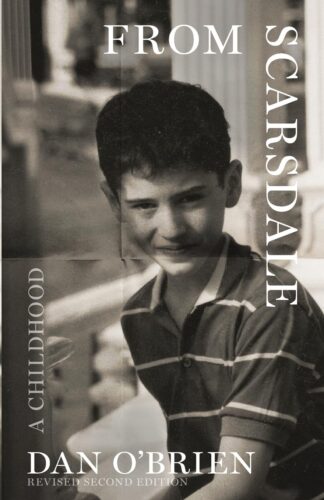
Dan O’Brien is a playwright, poet, and nonfiction writer. His play Newtown is the winner of the 2024 Blanche and Irving Laurie Foundation Theatre Visions Fund Award. His memoir From Scarsdale: A Childhood was recently reissued in a revised second edition from Dalkey Archive Press. His recognition for playwriting includes a Guggenheim Fellowship and two PEN America Awards. He lives in Los Angeles.
Tagged: "40 Questions About a Political Play", "Newtown"
Thank you Dan O’Brien for your thoughtful essay, and thank you Bill for running it. I especially liked ‘assumption two’ in point 12. Our country and our democracy are at a crossroads right now, and one of our challenges is how to translate progressive thought into sufficiently powerful action to approach or surpass Chenoweth’s 3.5% threshold.
I would also suggest that from one perspective (and I agree that there are others) and at one level, most plays (or books, articles, etc.) are political (if by political we mean supporting one or another ideas that are in conflict with each other.) I think we tend to call a play political if it in one way or another does not support the status quo, but it seems to me that plays whose stories, characters, and points of view are congruent with the status quo are political as well because they serve to reenforce the status quo. And the more everything (what we see, hear, and read from our families, friends, workplaces, and media) around us supports the status quo, the more likely we are to take it as inevitable and do nothing to change it. It’s the ‘you can’t fight city hall’ phenomenon. What we need more of right now, and urgently, are good (i.e. engaging the audience), thought provoking political plays that offer visions of alternatives to the status quo. This is important because one of the challenges in making social change is that it’s not enough to just be against something: the ability to sustain the momentum long enough to build a movement that can reach that 3.5% threshold is made much easier if there is some vision of what could replace the current reality –– the life we could have if enough of us join together to make a desired change.
A play (or even two or five or ten) won’t ever make it easy, but it can be a powerful tool, especially if we can stop denigrating ‘political’ theater. In any case, please keep writing, and I hope one of the theaters in Boston will do Newtown at some point.