
Children’s Book Reviews: Changing the World in Big and Little Ways
By Cyrisse Jaffee
Two portraits of champions: a famous fighter for civil rights and a little girl who loves chess.
A Flea for Justice: Marian Wright Edelman Stands Up for Change by Valerie Bolling. Illustrated by Temika Grooms. Charlesbridge, 2025.
Elsa’s Chessboard by Jenny Andrus. Illustrated by Julie Downing. Neal Porter Books/Holiday House, 2025.
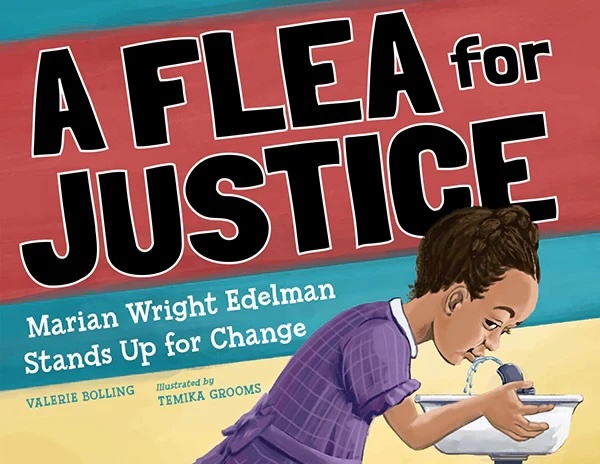
Many people may recognize the name Marian Wright Edelman, but may not know how her experiences with injustice led her to become a fighter for equality. As a child growing up in the segregated South, she was furious at having to drink at the “colored” water fountain, that her schoolbooks were second-hand, at the indifference of white police officers when a Black person was injured in an accident, and the lack of medical care for a friend who died after stepping on a rusty nail.
Inspired by Sojourner Truth — the abolitionist and women’s rights activist —Marian vowed to become a “flea for justice.” (The book explains the derivation of the phrase.) She became a civil rights activist and the first Black woman lawyer in Mississippi, using her skills to defend people “who were arrested for helping Black people register to vote.”
After her friend and colleague Martin Luther King Jr. was assassinated, people felt hopeless and frustrated. Marian decided to put her efforts into helping children have more hope for the future. Edelman’s Freedom Schools provided kids with books and education that they otherwise wouldn’t be able to access. She also founded the Children’s Defense Fund, which still exists today, continuing to advocate for children of color, kids who are poor, and those who are disabled.
The lively narrative is interspersed with quotes from Edelman, whose story is compelling. The “flea” metaphor — the idea that fleas make people scratch and thus are a source of power — is occasionally awkward, but the basic idea will resonate with early elementary school-aged kids. More information about Edelman is provided in an afterword, and one wishes that more of her accomplishments (e.g., her experiences at Yale Law School, her work with Head Start) were included in the main story. Nevertheless, this is a welcome biography of a notable Black woman.
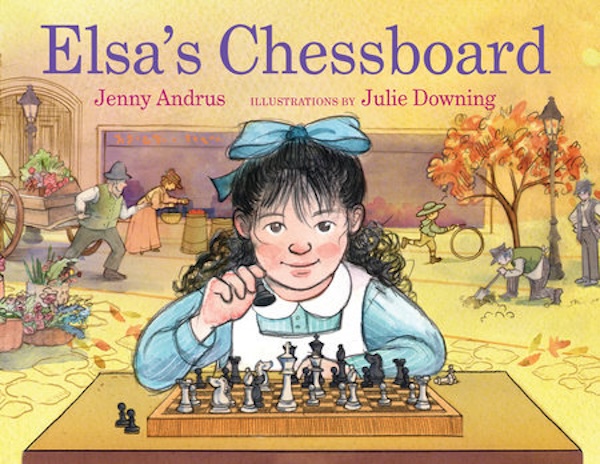
Based on the experiences of her great-grandmother, Jenny Andrus’s Elsa’s Chessboard is about a smaller, yet still significent, victory in the fight for equality. It too is about a little girl who defies the restrictions of her time. Elsa’s story begins in early 20th-century Vienna. At six years old, she watches her brothers play chess and longs to learn. But chess is not considered a proper game for girls. Finally, one of her brothers agrees to teach her and they give her a chess set for her 10th birthday. Elsa carries her chessboard everywhere, looking for opportunities to play.
When Elsa challenges a young librarian named Edmund to play, they end up falling in love, getting married, and having a baby. Soon, however, they must leave their homeland during the 1930s, as war becomes imminent. Elsa’s precious chessboard is one of the few things they take with them.
In this new country, Elsa struggles to learn the language and make friends. Once again, chess helps her, even though initially some of the men at the dress factory where she works grumble, “Women don’t play chess!” Soon she is playing and winning. Eventually, Elsa also teaches some of the women to play.
After her beloved chessboard is lost, Elsa plays lots of games with her grandchildren — but not chess. Years pass and, miraculously, the chessboard is found again. Elsa sits down to play once more, this time with her great-grandson.
This is a gentle story, filled with heart and hope. It’s not only a story of a minor triumph — a girl succeeding at a boy’s game — it’s also one of perseverance, courage, and finding one’s place in a new world as an immigrant.
Although the narrative mentions that Elsa and Edmund are Jewish, and we see a menorah in one of the illustrations, the text doesn’t go into detail about why they must leave Austria. This is provided in an author’s note, which also mentions other ways in which Elsa defied stereotypes: she cut her hair short when others wore it long, she wore pants when most girls wore dresses, and so on. The book also provides a bibliography and photographs of the real Elsa Konstandt Weisz, together with her granddaughter (the author) and her great-grandson, playing chess with the treasured chessboard.
Cyrisse Jaffee is a former children’s and YA librarian, children’s book editor, and a creator of educational materials for WGBH. She holds a master’s degree in Library Science from Simmons College and lives in Newton, MA.
Tagged: "A Flea for Justice", "A Flea for Justice: Marian Wright Edelman Stands Up for Change", "Elsa’s Chessboard", Jenny Andrus
1 Comment
Leave a Comment
Thank you for the thoughtful review. It meant a lot to me.