
Book Review: The Poetry of Zbigniew Herbert — Mr Cogito’s Insomnia
By Laura Sheahen
How should artists live under autocracy? A Cold War Polish poet doesn’t have good answers, but offers chilling advice.
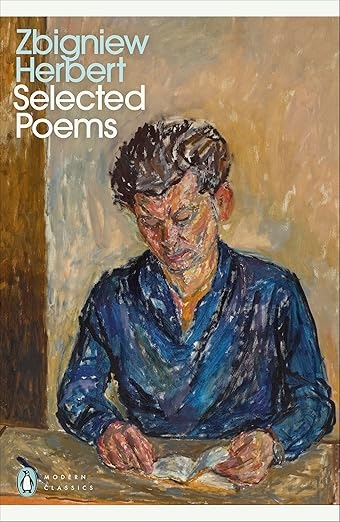
Selected Poems by Zbigniew Herbert. Selected and introduced by J. M. Coetzee and Alissa Valles. Penguin Classics, 288 pages
Reconstruction of the Poet: Uncollected Works of Zbigniew Herbert, Translated by Alissa Valles, Harper Collins, 288 pages
 “Keep watch.” “Take a few indispensable things.” “Examine your fool’s face in the mirror.” “Drink an extract of bitter herbs/but not to the dregs.” The poetry of Zbigniew Herbert, one of the twentieth century’s few essential poets, often reads like a panicked ransom-note job description for artists living under totalitarian regimes. Do this; don’t do that. Suffer this…
Familiar with tyranny, this Cold War Polish poet in “The Power of Taste” advises: “Before we declare our consent we must carefully examine/the shape of the architecture the rhythm of the drums and pipes.” Upon closer inspection, the promised utopia turns out to be “a mud pit a cutthroat’s alley a barracks called a Palace of Justice.”
Censored and surveilled, poor enough that at one point he sold his blood to get by, Herbert nevertheless survived the carnage of the Second World War and the ugly authoritarianism that followed it. His creative determination is a case study in long-distance endurance for artists.
“The war was long/you get used to it,” says Herbert’s alter ego Mr. Cogito. “War is beautiful only in parades/ but apart from that as we know—mud and blood/and rats.” Young soldiers carry “knapsacks filled with defeat,” and “the sky is hidden by a banner/stitched from empty sleeves.”
When rulers “think with a hammer,” old values are worthless: “the rat is the unit of currency” and “facts only are valued on foreign markets.” The people doing the math—like “the bookkeeper of the era in spectacles of barbed wire”—cannot be trusted. “The torturers sleep soundly their dreams are rosy,” while sleep eludes victims “staring dully at the clock” as “memory’s bell repeats its great terror.”
In Poland’s postwar years, Herbert never had any pretensions about his modest role. He knew he was assigned to the duty of “chronicler,” that he would “play a supporting role” as people around him struggled and suffocated under the repression of dictators. The job description again: “be freedom’s intermediary hold the escape rope smuggle the message give the sign.”
Herbert is a crucially necessary model of “unheroic integrity,” as J.M. Coetzee puts it in his introduction to a new Penguin Classics selection of the poems. Available in the UK, the book is an excellent compendium of Herbert’s best poetry. It also draws from previously untranslated work published only last year in the US volume Reconstruction of a Poet.
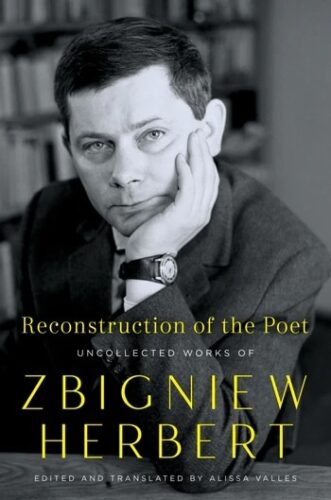 Both books are edited, and most of their text is translated, by Alissa Valles. Nearly two decades ago, much angry ink was spilled about whether Herbert’s poems should have been wrenched from the capable hands of translators John and Bogdana Carpenter. One critic claimed that multiple translators cluttered the field (abstaining, of course, from mentioning poet Czeslaw Milosz—Herbert translator, Nobel laureate, and fellow Polish poet). For English speakers, Valles’ more colloquial word choices are more propulsive: she uses “bulletproof doors,” the Carpenters “armor-plated”; Valles supplies “getaway carriage” rather than “carriage for escape.” But this is the rare case where the purchaser cannot go wrong; both the Carpenters and Valles have their small flaws and great successes. That English readers cannot buy a bad translation of Zbigniew Herbert’s work is cause for rejoicing.
There is comfort in arguing about which is best among good translations; it helps us avert our eyes from the enormities Herbert faced head-on in the poems. Parsing whether a word should be translated “necktie” or “bowtie” (and yes, it matters, and yes, I prefer bowtie) distances us from the fate of Herbert’s scrawny-necked biology teacher, “killed by history’s schoolyard bullies.”
What should artists do when their childhood models of civility are slaughtered or “vanish/in abysslike basements/great police compounds”? When even “defending counsel smiling gently /was an honorary member of the execution squad”? What to do when others “passively…wait for the enemy write servile speeches bury their gold”?
Virtue is despised the way a “whimpering old maid” wearing a “hideous Salvation Army hat” is: “No surprise/that she isn’t the true bride/of real men/generals/ power brokers/despots.” If people of principle fight back, the outcome is not in doubt: “for the informers executioners cowards—they will win.”
One tip from Herbert’s instruction manual: choose how you want to fail.
not much is left to him
really only
the choice of the attitude
in which he wishes to die
the choice of a gesture
the choice of a last word
Another command written in Herbert’s imperative mood: count your dead carefully. “Reject [] the sensible explanation/that it was long ago.” In “Mr. Cogito and the Need for Precision,” we watch
observers from the sidelines
give dubious figures
equipped with the disgraceful
little word—“approximately”
Count your dead, because “ignorance about those who are lost/undermines the reality of the world.”
And suffering? “Use suffering mildly/with moderation/like a prosthetic limb,” says Herbert. Play with it “as with a sick child/cajoling in the end/with silly tricks/a wan smile.”
Here’s more counsel, from the magisterial poem “The Envoy of Mr. Cogito”: “let your sister Scorn not leave you.” Make the imagination “an instrument of compassion.” “Be true to uncertain clarity.” “Be awake,” Herbert once carefully said — in English — to the Carpenters. And at least in one particular circumstance show courage: “when the mind deceives you be courageous.”
“As long as terror lives in man, we need to cry out,” insists the poet Homer in one of Herbert’s newly-translated works. The writings collected there are not exactly juvenilia—most are from his late twenties/early thirties—but they tend towards the wispy, romantic, or abstract. There are numerous off-target metaphors: superior lines, like “soldiers of a crooked oath,” are buried among weaker ones, such as “A poem flares on the breath—rose bouquet of winds.” Still, radio plays such as the titular “Reconstruction of the Poet” prefigure later efforts: Herbert is beginning to look, like Homer, “even upon the cruelty of war with the cold eye of the true epic poet.”
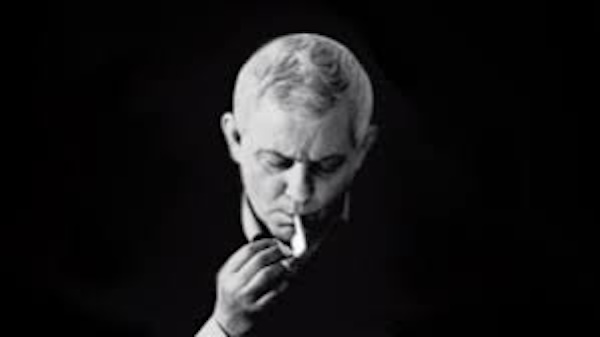
Polish poet Zbigniew Herbert — a crucially necessary model of “unheroic integrity.”
Some of postwar Polish poetry’s most difficult instructions grapple with the value of irony. The verse itself is awash in it; the temptation is towards an effortless drowning. “Enter Irony/patroness of the defeated,” says one of the newly-translated poems. “Irony, the weapon of the powerless,” echoes Coetzee in his preface. In a prose poem called “From Mythology,” Herbert imagines how “superstitious neurotics carried in their pockets little statues of salt, representing the god of irony. There was no greater god at that time.”
But irony solves nothing. And it can be corrosive, an acid more damaging to its container than its target. Under pressure, most artists will get irony wrong, whether their masters are human tyrants, or AI off the leash. Is there a way to get it right? “The ironist runs the risk of slipping into an insidious modus vivendi with the powers that be,” asserts Coetzee. Resisting the siren song of irony could require giving up and not giving up, simultaneously. Herbert’s warning: deploy irony for the sake of protection or as a (mostly ineffective) weapon. Never take comfort in it, revel in it, make it your whole identity. In Milosz’s words, remember that “irony is the glory of slaves.”
In his masterpieces, Herbert also provides some crucial don’ts. Perhaps the most important is: don’t forgive.
and do not forgive in truth it is not in your power
to forgive in the name of those betrayed at dawn
None of this is reassuring, and none of this is victory. But it is at least somewhat practical. Will a playbook that worked last century work now? When the grip of autocracy tightens, and artists are “pacing an insomniac room,” they should keep Herbert’s words in mind:
I breathe lightly I don’t know
how many minutes of air I still have left
Laura Sheahen is an American poet who spends part of her time in Tunisia. She has a master’s degree in Russian literature.
Tagged: "Reconstruction of the Poet: Uncollected Works of Zbigniew Herbert:, Polish poetry, eastern european poetry