Book Review: “A Remarkable Man” — Surviving the Unthinkable
By Robert Israel
Still, even with its flaws, this short book is an important contribution to literature by and about atomic bomb survivors because it underlines their indispensable value as witnesses.
A Remarkable Man: Dr. Shuntaro Hida: From Hiroshima to Fukushima, by Marc Petitjean. Translated by Adriana Hunter. Other Press, 174 pp., $25
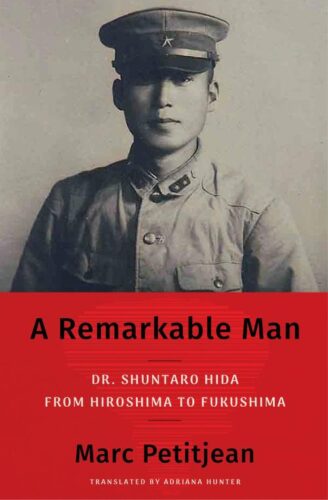
On August 6, 1945, when the atomic bomb exploded over Hiroshima, Dr. Shuntaro Hida (1917-2017) was a medical doctor on the ground. Within minutes of the explosion, hospitals and other buildings were destroyed; 140,000 men, women and children were killed instantly, among them an estimated 60 out of the city’s 298 doctors. Along with his fellow hibakusha (atomic bomb survivors), Hida drank poisoned water from radioactive cesspools as the city was reduced to ash. He somehow managed to survive and to minister to the injured.
In this book, French author/filmmaker Marc Petitjean proclaims that, because Dr. Hida pursued his lifelong mission of healing so selflessly, in extremis, he is to be lauded as “remarkable.” But during his lifetime, Hida himself never sought praise. While Petitjean should be commended for telling (in fawning prose) the story of Hida’s courage and resilience, his hero-worship has its failings, principally because it lacks valuable historical context. Eighty years have passed since 1945 — even readers with long memories need guideposts and clarity.
Take, for instance, an early statement, made by Hida, that the motivation for the Americans to drop the bombs was to “measure the…impact on structures and living things.” There is a general agreement that the use of atomic weapons was a cruel solution to hasten WWII’s end, but a deeper dive into history also shows that, while the U.S. military sought to gauge the bombs’ destructive power, counting the dead (or anticipating there might be survivors) was not an imperative. It had already been proved that the heat of the fireball would exceed 10,000 degrees Fahrenheit, reducing “structures and living things” to black radioactive dust.
In the book, Dr. Hida declares that hibakusha were “examined and studied like guinea pigs.” This statement is not factual. The U.S. Occupying Forces, entering Hiroshima and Nagasaki days after the blasts, made attempts to alleviate the human suffering they encountered. But they knew little about the full range of radioactive illnesses they would encounter. So, like Dr. Hida before them, they lacked sufficient medical supplies. While the survivors were indeed “examined and studied,” it was not in the demeaning way Dr. Hida implies.
Still, even with its flaws, Petitjean’s book is an important contribution to literature by and about the hibakusha because of their key role as witnesses to the unthinkable. Additionally — and this is not addressed in A Remarkable Man — their reactions should be given special consideration because they were initially censored by the U.S. Occupying Forces. It was part of an American effort to tamp down on any negative global criticism about the horror of radioactive diseases. (The official terms of surrender insisted that the Japanese be prohibited from publishing first person accounts, in retaliation for imperialist propaganda issued during wartime.) Years of imposed silence ended after Japan was granted self-rule in 1952. But the newly installed Japanese Diet, or Parliament, added further injury by refusing to allocate funding to help hibakusha access to costly medical treatments. (For an insightful analysis of this and other issues, readers are advised to turn to Nobel literature laureate Kenzaburō Ōe’s lucid and insightful essays in Hiroshima Notes.)
The narrative places us in Hiroshima, Tokyo, and Nagasaki, but it omits key details about the lifesaving efforts conducted by the staff of the Atomic Bomb Hospital (now Shima Hospital) in Hiroshima. I toured that facility during my first visit to Japan years ago as a visiting reporter for the Montreal Gazette. At the time, my translator pointed out that the hospital purposefully left damages to the building intact. For example, the cast-iron window casements the bomb’s extreme heat had turned into what looked like twists of licorice. Indeed, the entire city of Hiroshima has dedicated itself to this singular mission: orienting visitors to the then versus the now, beginning at the Atomic Bomb Museum located at the entrance to the Peace Park, steps from the Atomic Bomb Dome, which marks ground zero.
Admirably, A Remarkable Man underscores that we live in perilous times today, caught between two extremes. On the one hand, America blithely accepts its legacy as the initial instigator of the atomic age, seeing it as just one more element in our realpolitik arsenal. On the other hand, we are implored to emulate a kindly doctor who walked in that radioactive Valley of Death and dedicated his life to peace and healing. We can’t have it both ways. We must either embrace the current vision of maintaining multiple arsenals of atomic weapons (ready for deployment at the push of a button), or heed the urgent pleas of the hibakusha, who, like the late Dr. Hida, demand these weapons be eliminated so that “the sin shall not be repeated.” There is urgency to this plea: the survivors are now estimated to number less than 100,000 souls, most are in their 80s, and many are gravely ill. This book was written and published before the Nobel Prize committee awarded the 2024 Peace Prize to Nihon Hidankyo, the hibakusha lobbying organization. Petitjean could have included ways readers might connect to the hibakusha, and, if so motivated, add their voices to their valiant mission of global disarmament. Sadly, this information has been omitted.
Reading Petitjean’s book reminds us that we have little time to waste. The Doomsday Clock, which measures how close we are to global catastrophe, now stands at 89 seconds to midnight.
Robert Israel received the Hibakusha Travel Grant to report from Japan for the Montreal Gazette. A contributing Arts Fuse writer since 2013, he can be reached at [email protected].
Tagged: "A Remarkable Man: Dr. Shuntaro Hida: From Hiroshima to Fukushima", Dr. Shuntaro Hida, Hiroshima, Marc Petitjean, Nagasaki