
Film Review: “Pavements” — Theme and Variations on the Band Biopic
By Neil Giordano
Impish, absurd, and entertaining, Pavements tosses the musical biopic into a counterfactual blender.
Pavements screens at the Brattle Theatre, June 6 through 12
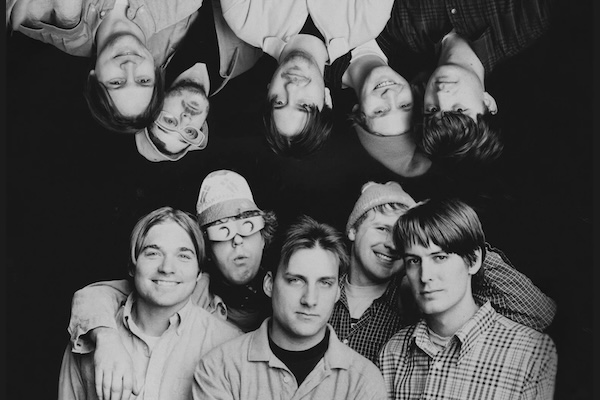
Pavement in its heyday (below); the cast of Range Life (above). Photo: Michael Wong and Daniel Stahl
If you were a music lover in the ’90s, you probably found your way to the indie rock band Pavement at one time or another. On the margins of the more popular grunge and alt-rock movements of the decade, that band occupied a distinctive spot that defied pigeonholing. If you were an early adopter of their slacker-ethos noise rock, you enjoyed the band’s live shows. They were about more than the music — they were the performance art of an anti-band. At times, the music morphed into screeches and band chatter. Pavement’s lyrics ranged from cryptic paeans to existential angst (“Zurich is stained/but it’s not my fault” “Is it a crisis or a boring change?”) blended with semi-intelligible word salad about robed girls mixing drinks with “plastic-tipped cigars” and then people dancing with them with “no castration fear.” Pavement often left you wondering: were they geniuses or just stoned? Even when the band grazed mainstream attention mid-decade with minor hits, such as “Cut Your Hair,” Pavement seemed not to be interested in fame or wider exposure. Everything they did was without any serious meaning. Pavement was telling inscrutable jokes — you might understand if you listened to them in the right way.
Pavements, directed by Alex Ross Perry, takes the form of an enigmatic punch line, as well. I’m pretty sure we’re not supposed to take the film all that seriously, and that might well be its point. Alternating between rock myth and reality, musical fact and fiction, the band’s story is distorted (on multiple levels) to the degree that we’re not even sure what’s true and what’s spoof. By the end, you are left trying to separate bits of reality from the tomfoolery. And this technique reflects the essence of Pavement — are they real or simply playing the part of a rock band?
The film starts out simply enough. We see the actual band, led by songwriter-guitarist Stephen Malkmus, first in late ’80s archival footage where, as young Gen Xers, they are playing their first concert. Then a fast-forward to the now middle-aged and grayed quintet, rehearsing for a reunion concert in 2022. But there is a catch: a title card introduces both episodes with “PAVEMENT: THE WORLD’S MOST IMPORTANT AND INFLUENTIAL BAND.” The irony of rock megalomania hits from the get-go.
Before we become too accustomed to the trappings of the then-and-now documentary approach, Pavements makes its first swerve elsewhere. We’re treated to a montage of musical-theater actors in an audition room, some singing fragments of Pavement lyrics and practicing dance moves. This turns out to be a casting call for Slanted! Enchanted!, a jukebox musical of Pavement songs named after their first album. The scene drew cackles in the screening I attended, because the incongruity is patently absurd: the earnest melodrama of musical theater is light years away from Pavement’s nonsense lyrics. Isn’t this a joke? Later in the film, rehearsal scenes include Broadway star Michael Esper (formerly of the hit jukebox musical American Idiot) and indie actress Zoe Lister-Jones. Is this musical for real? Then come snippets of the show’s debut in New York, a production that merited critical attention from The New Yorker and Rolling Stone. But it’s hard to tell — was everybody in on the jape? Who produced the musical? Alex Ross Perry.
The film’s fictional elements start to metastasize. Along with Slanted! Enchanted!, we see behind-the-scenes footage of another Perry-produced project: a biopic named Range Life (titled after one of the band’s fan-favorite songs). It is cast with real Hollywood actors. Joe Keery of Netflix’s Stranger Things (and also a musician in his own right) plays Malkmus. Is this film-within-the-film a faithful telling of the “real” Pavement story? Not by a long shot. In fact, it looks to be a spoof of the entire cinematic genre, especially the stereotypical “band rises to fame” story arc. Pavement never made the big time, and archival footage shows us that the band’s brushes with fame went nowhere. The fact is, the attempt to shoehorn them into a biopic format underlines the band’s true personality, its place in music history. This is a band unfit for Broadway and Hollywood.
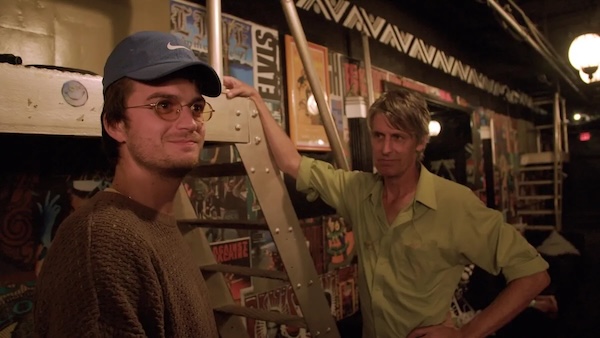
Joe Keery and Stephen Malkmus in Pavements.
Keery does yeoman’s work here, caricaturing himself along with the genre. He offers starry-eyed memories of Bohemian Rhapsody and dreams of winning an Oscar. He hires a vocal coach to sound like Malkmus, fashions his posture to resemble his, and reenact parts of the Pavement origin story. In a thoroughly ridiculous episode, Keery visits the site of the old Whitney Museum, where band members worked as security guards in the late ’80s. The performer asks clueless present-day employees if there’s a plaque marking this momentous factoid. The trials and tribulations of the band are played for laughs, as well. Jason Schwartzmann plays a record executive who practically begs them to go for mainstream acceptance without compromising their slacker instincts (“C’mon, guys. Go out there and give it a 100%…or, you know, 50%, or whatever”). Scenes from the band’s history are recreated via moldy melodramatic dialogue. Meanwhile, archival footage simultaneously shows us that none of this theatrical invention happened.
We never learn if Range Life was completed. Or was this just a conceit to be included in Pavements? Ultimately, it really doesn’t matter. The real question is whether it is worth trying to make sense of the film’s hall of mirrors. What are the rewards of trying to figure out metafiction piled on metafiction? Pavements obviously isn’t out to provide the conventional satisfactions of Bohemian Rhapsody or last year’s A Complete Unknown. But nonstop parody has its own drawbacks — what is the payoff once you get the joke? One sign of beating a dead one-liner: there’s a subplot about an art exhibit in New York featuring Pavement memorabilia. Much of this presented as tiresome winking humor (To wit: One glass-encased entry consists of the band’s original drummer’s toenail. It is “on loan from a private collection.”)
The meta-approach taken by Pavements reminded me of the work of documentary filmmaker Robert Greene, whose movies Kate Plays Christine (2016) and Procession (2021) use fictional elements to highlight nonfictional truths. And, lo and behold, Greene both edited this film and served as one of the producers — clearly Perry was absorbing more than a little of the Greene mojo.
But, in this case, Greene’s subtlety is cast aside for farce. The conundrum of Pavements (and of Pavement) might be expressed in a refrain from one of the band’s songs, which is repeated throughout the film: “And you’re the only one who laughs/At my jokes when they are so bad/And the jokes are always bad.” Are the jokes always bad? No, some of them are quite funny. For fans of Pavement, the movie will be a treat, a horselaugh of a confection. For nonfans, there’s enough here to make a viewing enjoyable, once they stop trying to make sense of it all.
Neil Giordano teaches film and creative writing in Newton, MA. His work as an editor, writer, and photographer has appeared in Harper’s, Newsday, Literal Mind, and other publications. Giordano previously was on the original editorial staff of DoubleTake magazine and taught at the Center for Documentary Studies at Duke University.