
Television Review: The Docuseries “Trial 4” — Boston Crime and Questionable Punishment
By David Daniel
Trial 4, along with other currently streaming crime docuseries, examines the systemic biases, misuse of official force, and internal corruption that impede and subvert justice, undermine convictions, undercut integrity, and erode public trust.
Trial 4, directed by Rémy Burkel and executive produced by Jean-Xavier de Lestrade. Streaming on Netflix.
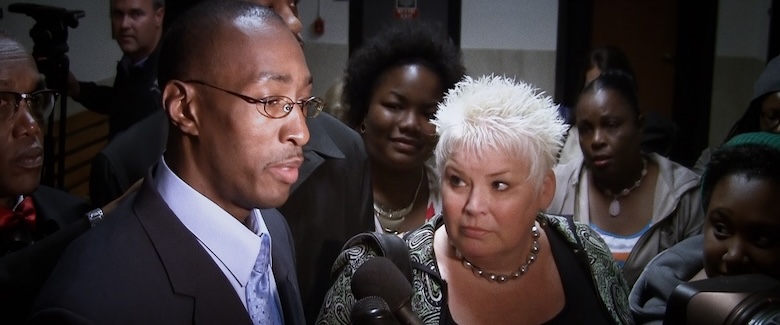
A scene from Netflix’s Trial 4.
On a September night in 1993, in the lonely predawn hours, veteran Boston Police detective John Mulligan, on a paid security detail outside a 24-hour Walgreen’s, naps in his private vehicle. He never wakes up. Responding officers find him dead, shot “gangland style,” as the BPD Commissioner puts it. One theory is that Mulligan, a known “problem” officer whose aggressive tactics generated complaints, was targeted as payback. A 65-member task force is assigned to investigate.
In a matter of weeks, two young suspects are separately arrested and charged. One of them, Sean Ellis, 19, volunteers that he went to the pharmacy the night of Det. Mulligan’s killing to buy Pampers for his cousin. He denies any knowledge of the crime; no physical evidence ties him to it. What established a link is that a witness claims she observed a young Black male in the parking lot near Mulligan’s vehicle. After several tries, she picks Ellis out of a photo array. Later, the murder weapon and Mulligan’s service weapon are recovered in a field near where Ellis lives.
The case raises considerable questions, including suggestions of possible investigative misconduct and witness influencing, so a pair of top criminal defense attorneys agree to represent Ellis. At trial, sufficient reasonable doubt is raised — a jury cannot reach a verdict. An immediate second trial ends similarly.
In ordinary circumstances, after two mistrials, the case against Ellis might have been dropped. But this is a cop killing, and the Commonwealth is determined to get a conviction. There’s a third trial: Ellis is found guilty and sentenced to life without parole.
The docuseries Trial 4 takes a long, deep dive into the case. Meticulously researched, expertly constructed, the narrative runs to nearly eight hours. But the probe is so compelling that it feels much shorter. Glimpsed in somber period video at the time of his 1995 arrest and arraignment, Sean Ellis is a skinny, handcuffed, stunned-seeming kid. There is the possibility that, yes, he might well be guilty. The Ellis we see in most of the series is a grown man in his 30s and 40s, quiet and unprepossessing. At times he finds it difficult to express strong emotions; he speaks slowly, with a stutter he’s had since childhood. (His street name was “Studda.”) With simple eloquence, Ellis talks about the fear and discouragement that inevitably accrue with long incarceration.
The killing of a law enforcement officer is always troubling, a visceral assault on the social order. Men and women who wear a badge and a gun have sworn an oath to serve and protect us. They are our primal line of defense. A death demands answers; punishment is expected to be meted out. But, in this case, serious doubts linger. Ellis had no prior record of criminal conviction and no connection to Officer Mulligan. In terms of the incriminating testimony, just a single witness who may have been influenced by detectives. And, naggingly, there’s the enigma of motive and method. This is a killing that suggests an execution (five gunshots to the face in a cruciform pattern). Does it make sense that a teenager with no organized crime involvement — and the DA’s thin explanation that Mulligan’s gun was “a trophy” — would be a top suspect? Mulligan’s aggressive “cowboy” tactics, often against drug offenders (suspected or imagined) often led to lawsuits being filed against him. As one fellow officer put it, “if there were a hit list of Boston cops, John Mulligan would be the top.” A Boston Globe reporter wondered, had his past caught up to him?
Two years prior to the murder, the Globe had run a four-part investigative series on the BPD. Titled “Bungling the Basics,” it enumerated what reporters found to be “serious deficiencies” with the department’s ability to solve crimes.
Fast forward to 2015, by which time Ellis had served two decades of incarceration. An unrelated inquiry by federal investigators exposed a scheme by three veteran BPD detectives to rob drug dealers and steal narcotics and cash for personal gain. All three pleaded guilty to federal corruption charges. Two were sentenced to prison terms and the third was granted immunity in exchange for his testimony. It so happens that the same trio played outsized roles in the original investigation and arrest of Ellis. Partly on the basis of this revelation — though after lengthy delays — Ellis won an appeal to have a “last-try” fourth trial.
In 2004, already having served 10 years, Sean Ellis heard from an attorney willing to consider taking his case. Enter Rosemary Scapicchio. She grew up in a large, working-class family in working-class Brighton and attended Suffolk Law. Scapicchio is a busy and vigorous defender of people she believes the system has handed a raw deal. Despite her aggressive interest, it was many months before she could get to Ellis’s case and then years more before he could be granted a new trial — number four.
Will the full story of Mulligan’s killing ever be known? There is no reason to doubt that the bulk of the officers assigned to the case worked it honestly and hard, but a corrupt few may well have put a thumb on the scales of justice. If so, that raises unquiet questions about the BPD and the Suffolk County DA’s office during those years. The verdict rendered in the fourth trial is withheld for much of the series — I only vaguely recalled the case and didn’t remember the outcome — but this tension — its threat and poignancy — drives what turns out to be a very thought-provoking ride.
The docuseries encourages modern documentaries to supply the storytelling complexity of a novel. Trial 4 is a multilayered narrative that skims, with ease, backward or forward in time. Director Remy Burkel has structured the yarn in chapters with cliff-hanger endings; he also makes use of creative graphics and illustrations. Trial 4 was begun before key outcomes in the case were determined and filmed over an extended span of time. Thus it was able to access many of the major players, draw on an impressive array of documents and records, and make use of opportunities to exploit real-time dramatic tension. Incidentally (or not), as a backdrop Boston has never photographed better –in every season the city sparkles and looks like a place where people live interesting and important lives.
A recent article in The Guardian notes that the market for documentaries “has seen buyer interest and dollars shrink, particularly for politically sensitive or social impact films.” Backing away from sensitive content is explicable (if not admirable) in this time of corporate cowardice and capitulation under pressures from the Trump administration. Still, true crime seems to be an exception to the rule. Filmmakers, equipped with a raft of technical and craft advances, and making effective use of the extended docuseries format, are making powerful stories that are welcome in the marketplace. At their best, these documentaries serve as an ally of the traditional Fourth Estate news media because they raise uneasy questions about the underside of authority. Along with Trial 4, currently streaming crime docuseries, such as Gone Girls (about the Gilgo Beach murders), The Innocence Files (both on Netflix), and Murder in Boston (HBO), examine the systemic biases, misuse of force, and internal corruption that impede and subvert justice, undermine conviction, undercut integrity, and erode public trust.
David Daniel has been an Arts Fuse contributor since 2020. His essays also appear in the Ideas section of the Boston Globe.
Tagged: "Trial 4", John Mulligan, Remy Burkel, Rosemary Scapicchio
Very well presented. Every quote was awesome and thanks for sharing the content. Keep sharing and keep motivating others.
Wow! This raises some great questions. I find it difficult to believe Ellis shot the officer. And what about the Double Jeopardy Clause in the Fifth Amendment? How did the DA get around that?
I wasn’t familiar with the case (living in Wisconsin at the time), but after reading this great review, I will have to resubcribe to Netflix!! Thanks, Dave!
Dave Daniel writes a review here that makes me want to see several programs that I usually wouldn’t consider and gives a memorable feeling for Boston that makes me feel like an insider.