Film Review: “Thunderbolts*” — A Great Time at the Movies
By Michael Marano
It’s pretty interesting that we live in a moment in which our comic-book obsessed culture is creating a number of antagonists based on the premise of, “Hey, what if Superman were emotionally stunted and really evil?”
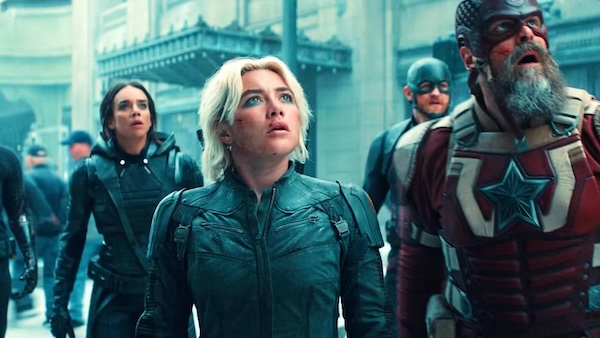
A scene from Thunderbolts*
Thunderbolts* (yes, the asterisk is part of the title) is the best Marvel superhero movie to come down the pike in years.
Is that saying much?
Yes, it is. Once we put that in perspective.
Because the fact that Thunderbolts* says something, anything, beyond smashy-crashy-bashy horseshit feels miraculous at this point.
Is Thunderbolts* a character-driven story of self-discovery on par with Wild Strawberries? No, but the fact that it’s character-driven at all, and not entirely franchise-driven, and doesn’t just exist as a hook for the next Marvel movie to hang off of, makes it stand out. There are actual… y’know… arcs in this movie. And, when you compare that to the previous Marvel entry Captain America: Brave New World and all the potential and promised character arcs that had been set up in that movie but weren’t completed, this is a huge achievement. The last few Marvel movies looked like they had been shot through fishtanks full of second-hand fryer grease. Sorry, but when you have a giant Red Hulk fighting a Red-White-and-Blue bedecked Captain America amid Washington’s cherry blossoms and it has the visual punch and sense of scope of a Ziggy “Get Well” greeting card seen through a clot of conjunctivitis, y’all fucked up.
Thunderbolts* looks like an actual movie. Are we talking Barry Lyndon-level cinematic artistry? No. But there’s textures and shadows and composition, including a very complex action sequence done in a few long takes with John Wick-level mayhem that could have been shot in a show-off-y way. But, because the emotional core of that scene is ennui, director Jake Schreier finds a pretty brilliant way to make the sequence remote and detached, but still cool and interesting.
Hey… at least Thunderbolts* is trying, and that counts for something.
That ennui seems to indicate an awareness of franchise fatigue within the Marvel Cinematic Universe itself. This is the 36th (!) entry in the film series, and damn if I have even a glimmer of how the myriad TV shows on Disney+ fit into any of this. Florence Pugh, who goes all Tom Cruise and does a pretty goddam incredible Mission: Impossible-level stunt herself at the start of the movie, plays Black Widow assassin Yelena Belova (sister of the deceased Black Widow, Natasha Romanoff, played by Scarlett Johansson), who’s in a rut. She’s sick of being a ruthlessly efficient killing machine, doing dirty work and dirty deeds for evil corporations and politicians, and wants a more “public facing” job. Wackiness ensues when she crosses paths with a motley group of second-string anti-heroes and “also rans,” which on one level leads to a great Reservoir Dogs/City on Fire standoff, but which also unfortunately strands the movie in a fairly uninteresting dungeon/bunker/complex/lab/lair for a bit more runtime than it should. Each and every character in this movie needs a change, and the fact that they get them, even if it’s not the ones they wanted, furnishes the movie with the above-mentioned arcs.
Franchise fatigue and a need for change might not be the only conflation between the characters in Thunderbolts* and the MCU itself. In a matter of weeks, the MCU will be old enough to date Leonardo DiCaprio. I know a lot of younger people for whom the MCU is all they know about cinema. For good or ill, it’s the cornerstone of what they understand movies (and storytelling itself) to be.
There’s a very young character in Thunderbolts* whose entire world has been defined by the superheroes who have been in her awareness since she’s been a child (it’s explicitly stated she was in high school in 2012, when the events of the first Avengers movie took place). This character… has an arc. She has to grow up and face the fact that there are moral ambiguities that neutralize the simplistic Good Guy/Bad Guy dichotomies that have defined most of the MCU. Through her growing up and facing grey-area ambiguities, Thunderbolts* is kind of hinting that the MCU will be doing the same. One of the characters in Thunderbolts* describes its group of protagonists as “scrappy anti-heroes,” which is not something that the anti-heroes of ’70s auteur cinema would say about themselves. But it’s a start. Sure, Loki and the Hulk and a few other characters in the MCU could be “anti-heroes.” But there’s a new, pleasantly unpolished kind of grit to the anti-hero vibes here that’s greatly appreciated.
The threat that the Thunderbolts must face as a team is a melding of corporate, political, and media power, intended to subvert a Congressional impeachment procedure, founded on the messianic advent of a powerful, needy, drug-addicted man-baby with stupidly dyed and styled hair who weaponizes the darkest aspects of the American psyche. Am I saying the threat in Thunderbolts* is a metaphor for Trumpism? Nope! Not directly.
But it’s pretty interesting that we live in a moment in which our comic-book obsessed culture is creating a number of antagonists based on the premise of, “Hey, what if Superman were emotionally stunted and really evil?” We have the Homelander in the show The Boys, and Omniman in the animated series Invincible. And in Guardians of the Galaxy Vol. 3 we had a version of the god-like Adam Warlock who was just a whiney Mama’s boy. We live in a world in which guys such as Trump and Musk and Zuckerberg and billionaires with power that Roman emperors would envy reveal themselves to be simpering dodgeball victims at heart, which they have to overcompensate for by becoming bullying psychopaths.
A number of the “scrappy anti-heroes” in Thunderbolts* are washed-up and past their prime. And then they find a new sense of purpose by actually giving a damn about people and themselves. If Thunderbolts* is, indeed, sort of about the “washed up and past its prime” MCU addressing its own weariness, heeding the call to grow up and leave behind simplistic dichotomies, then I’m all for where the next phase of the MCU will go.
Even if it’s not, Thunderbolts* is still a blast, and a great time at the movies.
Author and critic Michael Marano (www.BluePencilMike.com) sees the creeping influence of the MCU in his other profession as a personal trainer. He encounters guys who have worked out to look like Chris Evans as Captain America… and who are in terrible shape, because none of their exercise regimen is devoted to cardio. The guys look great. But they’re weak as kittens.