
Film Reviews: Five Fine Movies at This Year’s Independent Film Festival Boston
By Tim Jackson
An independent film festival presents works that expose audiences to diverse voices, to alternative political and social points of view, and to different ways of understanding the world.

A scene from Linda.
Jury Winner: Linda (Argentina)
The eponymous maid (played by Eugenia “China” Suárez) in Linda, Mariana Wainstein’s first feature, takes a job as a domestic worker for a wealthy Argentine family while her cousin is recovering from an accident. Slowly, each member of the family — the adolescent son and daughter, the mother, and the father — is upended by Linda’s beauty, each responding in a distinctly shocking and laughable way. An elegant home, stocked with fine wines that the family members are obsessed with, serves as the location for a pointed commentary on class, power, and the disconcerting nature of the male gaze. Director Wainstein pays close attention to the subtleties of behavior: a sniff of perfume, a touch of a hand, a suggestive conversation. And she trusts the audience to pick up on clues and make their own judgments. Linda’s undefined intentions (and meager backstory) draw us deeper into the mystery of her motives and as well as the family’s peccadillos. The well-off are not portrayed as oppressors, but as privileged bourgeoisie frustrated by repressed sexual desire. They allow Linda to wear street clothes rather than a maid’s uniform and, for a time, patient with her unwillingness to conform to the standard restrictions of her role. Linda, about whom we know little until the very end, dutifully goes about her chores, ignoring the family’s erotic overtures with cold indifference – until she doesn’t.
Runner-Up Jury Winner: Moloka’i Bound
An independent film festival presents works that expose audiences to diverse voices, to alternative political and social points of view, and to different ways of understanding the world. Moloka’i Bound exemplifies that ideal. Directed, written, and produced by Alika Maikau, the feature revolves around a father, Kainoa De Silva, who was recently incarcerated after having decided to deal drugs to support his family. The story is familiar, but Maikau’s patient narrative interweaves social issues with family dynamics. The director’s mother was raised in Moloka’i, where some of his family still reside. The film blends English and Pidgin, and underplayed performances are supplied by the all-Hawaiian cast, led by Holden Mandrial-Santosas as Kainoa. Maikau’s alluring film immerses us in the land, the language, the food, and the details of Hawaiian life hidden away from tourists.
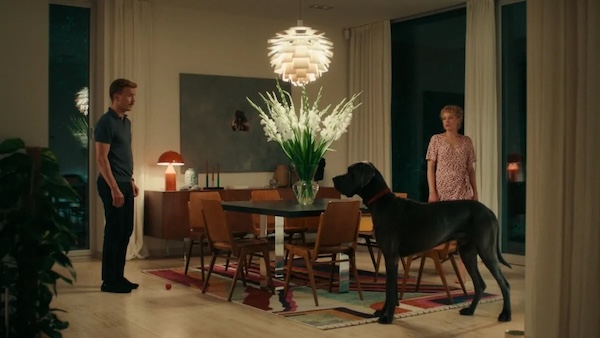
A scene from Peacock. Photo: Geyrhalter Film/CALA Film/Albin Wildner
Audience Choice Best Narrative Film: Peacock (Austrian-German)
Albrecht Schuch, who played a supporting role in the 2022 German version of All Quiet on the Western Front, takes on quite a different character in Bernhard Wenger’s debut feature, Peacock. Matthias is a man whose gift is his austere agreeableness. He makes a fine living by working for a rent-a-friend firm owned by an acquaintance. The agency sends him to serve as a companion for lonely people who can afford to pay for an artificial relationship. The job draws on Matthias’s passive disposition; his wife, frustrated by his lack of emotion, finally decides to leave him.
In terms of plot, Matthias suggests to an elderly client that she could stand up to her domineering husband if she learned to argue more fervently. In contrast to his usual laid back personality, he acts with the passion of a do-gooder. The results turn out to be disastrous. The film’s dry, dark humor skewers self-improvement programs, social manners, and what sociologist Erving Goffman called the theatrical “Presentation of Self.” Wenger’s ethically challenged characters, enduring sleek, antiseptic lives, are reminiscent of the people who populate the films of Swedish director Ruben Östlund, who takes on bourgeois respectability in films such as Force Majeure and The Square.

A scene from The Kingdom.
The Kingdom
This stunning first film by director Julien Colonna turns the gangster genre inside out. In Corsica in 1995, a young girl named Lesia is suddenly moved from her aunt’s care to a villa on a lake, inhabited by a group of men who we discover are members of the Corsican Mafia. We find out that she is the daughter of their notorious leader, Pierre-Paul. As the film develops, we piece together clues about the mob’s activities as her relationship with her father deepens. Gang war looms and, despite bursts of violence, the film becomes a love story between a father and daughter. The Kingdom’s publicity does not mention that the director is the son of Jean Jérôme Colonna, who was described in the New York Times as Corsica’s last remaining “godfather.” Colonna died in a flaming car crash in 2006. This autobiographical background explains the story’s compelling focus on the parent-child relationship. The excellent cast of non-professionals infuses life without artifice. Novice actress Ghjuvanna Benedetti, a dead ringer for the figure in Delacroix’s painting “Orphan Girl at the Cemetery”, makes Lesia a soulful figure.
Audience Choice Best Documentary Film: Rebel with a Clause
Grammar guru Ellen Jovin begins her film by diagramming a sentence, leading one to worry this will be a back-to-school exercise in learning the fine points of grammar. But after she sets up her “Grammar Table’ and engages curious bystanders, it thankfully evolves into a different experience. The documentary follows Jovin’s travels through all 50 states, where she enthusiastically answers questions posed by the grammar-curious, talking to a variety of spirited Americans genuinely interested in the rules of grammar.
Accompanied, filmed, and edited by Jovin’s tall, grinning husband, Brandt Johnson, Rebel with a Clause is a fast-paced trip across the nation. Couples argue about the Oxford comma while others accept answers to their lifelong problems with language and punctuation as we watch, learn, and laugh. The film is non-political, though it is amusing when a scruffy-looking man wearing a MAGA hat wanders up to Jovin’s table in New York City and asks, “What’s an adjective?” Alert and charming as usual, Jovin supplies a clear and sobering answer, and the man shuffles off. “It was the most moving experience of our journey” Jovin and Johnson said during the film’s post-screening discussion at the IFFBoston. There have been offers, but for now the movie is self-distributed; it is available for private group screenings. (There are hints that it may become a series.) With 400 hours of footage in the can, there’s plenty of material.
Tim Jackson was an assistant professor of Digital Film and Video for 20 years. His music career in Boston began in the 1970s and includes some 20 groups, recordings, national and international tours, and contributions to film soundtracks. He studied theater and English as an undergraduate, and has also worked helter-skelter as an actor and member of SAG and AFTRA since the 1980s. He has directed three feature documentaries: Chaos and Order: Making American Theater about the American Repertory Theater; Radical Jesters, which profiles the practices of 11 interventionist artists and agit-prop performance groups; When Things Go Wrong: The Robin Lane Story. And two short films: Joan Walsh Anglund: Life in Story and Poem and The American Gurner. He is a member of the Boston Society of Film Critics. You can read more of his work on his blog
Tagged: "Peacock", "Rebel with a Clause", "The Kingdom", Alika Maikau, Bernhard Wenger, IFFBoston, Julien Colonna, Linda