
Television Review: “Étoile” Puts a Promising Dramatic Spotlight on Ballet
By Robert Steven Mack
All of the gritty challenges for today’s ballet companies are touched on in Étoile, including financial troubles, union strikes, rapaciously controlling donors, jealous, egomaniacal dancers, and more bumps in the road.
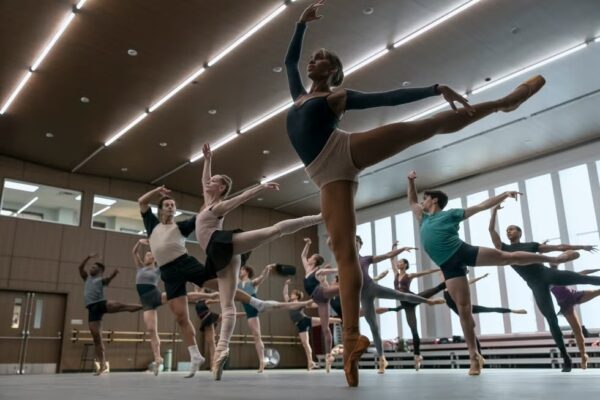
A scene from Étoile. Photo: Philippe Antonello
Ballet dancers have been waiting a long time to receive their due in film and television. Even the better movies about ballet, such as Black Swan, have drawn on a tawdry showbiz stereotype: a dance troupe is envisioned as a collection of sex-crazed, drug-addicted psychotics. With Étoile (streaming on Amazon Prime), Amy Sherman-Palladino, the writer-director best known for creating the series Gilmore Girls, has come up with a new comedy-drama series that attempts to reset the sensationalized playbook.
Set in the spacious studios and plush stage spaces of the Lincoln Center in New York City, Étoile follows the personal and professional misadventures of the director of New York’s Metropolitan Ballet Company, Jack Macmillan (Luke Kirby), and the interim director of Le Ballet National in Paris, Geneviève Lavigne (Charlotte Gainsburg). Their respective companies are struggling to find a footing in perilous cultural times — their troubles include the pandemic, an economic downturn, and growing evidence that young audiences couldn’t care less about the fine arts. The two high-strung directors concoct an attention-getting swap between the companies: the switch-up includes sending the tempestuous Étoile Cheyenne Toussant (Lou de Laâge) to New York and gifting anti-social oddball choreographic genius Tobias Bell (Gideon Glick) to Paris.
All of the gritty challenges for today’s ballet companies are touched on in Étoile, including financial troubles, union strikes, rapaciously controlling donors, jealous, egomaniacal dancers, and more bumps in the road. In that context, the plot’s transnational swap comes off as a pretty plausible idea (at least if ballet is the cultural touchstone it seems to be in Sherman-Palladino’s alternate universe). To her credit, the writer-director uses her big budget to get the dance world “right,” though the outlandish antics of Cheyenne and Tobias stretch credibility. For example, Tobias stops a performance of his own ballet on stage on opening night — and re-choreographs it in front of the audience!
Most welcome are the numerous cameos from contemporary stars in the ballet world, especially the appearances of New York City Ballet principal dancer Tiler Peck, who plays a performer who, because she suffered a moment of stage paralysis, has a therapist following her around whispering words of encouragement. Other delightful scenes give Étoile Cheyenne an opportunity to take her acidic temper out on some of the darling boys of the real-life ballet world. She turns down potential partner and former New York City Ballet star Robbie Fairchild by telling his character, Larry, a macabre story of a murderer in her mother’s village who cut off a man’s testicles and then hung them up for public exhibition. Cheyenne also torments celebrated real-life choreographer Christopher Wheeldon OBE, to the point that the only way he can cope is to turn to therapy, Buddhism, and Nietzsche.
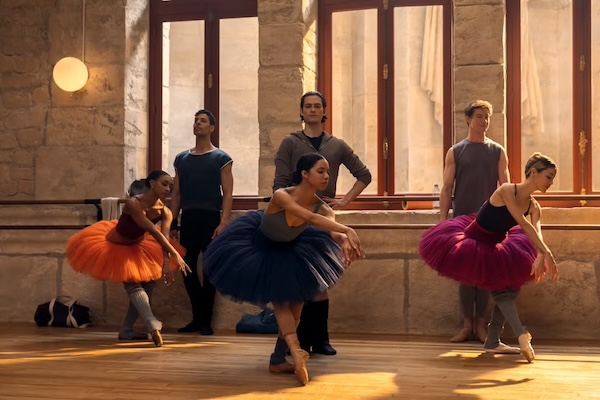
Taïs Vinolo as Mishi (center) in Étoile. Photo: Philippe Antonello
Other stars, including Unity Phelan, Joy Womack, and Irina Dvorovenko are also infused into the mix, not simply as one-off cameos but as recurring characters. This strategy gives Étoile an immersive quality, suggesting that its fiction mirrors the authentic world of ballet. Balletomanes will also spot real-life dances by Wheeldon, George Balanchine, and Marius Petipa. The only other film to come close to this level of accuracy is Robert Altman’s 2003 docudrama The Company, which featured the real-life Joffrey Ballet of Chicago. That movie, however, served up a hyper-realistic series of strung-together vignettes. Sherman-Palladino has constructed a fast-paced narrative that jumps back and forth between the chic dance worlds of New York and Paris.
The Company did one thing better, however. It looked at choreography cinematically. Altman photographed, magnificently, ballets by the likes of Gerald Arpino. These long and colorful sequences — whether the footage was shot on a stage or even in dusty rehearsal halls — were impressive artistic showpieces, touching to watch even if they didn’t serve the already sparse plot. Étoile contains world-class dancing, but the quick-moving narrative doesn’t always give the dance sequences time to breathe, chances to astound on their own. You could see this as an example of meta-irony — the dance sequences were shot for streaming culture. Bell’s ballets would have to be pretty remarkable for Geneviève to tolerate his childish behavior. But the final episode’s showpiece performance is reminiscent of the kitschy ballet at the end of the 2000 cult film Center Stage. It treats ballet as popular entertainment, not as an art form. Étoile has a way to go in representing the beauty and power of ballet to a mass audience. As one of the show’s characters advises, one has to educate an audience first.

A scene from Étoile. Photo: Philippe Antonello
Also, while several of the actors in the show are played by real-life dancers, many of the major players, including Cheyenne and the brash French male dancer Gilan (Ivan du Pontavice), have been given dance doubles. Kirby, Gainsbourg, and de Laâge, in particular, supply the show’s dramatic backbone; the casting of non-dancers to play Cheyenne and Gilan dilutes the series’s credibility, especially because there are so many capable actor-dancers. Robbie Fairchild, for instance, given his celebrated career on Broadway, could have easily handled a bigger part than the quickly emasculated Larry.
Still, the performances of the ensemble cast, along with the rapid-fire dialogue that fans of Gilmore Girls and The Marvelous Mrs. Maisel will recognize, easily carry the narrative along. As a professional dancer, it’s gratifying to see the ballet world depicted as what it is: a quicksilver, high-strung work environment. (Though the fanciful New York settings will be remote to most dancers working in small to moderate-sized companies.) The barb-tossing between the protagonists initially rushes the pacing. After the first few segments, the actors settle into their roles, de Laâge gradually trading in her high-strung sniping for a more natural delivery. Still, Sherman-Palladino would be wise to allow more time for the characters to communicate through incisive dialogue rather than rely so heavily on pop culture insults. There is no need for Étoile to curry favor with superficial relevance; it has enough grounding in the real world to entice viewers who know nothing of ballet.
At this point, Étoile displays considerable promise. In the future, the series needs to work to deepen the character arcs of its crowded stock of characters. To its credit, Étoile is not just about the ballet world — it is about contemporary cultural transformation and tension. It’s about the preferences of aging donors pitted against the appetites of younger audiences who encounter ballet via ten-second Tik Tok clips. It’s about attaining economic stability without artistic compromise. And it’s about respecting the integrity of artistic creation while also serving the humanity of all involved. By the end of season one, none of these issues have been fully developed. But there is every reason to hope that Sherman-Palladino knows what she needs to do if there is a second (season) act.
Robert Steven Mack is a company artist with City Ballet of San Diego and previously danced with Indianapolis Ballet. He is also a filmmaker and has an MPA from Indiana University, Bloomington. Robert has written for The New Criterion, Law and Liberty and American Purpose.
Tagged: "Étoile", Amy Sherman-Palladino, Charlotte Gainsburg, Gideon Glick, Ivan du Pontavice, Lou de Laâge, ballet
1 Comment
Leave a Comment

I’m loving it. Despite Bezos, I re-upped Prime Video just to see it.