
Arts Commentary: From the Editor’s Desk — By Popular Demand, 2025
Back in February of 2024 I began to write a weekly column for the newsletter on Substack. A few readers have asked that I post these opinion pieces in the magazine.
Here is a selection of last’s year’s standouts: Favorite Columns of 2024
Below is a selection of my top picks of 2025.
—Bill Marx, Editor-in-Chief
December 17, 2025
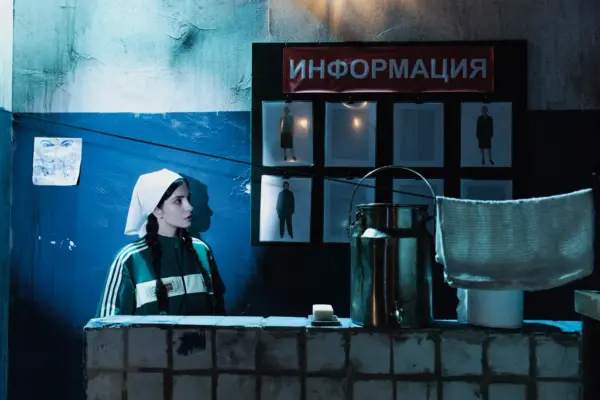
Nadya Tolokonnikova, POLICE STATE, 2025. Performance documentation from The Geffen Contemporary at MOCA. Photo: Yulia Shur. Courtesy of the Museum of Contemporary Art (MOCA).
On December 15, the Ministry of Justice, sitting in Moscow’s Tverskoy Court, officially classified the art collective Pussy Riot as an extremist organization. This verdict follows a string of individual charges filed against members of the feminist group. Founder Nadya Tolokonnikova was added to the wanted list and arrested in absentia in November 2023. Peter Verzilov was sentenced in absentia in April 2024. Five members — including Maria Alyokhina, Taso Pletner, Olga Borisova, Diana Burkot, and Alina Petrova — were handed down sentences in absentia in September 2025.
Conceptual performance artist and activist Tolokonnikova created the art installation Putin’s Ashes in January 2023, which triggered a criminal case against her, landing her on Russia’s most wanted list. Her latest piece is POLICE STATE, a durational performance installation that premiered at the Geffen Contemporary at MOCA in Los Angeles, from June 5–14. It later moved to the MCA (Chicago) where the run ended on November 30. As of now, I can’t find any confirmed future exhibitions or tour dates for POLICE STATE.
It would be wonderful if a Boston institution stepped in to bring the work here. I am not holding my breath.
A book documenting the installation features photographs, prison letters, etchings, and artwork by fellow Russian political prisoners, along with documentation of the “ICE” and “No Kings Day” protests held outside the museum during Tolokonnikova’s exhibit, all woven into a narrative of resistance. The artist says that POLICE STATE explores the “paradox of confinement and liberation; it both confronts the brutality of control and insists on the possibility of catharsis and connection.” You can order the volume here.
December 10, 2025
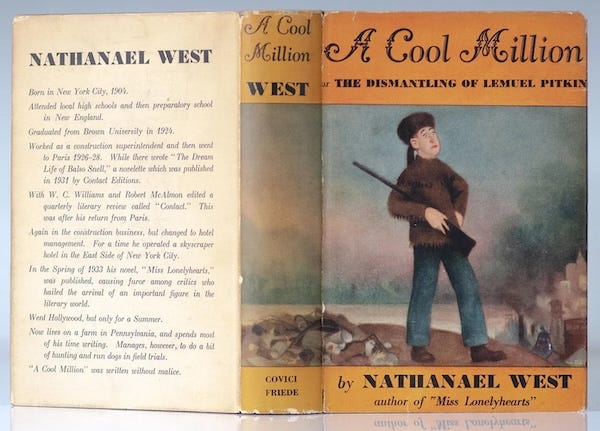
I have been looking around for American novels from the 1930s that address the rise of authoritarianism or fascist leanings in the homeland during the Great Depression. The favorite among commentators is Sinclair Lewis’s 1935 novel It Can’t Happen Here, which of late has inspired several stage adaptations and readings. This solid, earnest narrative, which chronicles the rise of demagogues from the top down, lacks Lewis’s customary caustic tang.
A more provocative, visceral work of political satire, which views the polarizing attractions of White Christian nationalism from the point of view of the underclass, has been neglected: Nathaniel West’s A Cool Million. Published in 1934, the novel is rated far below his masterpiece, 1933’s Miss Lonelyhearts, and is deemed inferior to 1939’s The Day of the Locust, still one of the best fictional assaults on Hollywood. I don’t disagree with that assessment, but A Cool Million’s brutal comic vision of American violence and hatred run amok, cartoonish as it is, conveys a rage at dehumanization that speaks to the viciousness of what we are experiencing today.
The episodic storyline follows the dismantling of its protagonist, Lemuel Pitkin. This sad sack of an optimist from Vermont is methodically dismembered during a series of swindles that are symptomatic of the virulent forces — economic and xenophobic — polarizing a country through which armies of the homeless and unemployed roam. Over the course of the book, Pitkin loses his teeth, an eye, a thumb, his scalp, and finally a leg, his condition ultimately landing him a job as the butt of jokes in a vaudeville act, where he is eventually assassinated — a martyr to the autocratic cause espoused by his would-be despot guru, Nathan “Shagpoke” Whipple, ex-president of the United States, head of the Rat River National Bank, and leader of the National Revolutionary Party, which warns its followers that “your sweethearts and wives will become the common property of foreigners to maul and mouth at their leisure. Your shops will be torn from you and you will be driven from your farms.”
In 1993, dramatist James Lapine adapted West’s book for the stage, titling it Luck, Pluck & Virtue. A 2024 theater version of A Cool Million premiered at London’s Brockley Jack Studio Theatre. Enterprising stage companies — take note.
Note: Critic Leslie Fiedler in his 1963 collection No! In Thunder: “West’s bleakest novel is his funnest, A Cool Million, whose title comes from the “Old Saying”: “John D. Rockefeller would give a cool million to have a stomach like yours.”
December 3, 2025
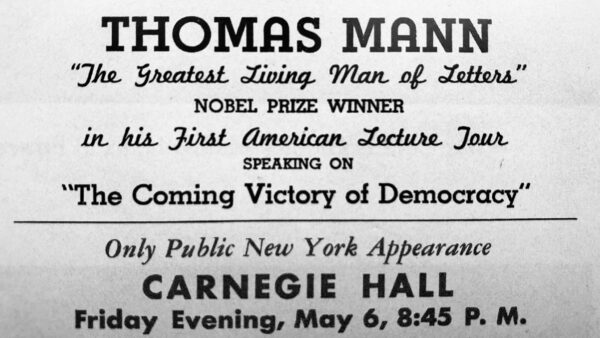
On Dec 1, Brandeis University’s Center for German and European Studies presented a conversation on Thomas Mann’s Antifascist Radio Addresses, 1940–1945 by the editors of the recently published book. You can listen to it here. The excoriating addresses that Thomas Mann broadcast to Germany are fascinating. (Hitler even listened and responded.) What was particularly interesting to me was how prescient the writer was early on, before the world knew just where fascism was headed. In the early 1930s, after he had fled Germany, Mann gave a series of talks in America denouncing the Nazis and the bloody authoritarianism to come. In a 1934 Time Magazine article, Mann said, “As a German, I can understand what has happened and why it has happened. As a human being I cannot justify it. . . . The German people may have learned what it means to be hated; that should only have taught them that vicious hate has no place in the civilized world. … If to be more German means to be less human, I can make only one choice.”
Which of our major artists and writers are touring the country, warning about the ongoing threat that MAGA and the Trump administration pose to democracy? Isn’t there only one choice to make, ‘if to be more American means to be less human’?
November 26, 2025
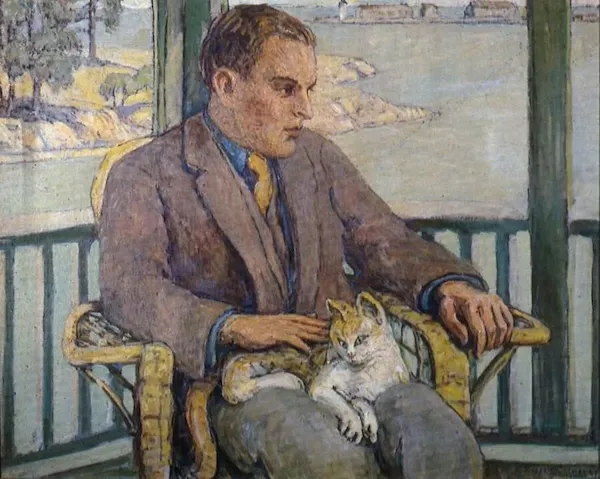
F. O. Matthiessen with Pansy Littlefield, painted by Russell Cheney, 1926. Photo: russellcheney.com.
This year marks the 70th anniversary of poet and fiction writer May Sarton’s novel excoriating red-baiting and cowardice at Harvard University, Faithful Are the Wounds, which was a finalist for the National Book Award. Mainly set in and around Harvard, Sarton drew inspiration from the suicide of celebrated American literary critic and scholar F. O. Matthiessen—a Socialist, Christian, and closeted homosexual—who died at the age of 48. In his suicide note, Matthiessen wrote, “I am depressed over world conditions. I am a Christian and a Socialist. I am against any order which interferes with that objective.” He had been a target of McCarthyist surveillance of left-wing university academics, accused of being part of so-called “Communist front groups.”
Sarton ignores Matthiessen’s homosexuality, portraying her narrative’s protagonist, Harvard literature professor Edward Cavan, as a monastic figure. She emphasizes his “sheer passionate intensity,” his awkward craving for intimacy and communion. She is much harder on Cavan’s liberal friends and careerist colleagues, who wall themselves off from each other and the demands of the times. What was at stake? One character sums it up in an appearance before a “Washington committee sent down to look into communism at Harvard University.” It is the belief that “the intellectual must stand on the frontier of the freedom of thought, especially in such times as these when this frontier is being narrowed down every day.”
Sarton had this to say about the book in a 1983 Paris Review interview: “I wrote the novel partly because I was very angry at the way people I knew at Harvard reacted after his suicide. At first, as always happens with a suicide, people close to him thought, ‘What could we have done?’ There was guilt. Then very soon I heard, ‘Poor Mattie, he couldn’t take it.’ That was what enraged me, because these people didn’t care that much, were not involved. And Mattie did care. I’m sure the suicide was personal as well as political, and perhaps everything was all wound up together at that point… but he was right in the deepest sense… His belief that people could work together, and that the Left must join, not divide, was correct. It proved to be unrealistic. But he wasn’t nearly as wrong as the people who didn’t care. That’s what I wrote the novel out of.”
It is this response of healthy outrage that makes Faithful Are the Wounds a particularly provocative read today. The story also suggests that the beleaguered F. O. Matthiessen is a critic well worth reevaluating, especially given that 62% of American adults under age 30 hold a favorable view of Socialism. It is this response of healthy outrage that makes Faithful Are the Wounds a particularly provocative read today. The story also suggests that the beleaguered F. O. Matthiessen is a critic well worth reevaluating, especially given that 62% of American adults under age 30 hold a favorable view of Socialism.
November 12, 2025

Last Thursday, I received an Arts|Learning Distinguished Advocacy Award for Media Support of Arts Education at an inspiring ceremony held at the Boston Renaissance Charter Public School in Hyde Park. Critics usually hand prizes to artists – I was honored that this magazine’s nearly two decades of commitment to thinking deeply, seriously, and critically about the arts were recognized by creatives and their supporters.
At that event, I heard about an attempt to advance legislation that should be of deep concern to all who love the arts and worry about their future. Earlier this year, The Lowell Mason Arts Education Equity Act was submitted to the Massachusetts State House. If passed, the bill would mandate a 1% increase in Chapter 70 state funding for all school districts across the Commonwealth. These funds could be used solely for arts education, supplying—within the first year alone—millions in dedicated support, largely for new staffing and programs in the arts. Every student in Massachusetts public schools would have access to high-quality arts education across the creative spectrum (dance, music, theater, visual arts, and media arts).
Jonathan Rappaport, Executive Director Emeritus of Arts|Learning, told me that passing this bill is crucial “because we go through cycles when there are terrible budget cuts and you can guess what is cut first — the arts. And those cuts can be devastating. School districts will go through periods in which the arts will thrive. Then come the cuts; it takes six to ten years to revive an arts program in a district because you have to build it from the ground up, develop a feeder program through the elementary grades up through middle and high school. One of the virtues of this legislation is that it does not ask for towns to provide any additional funding for arts education. It would not take anything away from existing programs — you’re not robbing Peter to pay Paul.”
What’s not to like? Inexplicably, there has been little media/arts industry buzz about this effort to bolster arts education at a time when the arts are under direct political attack. Rappaport says that volunteers have tried to get the word out, but their efforts have been limited. Our artistic institutions and organizations are, as usual, AWOL when it comes to living up to their rhetoric about caring for the community. Hell, what about thinking about their future? Do they have a death wish? The fact is, the students in these invigorated arts education programs across the state will be the artists and audiences of tomorrow. Marketing is not going to be enough to sustain interest: it is essential to nurture a knowledge and love of the arts among the young.
The bill was reviewed at a hearing by the MA legislature’s Joint Committee for Education on September 16. They have until November 15th to decide on the fate of this bill going forward. Through this app you can ask for your local state Representative and state Senator to co-sponsor the bill. Rappaport believes there are plans to make big changes to Chapter 70 funding in general, so he is uncertain about what will happen. The committee may decide to kick the arts education can down the road. Still, for him, “it’s very important we get as many people contacting legislators to support the act because then a lot of legislators will know that this is important to people out and around the state.”
November 5, 2025
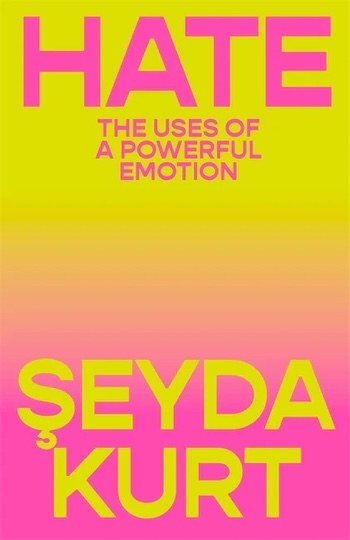
At the moment, hate is everywhere in dementedly polarized America, each side of the political spectrum fiercely reviling the other. And that is a bad thing, is it not? There is a knee-jerk consensus that the emotion is self-defeating, its weakness summed up by Confucius’s adage “If you hate a person then you are defeated by them.” But is that always true? German journalist Şeyda Kurt, in her stimulatingly acidic polemic Hate: The Uses of a Powerful Emotion (translated by Jackie de Pont), argues that rage can also nurture resistance, over the long haul, against the racist, patriarchal capitalism we live under. Hate has been, and can be, “a driving force for a collective pursuit of change.”
If nothing else, Kurt supplies a welcome kick in the teeth to our Pavlovian army of itching to sing “Kumbaya” at the drop of an empathetic tear.
Like all disruptive critics, Kurt takes aim at a bromide that many hold sacred: in our civilized Western society, grounded in Judeo-Christian values, hate should be reviled. It is an ugly and destructive emotion. But, for her, this wholesale rejection of loathing only reinforces our indifference to social injustice — it feeds an emotional placidity, a consumer-obedient passivity that accepts the status quo. In response, Kurt calls for the cooperative cultivation of simmering rage — fueled by fixation and stamina — aimed at the proper targets. She calls this a strategic hatred: “A hate that is tactical, considered and circumspect. A hate that radically and completely challenges the prevailing dynamics of violence and domination.”
Hate, a best-seller in Europe, makes for a refreshingly spiky read. Like any radical gadfly, Kurt veers off course from time to time. It would have been helpful to have a few examples of how hate helped spur sustained political movements, not just long-term protests. But, as the current administration slides into authoritarianism (even the NYTimes admits it now) and embraces fascism, Kurt gives our accumulating bands of dissenters blissful, fiery permission to hate fully and freely — though strategically.
October 29, 2025
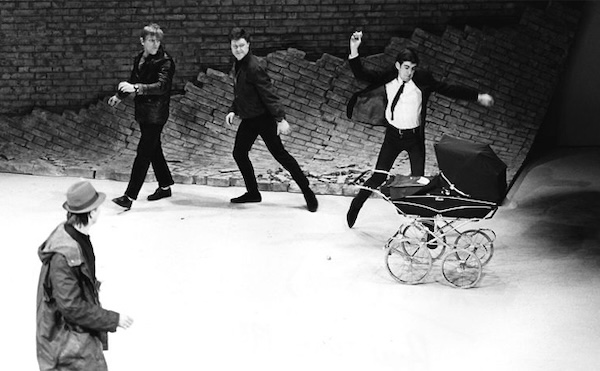
The controversial baby-stoning scene in Edward Bond’s Saved. Sunday Times theater critic J.W. Lambert : “Was there ever a psychopathic exercise so lovingly dwelt on as this, spun out with such apparent relish and refinement of detail?”
Aside from slowly proceeding court cases, America’s theaters are suffering through the Trump administration’s crackdown on artistic freedom (and federal funding) in abject silence, at least from what I can tell. National efforts, such as “Fall of Freedom,” are coordinating public demonstrations, enlisting prominent artists and cultural organizations to protest the administration’s attempts to control museum and arts programming. An action is scheduled for November 21 and 22. (Castle of our Skins is the only Boston participant listed at the moment.) In terms of programming, however, escapism is being marketed as “bold” fare as usual. Trot out the dysfunctional family dramas and comic book musicals. The fragility of democracy is too risky a topic.
Those concerned about the future of self-censorship in America must look elsewhere. The Stage reports that respected Swiss director Milo Rau’s production for this year’s Belgrade International Theatre Festival was blocked by the event’s board. Why? Could it be political revenge for “Rau’s speech at the festival in 2024, which mentioned environmentally harmful mining practices in Serbia and beyond”? Or might it be the show’s violent subject matter: “The Pelicot Trial is based on the high-profile case of Gisèle Pelicot, who was raped and assaulted by dozens of men.” Whatever the reason, the threat to free expression is real, and growing. “It is very concerning to see how quickly limits on freedom of expression are being normalised around Europe,” said Heidi Wiley, executive director of the European Theatre Convention. “Public theatres and festivals are places of open, critical and inspiring debate, where artists from around the world are able to shine a light on the complex realities of today’s world through their performances and creative interventions.”
Apparently, our cultural-industrial complex intends to ignore the menace posed to “open, critical, and free” discourse on our stages. Perhaps our showbiz machinery thinks we won’t notice. But repression of the imagination must be faced and defeated. 60 years ago, on November 3, the world premiere production of Edward Bond’s Saved by Britain’s Royal Court Theatre stood up to State censorship as well as the braying for blood of a cadre of deeply hostile critics, who condemned the script for what they perceived as its gratuitous violence, particularly a scene in which a baby in a pram is stoned to death. The Royal Court responded to the uproar by hosting a discussion in which Bond and director William Gaskill debated with critics of the play, divided between the sympathetic (Kenneth Tynan and Mary McCarthy) and the dismissive (J. W. Lambert and Irving Wardle).
The upshot of this aggressive defense of artistic freedom: the eventual shutdown, three years later, of the Lord Chamberlain’s Office, which in 1737 had been made responsible for granting licenses to theaters and approving the texts of plays. This outcome is proof that — rather than kowtow to the fear generated by an abusive power — our theaters would better protect themselves by confronting, via productions and public discussions, the perfidy of censorship.
October 22, 2025
One would think that somebody would write on one of the 20th century’s most bilious satires condemning man’s yearning for immortality, given the publicized yearnings of uber-rich libertarians, PayPal founder Peter Thiel among them, who are reported to be fascinated by the ideas of the death-evading “transhumanist” movement, with its interest in “heterochronic parabiosis” — the sewing together of two animals in order to create a living chimera. Aldous Huxley is best known for his 1931 novel Brave New World but, after the first of many stints in Hollywood writing screenplays for MGM, in 1939 he published After Many a Summer Dies the Swan, a book critics consider to be his last major work of fiction. Set on the West Coast, this grotesque fable about American delusions is set in a kitschy, Hollywood-crazed wonderland, a huge estate whose grounds include an ornate castle, a children’s hospital, and a mortuary that no doubt served as one of the inspirations for Whispering Glade in Evelyn Waugh’s The Loved One.
Fascism is on the march in Spain, the effects of the Depression are still being felt, but the aging mega-millionaire, Jo Stoyte, is obsessed with longevity, if only to continue to serve his starlet mistress, Virginia Maunciple. To that end, he has hired the gleefully nihilistic scientist Sigmund Obispo to conduct extensive research into how life can be prolonged indefinitely. It turns out that carp guts may be the key to attaining eternal life, though what happens to the human body after kicking around for hundreds of years is highlighted in the hideously hilarious ending. Also tossed into the mix are a couple of scholars, a smug British historian and William Propter, a former university professor who serves as the loquacious spokesman for Huxley’s vision of a pragmatic Buddhism that insists that we must reject the world as it is for the sake of saving it. Doing good — at the very least limiting harm — means rising above the rapacity of the ego, above the divisions of conventional religion and nationalism.
The plot of this acidic farce is minimal; its characters are either thinking about (or voicing) their obsessions, many of which are interestingly pertinent now. Propter is tinkering with solar power and working on schemes to help the lower class. Stoyte’s urge to overcome mortality smacks of the dreams of today’s biotech entrepreneurs and biohackers (a species anticipated here by the amoral Obispo as well as Stoyte), who see it as their individual right to enjoy life indefinitely, to never stop satisfying their desires regardless of the consequences to morality or society. Huxley admired the iconoclastic H. L. Mencken, and in this outlandish fable joins him in zestfully lambasting American monsters: “the solemn mammoths of stupidity, mountain-bodied and mouse-brained … sinister, rapacious, philanthropic beasts.”
October 15, 2025
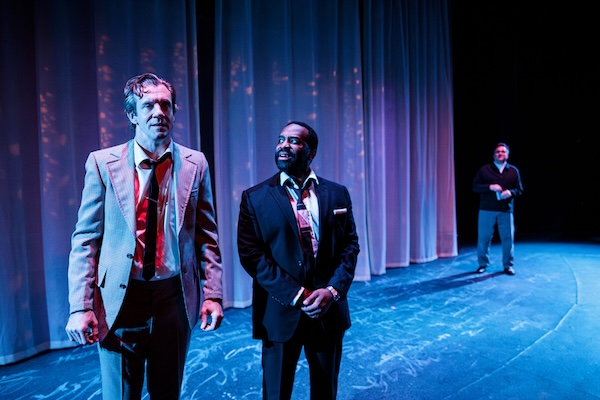
Jesse Hinson, Omar Robinson, and Dennis Trainor Jr. in the Actors’ Shakespeare Project’s production of Macbeth. Photo: Benjamin Rose Photography
I have not seen the Actors’ Shakespeare Project’s production of Macbeth, but twee notions about political theater in Don Aucoin’s Boston Globe review left me shaking my head. He is outraged that — at one point in the production — “a minor character seizes the spotlight and proceeds to inveigh against ‘MAGA fascism,’ the gun lobby, ‘ICE disappearing people into the black hole of history,’ the likelihood that AI will ‘make us all obsolete,’ Rudy Giuliani, and ‘Democrats who keep voting to fund a genocide in Gaza.’” Yes, we live in “Trumpy times,” the critic admits, “when threats to freedom seem to accumulate every day, alarming Americans who have grown, you know, fond of democracy.” But an injection of raw polemics is just too much. There’s no nuance. Yes, there’s a crisis, but well-behaved theaters don’t do things like this — and to the Bard!
I asked for, and received, ASP Artistic Director Christopher V. Edwards’s response to the Globe review:
“When Shakespeare’s Macbeth was first performed around 1606, following the assassination of King Duncan in Act 2 – the audience would have been treated to the Porter character emerging from the world of 11th Century Scotland and talking about the modern events of 1600s London – with references to English tailors, and the ‘equivocator’ line often thought to be a reference to the Gunpowder Plot led by Guy Fawkes the year prior.”
“We saw it as our duty as stewards of this play to have our Porter (played by Dennis Trainor Jr.) break from the world of Cold War America and discuss the political matters of today – from artificial intelligence to global warming to the genocide in Gaza.”
“Don Aucoin of The Boston Globe clearly did not enjoy that portion. And he’s fully right to have his own opinion on it. But we wish he had been able to see that not as ’straining for relevance’ as he put it – Macbeth is clearly relevant enough for our own times to stand on its own two feet – but the exact opposite, as harkening to the tradition of the piece and how Shakespeare’s audiences would have engaged with this work itself.”
Kudos to Actors’ Shakespeare Project for a rare acknowledgement, at least among Boston area theaters, that these are not normal times. Political theater comes in many forms, from the circus-like satire of Bread and Puppet (currently touring in Texas, where NPR reports that a few audience members have walked out) to the capitalist critiques of Bertolt Brecht and Caryl Churchill, the activist antics of street theater, and the fact-based drama of the Living Newspaper and other strands of documentary theater. Different kinds of political theater aim at distinct goals: to provoke, inspire, shock, amuse, sustain believers, disrupt, and so on. During these dangerous days, how are our theaters reacting? The majority are choosing to play it safe, to hunker down and maintain business as usual. It sounds to me as if the ASP dared to do something different. To hold up a mirror to a nature that is overheating and an America that is drifting toward authoritarianism.
But Aucoin is part of the culture-industry contingent that knows that all will be well, that it is best to hang back and wait. “There will doubtless be many Trump-inspired dramas in the years to come. It would be best if they’re subtle enough to let the people in the seats connect the dots. As with saving democracy, the audience has a job to do.” How is he so certain that “Trump-inspired” shows are on the way? We have seen major universities, mega corporations, media giants, and tech firms bow to Trump’s will; instances of censorship are growing at record rates, along with rising levels of self-censorship. Fear, like courage, is contagious, particularly among the rich and powerful. Perhaps, by “Trump-inspired,” Aucoin assumes the arrival of dramas that will praise the heroic deeds of our fearless leader? Perhaps there will be subtle ones?
Aucoin rightly notes that audiences must do their job to save democracy. But don’t theater companies have a responsibility to protect democracy? To inspire people to fight for its survival? Ironically, Aucoin leaves out an important question: what is the job of the theater critic in these dark times? Apparently, it is to complain when a stage company doesn’t stick to the same old tame, apolitical script
October 8, 2025
Orwell’s Big Brother likes obedience in advance. Censorship is steamrolling along without the need for a rap on a finger, let alone a boot in the face. “Never before in the life of any living American have so many books been systematically removed from school libraries across the country,” warns PEN America in its invaluable report Banned in the USA: The Normalization of Book Banning. The motto for Banned Books Week (through October 11) is “Censorship is so 1984: Read for Your Rights.” The truth is, 1984 is au courant — it is among the most banned volumes in the world. So far, Americans have been dangerously complacent, complicit, or indifferent to the surge in book banning — a direct assault on the freedom to read that threatens to gut democracy and public education, normalizing fear by classifying books and writers as enemies of the state.
The nefarious process is coming along in this state. Objections to the holdings in Massachusetts libraries have more than doubled over the past three years, with the majority of objections churned out by organized movements (ideological pressure groups and government entities) rather than individuals. Among the titles that have been banned or challenged: Worm Loves Worm and This Book is Anti-Racist.
Is Massachusetts doing anything to protect independent voices in an increasingly hostile landscape for writers and readers? Our allegedly liberal state is spinning its wheels. Those who want to fight censorship should support the Mass Freedom to Read Coalition, a group urging state legislators pass a comprehensive Freedom to Read bill that “protects librarians and educators from harassment for doing their jobs, and protects authors, creators, booksellers, and publishers from economic harm due to censorship.” This is the third year the Massachusetts legislature has considered the bill, but it has never moved to a floor vote. Thirteen other U.S. states have passed legislation protecting the freedom to read — including Rhode Island in August of this year. But Massachusetts has not, though passage would seem to be a slam dunk. Why?
I asked Nicholas LaRue, co-leader of the Massachusetts Authors Against Book Bans coalition, about what’s behind the holdup. It turns out that — along with the inertia of politics as usual — it comes down to old-fashioned cowardice. “Our legislators don’t want to draw the ire of the administration in Washington more than they already have,” LaRue told me. “They don’t want all that dark money that’s being pumped into other states for primary candidates to come here. The feeling is, as long as we can keep our heads down and continue to make money, as long as the right people leave with smiles on their faces, the state is in a good position. Why rock the boat? Nobody is going to lose their jobs if we keep the status quo.” Still, LaRue has hope that this year the bill will pass.
This decision to hunker down also reflects our arts community’s passive posture. It is a mistake. From everything we have seen of Trump’s reactionary administration, inaction is targeted as a sign of weakness. “Repression lives off fear,” wrote Belgian-born Russian revolutionary, novelist, poet, prisoner, journalist, and translator Victor Serge. We are not going to protect the freedom to read — as well as many of our other freedoms — by playing possum in front of an authoritarian regime-in-the-making. It only makes us easier candidates for roadkill.
October 1, 2025
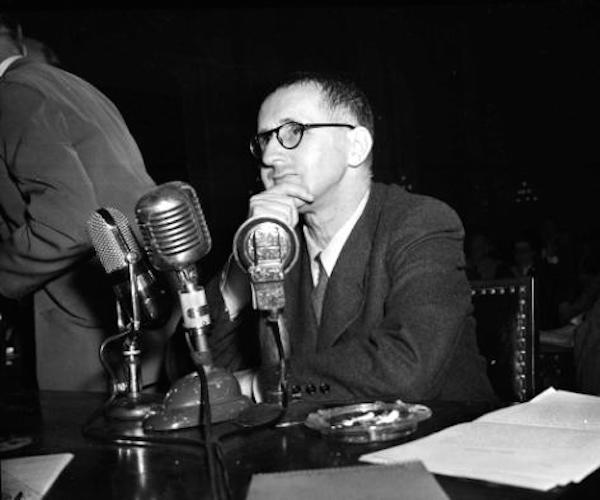
German poet/dramatist Bertolt Brecht testifying in 1947 before the House Un-American Activities Committee. Photo: Open Culture.
“As Trump increasingly targets the arts, artists are faced with the question of whether to speak out or keep their heads down” stated the introduction of a segment of a Sept 29 PBS NewsHour. Is anyone who has been paying attention surprised that America’s arts and culture establishment has decided, this time around with Trump, to glue its knees to the floor? New York Times Culture Reporter Robin Pogrebin summed up the creative industrial complex’s docile reaction to the administration’s ongoing assault on democracy, freedom of speech, and the arts: “You see a kind of — much more of a cowed, capitulating stance on the part of the art world, I think a sense of resignation. It may be just something they have to hunker down and weather for the next four years under Trump.” That last point raises an elemental question — what is going to be the condition of arts and culture after four years of Trump? After self-censorship becomes de rigueur, and fear and intimidation routinely undercut artistic freedom?
Don’t worry, be happy. Harvard University’s American Repertory Theater assures us that, with the assistance of its current presentation, 300 Paintings, “It’s time to laugh.” (Though I doubt there is much guffawing happening at Harvard, given Trump’s new effort to block all federal funding from going to the institution.) I agree that it is a damned good time for laughter, but the hilarity should aimed at the inane crudity of the enemies of democracy and freedom.
For chuckles of that type, McCarthy era version, watch this short (31 minute) and amusing dramatic reconstruction of poet/dramatist Bertolt Brecht’s testimony before the House Un-American Activities Committee on October 30, 1947. A Good Example: Bertolt Brecht and HUAC was shot in 1979 by local writer/actor/ producer David Rothauser with help from the Angry Arts Film Collective and Walnut Films. (Rothauser cast himself as Brecht, and he is quite good.)
Brecht’s responses consist of wry obfuscations and jokes. He often plays dumb or wanders into double talk about how any play that deals with modern times must include references to Marxism. He frequently blames sloppy translation for the committee’s “misunderstanding” of his work and his politics. Still, at the end of the session, Brecht was praised by HUAC chair Rep. John Parnell Thomas (R-NJ) for his cooperativeness. He flew to Zurich the day after the hearing.
Some of Brecht’s thoughts on the clumsy grilling are included in the film, including this chilling, prescient observation from his 1948 speech at Stockholm’s International PEN Club: “From the United States we will see the almost incredible news that some of their best writers will now be sent to jail. I sat next to them on the defendant’s bench in Washington two and a half years ago … my American colleagues were protected by the Constitution; it was the Constitution that was not protected.”
September 24, 2025

A mosque in Gaza destroyed in an Israeli airstrike, 20 February 2025. As of January 2025, Israel had destroyed 815 mosques and 19 cemeteries over the course of the Gaza war. Photo: Wikimedia
There’s been a debate about genocide, but not much discussion about the horrors of cultural genocide. And that silence is deeply disheartening. On September 18, PEN released the report All That is Lost: The Cultural Destruction of Gaza. Everyone in the creative industrial complex should read this terrifying document. It “examines the destruction or partial destruction of 36 cultural, historical, religious, and educational sites, and also includes three instances of deliberate book burnings and two cases of reported looting of archaeological artifacts … The war has inflicted a catastrophic blow to Gaza’s cultural life and heritage, with some of the most important cultural and religious landmarks in Gaza destroyed. Israel’s military campaign has resulted in the total or partial destruction of every university and college in Gaza and 11 libraries, including the total destruction of the Gaza Public Library, which housed 10,000 books in Arabic, English, and French.” Israel has systematically — and shamefully — set out to obliterate a people’s history, arts, and identity. It should be condemned: what the IDF has done provides a blueprint for efforts at cultural extinction elsewhere.
On a less apocalyptic level, the repression of the arts in Hungary and in Israel foreshadows the actions of the Trump administration. This approach draws on direct government intervention in the arts, media, education, and museum sectors. The administration appoints loyalists to major cultural institutions as it shifts funding towards projects aligned with its conservative ideology and cuts others, marginalizing non-conforming artists and institutions. Hungary serves as an authoritarian model for how Trump may want to structure the arts. Independent artists who have not already fled Orban’s fiefdom have organized a bohemian underground that the police keep under surveillance. That two-tiered division – the complicit and the non-complicit – may well soon surface in America. Artists who don’t censor themselves will be targeted as the “enemy within.”
Israel also serves as a model for intimidating free-thinking creators. According to a September 17 report in Haaretz, the government has suspended funding for Israel’s top film prizes, the Ophir Awards, because the movie that won Best Film honors this year, Shai Carmeli-Pollak’s The Sea, is about a Palestinian boy from the West Bank who journeys to see the sea for the first time. The Culture and Sports Ministry claimed that the film “defames” the IDF and Israel. According to the rules, The Sea will be Israel’s submission for the Oscar for best international feature.
Assaf Amir, the chairman of the Israeli Academy of Film and Television, is proud of the Ophir Awards’ gesture of defiance. Let’s hope that legions in America’s arts and culture community find the courage to speak out — and act decisively — against the Trump administration’s growing efforts to curtail artistic freedom. A recent issue of American Theatre details the admirable effort of artists and culture workers to organize nationwide under the banner of The People vs. Project 2025. Boston’s arts community has been puzzlingly mum in the face of repression, content to go about marketing its business as usual. For example, the American Repertory Theater tells theatergoers to book early because “Wonder Awaits” the arrival of its latest Broadway-bound musical. Shouldn’t someone in the arts community be concerned that its not so wonderful that authoritarianism sits around the corner as well?
September 17, 2025
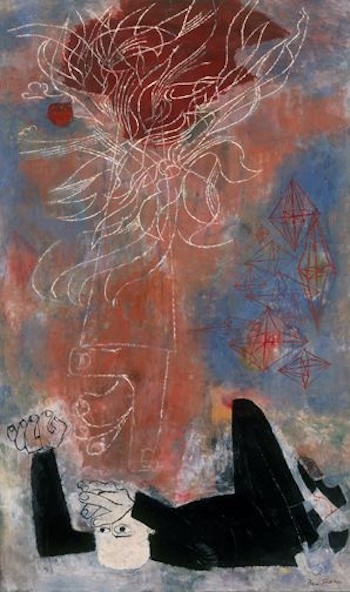
Ben Shahn, Second Allegory, tempera on Masonite. 1953.
I went down to New York this weekend to check in on masterpieces by two of my favorite artists: the Theatre for a New Audience presented a moving production of Henrik Ibsen’s still salient blast at homicidal self-righteousness, The Wild Duck. And there was Burning Bright, a satisfying exhibition of the art of William Blake at the Yale Center for British Art, which owns a fabulous collection of the poet/printer/visionary’s works. What was odd about the Blake show was that the curators had decided to tone down acknowledging the writer’s rabble-rousing side; his rage at tyrannical authority, especially its violence and economic pitilessness. Also ignored: Blake’s utter disdain for what he saw as the cruel, coldly rational God of Christianity. Trump is very much in the rancid mold of Blake’s Nobodaddy – a hollow deity/father figure, transactional and ineffectual.
In contrast, the fusion of artist and activist are celebrated in the splendid show Ben Shahn, On Nonconformity at NYC’s Jewish Museum. Shahn’s political orientation was steadfastly leftist, his socialistic perspective critical of fascism and authoritarianism. His life and art were dedicated to economic equality and social justice, a commitment well dramatized in this exhibition, which could not come at a more propitious time in our history. Artists need to be reminded of their responsibility to question the powers-that-be; critics must get over their knee jerk dismissal of political art. A quotation from Shahn’s 1956-1957 Norton Lectures (written at the tail end of the McCarthy era) sums up the counter-argument: “Noncomformity is the basic pre-condition of art, as it is the pre-condition of good thinking and therefore of growth and greatness in a people. The degree of nonconformity present — and tolerated —in a society might be looked upon as a symptom of its state of health.”
As government repression increases, curtailing thought and action, spreading fear through intimidation, our artists should see it as their task to resist conformity, which inevitably means challenging official strictures regarding what can be seen and said. Shahn also writes in his Norton Lectures that an artist “must never fail to be involved in the pleasures and the desperation of mankind, for in them lies the very source of feeling upon which the work of art is registered.” The temptation is to stick to doling out pleasures. But desperate times are here for many, and our artists are called to be among the witnesses.
Note: I had a spicy conversation about the moribund state of arts criticism (looking at you, Boston Globe, New York Times, and NPR), the growing need for online magazines like The Arts Fuse, and my new venture, Viva La Book Review, with Ellen Clegg and Dan Kennedy on their “What Works” podcast. Check it out.
September 10, 2025
The AP’s recent decision to discontinue book reviews, compounded by cutbacks in book coverage in major national newspapers and magazines, is symptomatic of a book culture in serious decline. It is time for the empire of those who care about books and reading to strike back and do something about it. It is time to call in a rainmaker.
And one has arrived. I am pleased to be on the board of a new nonprofit organization, Viva La Book Review, which is dedicated to turn things around for book reviewing in our country’s community newspapers and online media. According to VLBR’s mission statement, the goal “is to foster thoughtful, well-crafted book criticism that supports a crucial open dialogue among reviewers, authors, educators, librarians, and above all American readers, raising issues critical to all readers, critics, and editors maintaining a healthy democracy.” Our funds and considerable know-how are fully committed to growing book coverage at the grassroots —in print, digital, and audio media — thus increasing the number, as well as the quality, of book reviews in communities across the country. Readers, writers, editors, and publishers need to come to the defense of the beleaguered book review: the effort will not only stimulate readership, but also strengthen threatened democratic values
What is VLBR’s strategy? Downright revolutionary: work with and/or train book critics, pay for book reviews in cooperating publications, subsidize and eventually expand the number of critiques. In addition, build up free educational resources for critics — provide tips on how to write effective book reviews, pick volumes to critique, and pull off a ‘mixed’ review. In the future, online conferences, one-on-one tutorial sessions, and seminars on the craft of book reviewing, led by veteran book critics, will become available. Assistance to local media regarding how to amplify the impact of reviews will be offered, as well as help with spreading the critical word in bookstores, libraries, social media, and other channels.
What am I, my fellow board members, and an impressive line-up of advisors, made up of professionals familiar with all aspects of book publishing, asking? That editors and reviewers in local media get the book coverage ball rolling by contacting VLBR at: [email protected]. Recently, The New Yorker‘s David Remnick wrote that arts reviews “have the blessing of thinking, of judgment—and thinking about what makes a work of art unique or brilliant or dull or even pernicious is an invaluable part of the job of criticism.” Viva La Book Review believes that the job of a reviewer is of indispensable cultural benefit. Join us in the fight to keep the blessings of thinking and judging around.
September 3, 2025
Another reminder of the bewildering spinelessness of the Boston arts community as the country is confronted with a slide toward authoritarianism. Last week, the National Coalition Against Censorship (NCAC) and the Vera List Center for Art and Politics (VLC) announced the Cultural Freedom Demands Collective Courage: A Nation-Wide Statement of Values and Principles for the Field of Arts and Culture. As of this writing, only two of the city’s arts organizations have signed on, even though the statement doesn’t even (dare) mention Trump.
Our theater companies continually proclaim how “bold” and “boundary-stretching” they are. But that is marketing hooey. When it counts, our stages have been — and remain — silent in the face of encroaching tyranny. The Lyric Stage is producing Our Town later this month. The irony is head-spinning: “our towns” in America are being starved of funds; our major cities invaded by deployments of the National Guard (Boston may be on Trump’s to-do list); immigrants grabbed off our streets and shipped to gulags in other countries without due process.
What explains the gutlessness? The inaction among too many liberal power centers during what dramatist Lillian Hellman would no doubt characterize as a “scoundrel time”? Fear, of course, fantasies that they will be able to “ride this out,” and a fatal lack of nerve and imagination that Trump and company have aplenty. Nothing stops them from attempting whatever they can dream of to really push boundaries and consolidate a stranglehold on power. In contrast, our theaters (and other arts institutions) keep their heads planted in the sand, doing what they always do. Praying that all of this unpleasantness will just blow over. And if it doesn’t, well, don’t panic: there will be well-heeled fascists willing to pay big bucks to be entertained on Broadway and elsewhere. You just have to self-censor what you put on stage.
For decades, creative institutions have assured us that they serve the community. Is this what the citizens of Boston want at this time? Have they been asked? No rabble-rousing town halls? No protests led by artists demanding the protection of creative freedom? No shows acknowledging rampant cruelty and the plutocracy’s attacks on democracy, working people, and fairness? No attempts to inspire resisters to keep on fighting for a sane future? The same old, same old — is that all we are called for now? Timidity rather than leadership? Commercial fare that ignores how our institutions and guiding principles are being melted down, as if audiences and the creative class can escape the corruption and ugliness by pretending it isn’t there. It will not work. What will? “Cultural Freedom Demands Collective Courage” — backed by serious coalition building and action. Business as usual is cowardice, and worse — complicity.
August 27, 2025
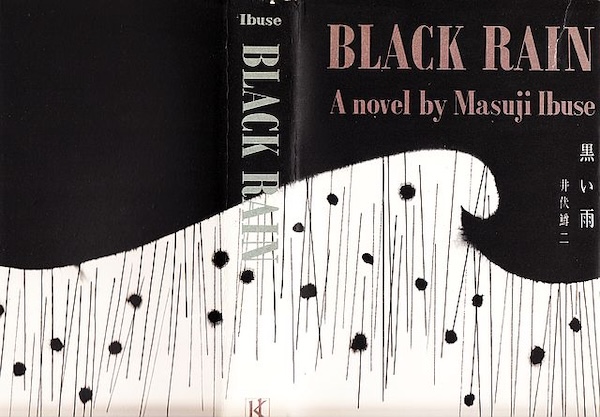
There have been articles on the 70th anniversary of Lolita as well as on The Great Gatsby and An American Tragedy turning 100. But, aside from an academic article or two, the media large and small has otherwise been silent on the 60th anniversary of the first serial publication (in the magazine Shincho) of Masuji Ibuse’s powerhouse novel Black Rain, an unsparing narrative about the atomic bombing of Hiroshima and its aftermath, which won the sought-after Noma Literary Prize in 1966. The neglect is odd, especially given that this month marks the 80th anniversary of the catastrophic strike. Perhaps the book’s graphic detailing about existence in extremis make it an upsetting read. Few works of literature offer as unflinching a vision — poignant rather than sentimental — of surviving through devastation that exceeded the limits of the human imagination at the time.
Born in Hiroshima Prefecture, Ibuse based his novel on journals and interviews with bomb survivors (hibakusha), conveying these experiences through what he called the “crudest kind of realism.” The storyline runs on two tracks: Shizuma Shigematsu writes down memories of enduring the bomb drop as he struggles to resume his life and unite with his family — his niece, Yasuko, and wife, Shigeko. He is undertaking this traumatic exercise to document that Yasuko escaped exposure to the “black rain” of radiation and therefore can marry an interested young man. But, five years after the bomb, Yasuko is starting to display symptoms of the disease. She is asked to report to the Atomic Bomb Casualty Commission (ABCC), established by the Allied occupation in 1947 to collect data on the victims. The ABCC was only charged with recording cases like Yasuko’s — it provided cooperating victims no treatment. U.S. censorship regarding radiation sickness at Hiroshima lasted until at least 1948.
In 1989, Shōhei Imamura released a powerful film version of the novel, but he chose to focus on Yasuko’s plight. Ibuse’s novel, translated into English in 1966, offers a more extensive — and fiercely graphic — look at what life was like for the people in the city during and after the atomic bomb drop. The documentary approach can be tedious at times; do we really need to know the diet of middle-class Japanese citizens during the war? But there are amazing episodes, such as when — because the area’s crematoria were overwhelmed — Shigematsu was forced to hold funeral services over corpses that must be burned in makeshift fashion along the banks of a river.
Reading Black Rain now, it comes off as not just a historical novel, a memorable description of horrors, or a protest against the use of nuclear weapons. Ibuse, like Samuel Beckett, chronicled the shock of the new on human consciousness — the denial, bewilderment, hapless disorientation, and numbness generated by an encounter with human destruction beyond what had ever been dreamed possible.
August 20, 2025
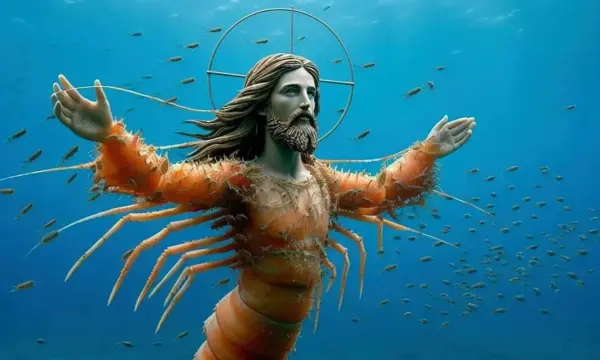
In 2024, AI-generated “Shrimp Jesus” images proliferated on Facebook. Photo: Wikimedia
Reading Terry Nguyen’s thoughtful review in Art Review of Medium Hot: Images in the Age of Heat, a 2025 essay collection by the artist and filmmaker Hito Steyerl, I came across this provocative charge aimed at her blasé attitude toward what she sees as the pernicious proliferation of Al Slop: “It’s tempting to wonder, then, what we should dare hope for. Are there any artist collectives or start-ups resisting this widespread computational absorption? Is there legislation being passed to limit resource waste? Disappointingly, Medium Hot doesn’t cohere into a manifesto for the contemporary image worker – the artists, photographers, actors and creative laborers whose work is being subsumed into training data as their livelihoods are increasingly automated.”
What struck me is that this charge, of standing back from critiquing the forces that are undercutting the economic health of culture workers, can be leveled at about all arts critics today. The definition of the job has shrunk to quickie consumer guide or pop culture influencer — jabbing their thumbs up or down on whatever cultural product is under consideration. The notion that critics should take an activist role — posing alternatives to business as usual, lambasting corporate homogenization, condemning philistine editorial perspectives, recommending legislation to protect artists and resources — was a possibility in the past, when writing on the arts was taken seriously by society. But, unlike sports or political coverage, arts criticism has been confined to a narrow lane, a disastrously ironic development at a time the culture is in horrific crisis, with censorship and authoritarianism on the march.
What remains crucial at the moment, concludes Nguyen about our visual culture’s shift toward “probabilistic abstractions” … “is a strong ethical commitment to staying with reality.” There is something at stake for arts critics in what is happening today: they should accept their obligation to fight for our cultural health, to acknowledge a reality beyond the transactional — or be complicit with nurturing a dominant fantasy world of slop.
August 13, 2025

The latest bad news for book criticism – the Associated Press is getting rid of book reviews. From the service’s global entertainment and lifestyle editor: “I am writing to share that the AP is ending its weekly book reviews, beginning Sept. 1. This was a difficult decision but one made after a thorough review of AP’s story offerings and what is being most read on our website and mobile apps as well as what customers are using. Unfortunately, the audience for book reviews is relatively low and we can no longer sustain the time it takes to plan, coordinate, write and edit reviews. AP will continue covering books as stories, but at the moment those will handled exclusively by staffers.”
Book coverage is hovering at the edge at the Boston Globe as well. Nina McLaughlin’s local book column at the paper was recently canned. One reader draws my attention to the fact that “the daily Globe nowadays seems to consist mostly of promoting local novels, often first novels, which tend to be mysteries or romances — you know, beach reads — with special attention to the authors’ extra-literary thoughts and interests. The Sunday section does have a couple of reviews, but they are usually eclipsed in number by various columns. Also, I notice that Kate Tuttle is apparently not the Book Editor. She is described as ‘editing the Globe‘s book section,’ or sometimes, ‘she handles the Globe‘s books coverage.’” For many decades, the paper had a Book Editor: making the position freelance suggests we are moving closer to the final fade-out.
There is a new critic at the Globe, a “TV and pop culture critic.” A staff writer, of course — TV coverage is too important to leave to a freelancer! After all, a lot of people actually watch TV. Meanwhile, in the Globe’s Ideas section, there’s a long thumb-sucker about the mystery of why men don’t read fiction. Maybe they think books are not important. Who gave them that idea?
Could it be the people that treat arts reviews as disposable? The Globe’s film section has now decided to review trailers rather than major movies. A sampling of recent films left unreviewed by the newspaper: Weapons, a critically acclaimed and popular feature (it receives a rave from former Globe critic Ty Burr in the Washington Post), Final Destination: Bloodlines (a box office winner), Jane Austen Wrecked My Life, It’s Never Over, Jeff Buckley, and Shoshana.
August 6, 2025
The dance field was shocked and saddened by a freak accident at Jacob’s Pillow August 1. Gifted production manager Kat Sirico, who used they/them pronouns, was moving platforms on a dolly down a slope when they tripped and fell and was crushed by falling platforms. Sirico had been part of the Pillow family since a 2005 internship and was an experienced backstage professional. The Pillow cancelled performances the weekend of August 2-3. All of us at the Arts Fuse send our condolences to their family, friends, and colleagues.
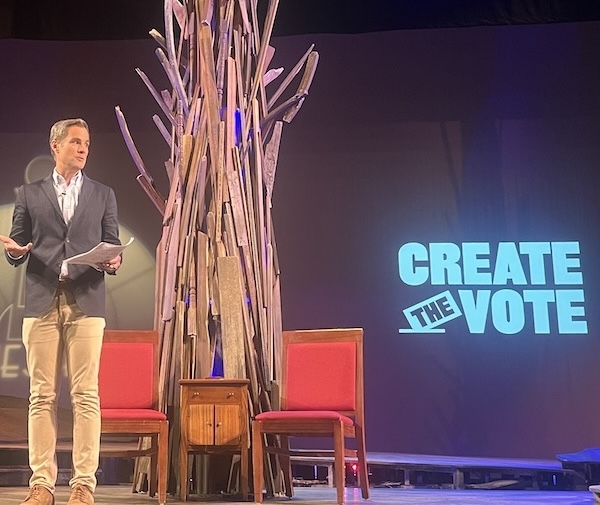
The Boston Mayoral Forum on Arts & Culture, moderated by Jared Bowen, host of GBH’s The Culture Show, featuring Michelle Wu, Josh Kraft, and Domingos DaRose.
The Boston Mayoral Forum on Arts & Culture at the Strand Theatre on July 30 was valuable because it focused on how the arts will fare in the city during the corrosive Trump years. Most of the talk was wearily predictable, ranging from host Jared Bowen’s boilerplate questions to the usual pledges from the candidates (Michelle Wu, Josh Kraft, and Domingos DaRose) to celebrate arts and culture, increase inclusive access, and support urban spaces dedicated to artistic creation and performance. The lacunae were glaring and, unfortunately, telling. For example, there was no mention of the precipitous nosedive to come in tourism to the city, not only because of the fears of foreign vacationers to visit America, but also by the hard fiscal times wrought by Trump’s economic policies. (Kraft alluded to it.) As artists learned during and then after COVID, when the fiscal going gets tough, the arts and culture ‘industries’ are among the first to be cut. The survivors are the larger organizations that maintain their power by remaining as homogenized and risk-averse as possible.
Most important, there was no discussion about how Boston’s arts and culture community, with assistance from the city, will meet the crucial demands of the political present: defending democracy against the approach of authoritarianism. Artistic freedom is already under pressure; censorship is on the rise. In what ways might Boston — and our heretofore publicly silent arts community — work together to defend bedrock civic values? Will the cradle of democracy sit out the accession of autocracy? Or might our reticent culture workers and their employers decide to get off their knees and offer dissent?
July 30, 2025
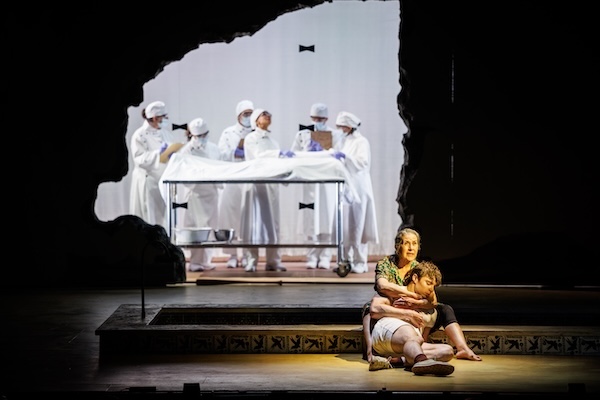
Nicholas Alexander Chavez, Socorro Santiago, and the cast of Camino Real in the production at the Williamstown Theatre Festival. Photo Maria Baranova
Last week, the New York Times undermined mainstream arts criticism by reassigning four of its critics—of theatre, TV, pop music, and classical music—to other duties. What is particularly galling is that, in a memo on the paper’s decision, culture editor Sia Michel insisted that it was part of an ongoing effort to “expand” the Times’ cultural coverage “beyond the traditional review.” For decades, I have been arguing that the extinction of reviews seriously harms the cultural ecology, in part because it diminishes dialogue about the value of the arts. That said, many online sites, like The Arts Fuse, are picking up the slack. This is where first-rate reviewing will be found in the future. What left me flummoxed is this call to go “beyond the traditional review.” What does that mean?
The Boston Globe’s enfeebled arts coverage suggests what it means— arts criticism will morph into utter pablum. Case in point: Don Aucoin’s recent “Critic’s Notebook.” The piece is not a review, but an attempt to go ‘beyond,’ and it asks a good question: Where does dramatist Tennessee Williams’s greatness reside? But Aucoin proceeds not to answer it. He offers no analysis of his own, aside from spouting cliches, among them that the playwright’s “legacy seems up for grabs,” his scripts offer “so many doors to open,” and “there is always something new to discover about the work of Tennessee Williams.” Remove the quotes from director David Kaplan, and the piece is essentially a listicle of recent productions, with no attempt to deepen our knowledge of Williams. An article this lazy and mindless should be an embarrassment for a major newspaper – but it is business as usual for arts writing at the Boston Globe.
Let me tweak Aucoin’s question and provide a response. Why do we need the work of Williams now? The diverting Williamstown Theatre Festival production of the playwright’s mythopoetic circus, 1953’s Camino Real, offers a direct expression of his version of romanticism: “the ability to feel tenderness toward another human being, the ability to love.” It is this respect for care that the play’s characters – Don Quixote, Casanova, Lord Byron, and Esmeralda, among them — must learn to protect against the brutality of a fascist society. The potency of kindness — especially when it is confronted with inhumanity — is at the center of Williams’s dramatic vision. Few major American playwrights have examined that conflict so directly, so powerfully. And, in a world increasingly dominated by the virtual and the transactional, where cruelty has become the point of power — in Gaza, Sudan, Ukraine, and America — tenderness is under mounting threat. That is one reason why we need to see the work of Tennessee Williams – and why he is great.
July 23, 2025
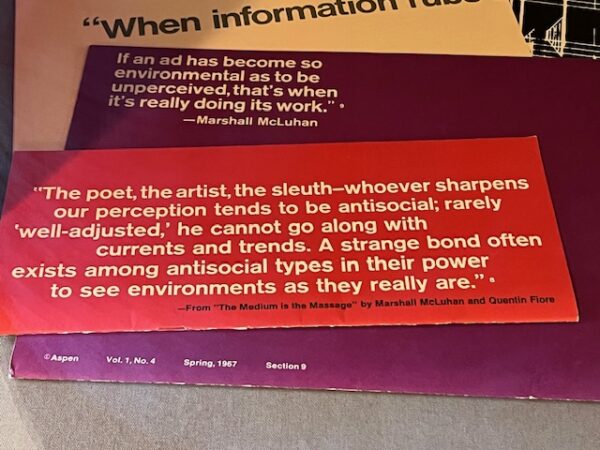
“Aspen: The Magazine in a Box vol. 1, no. 4,“ — author Marshall McLuhan, designer Quentin Fiore. In The Clark’s Bold By Design: Mid-Century Modern Graphic Arts exhibit. Photo: Bill Marx
First, the hopeful news. On July 16, the Healey-Driscoll Administration announced the launch of the Live Theater Tax Credit Pilot Program to support the development and expansion of live theatrical productions in Massachusetts. The program will award up to $7 million a year in tax credits for live theater productions. Its goal is to boost Massachusetts’ arts and culture ecosystem by attracting high-value theatrical productions that draw new audiences and support local industries.
But will this sweetener really energize our stage ecosystem? Boston’s small to mid-sized theaters were devastated by COVID and have never truly recovered. Larger theaters have been consolidating control and absorbing the available resources. A number of stated requirements for the tax credit—including “an estimated budget that demonstrates at least $100,000 of costs and expenses will be incurred in Massachusetts”—suggest that this program is tailored for the high rollers. Small companies are effectively shut out. And that means the Massachusetts theater scene will continue to flounder, both creatively and financially. Small stages are incubators for innovative talent and ideas; they are where the riskiest material is produced. Instead, the tax credit is designed to reward companies focused on producing commercial fare for New York, via pre-Broadway or pre–Off Broadway productions.
Obviously, the tax credit isn’t about strengthening theater as an art form—it’s about generating economic activity. Bowls of warm milk for the fat cats, as the press release spins it: “Through the Live Theater Tax Credit, we’re ensuring our theaters continue to deliver strong economic returns—creating jobs, filling hotels and restaurants, and strengthening communities across the state.” The announcement speaks of theater generating “joy” and “sparking imagination.” Nothing about stage productions as provocation, as art, as dissent. Marshall McLuhan states the counterpoint succinctly: “Whoever sharpens our perception tends to be antisocial” because they possess the “power to see the environments as they really are.” Why do we need theater? Because it delivers “strong economic returns”? This soulless, transactional blather erodes our understanding of the true value of the arts.
Funding for the arts is being clawed back. Free speech is under threat. Authoritarian forces are encouraging self-censorship and successfully curtailing protest. How can we fight back against oppression? Theater should be one answer. What would offer genuine assistance? A tax credit (and philanthropic support) for independent stage companies of all sizes willing to become part of the much needed resistance.
A thoughtful comment on this column from Jon Garelick:
I appreciate the pitch to make tax breaks available to smaller companies, but, really, pitching the arts as economic development may not be revolutionary but it’s not counter-revolutionary either. It means jobs: for playwrights, actors, set designers, and other theater professionals as welll as the workforce in the surrounding community. Pitching tax breaks as “provocation” and “dissent” and a way to stick it to the Man really doesn’t wash, sorry. Stick it to the Man who just gave you the tax break? How many musicians, carpenters, and actors have fashioned a sustainable livelihood by working in commercial theater? That is, when they weren’t waiting on tables or tending bar in restaurants that service the Theater District. Or, heaven forfend, invest the money they make from big budget films in independent film projects and their own community-based businesses. I don’t mean what’s good for Big Theater is Good for the USA, but $100,000 isn’t exactly Fat Cat expenditure. What’s the annual budget of the Central Square Theater, or other small theaters you could name? So, yes, let’s use that dirty money from the Fat Cats to produce Brecht or that production of “Mrs. Warren’s Profession” that you and I liked so much — or even something new! It beats robbing banks. https://www.bostonglobe.com/
My response:
All good points… but we should consider going beyond “business as usual.” Jobs, by all means, matter, but it’s clear that power is shifting in an authoritarian direction. The state claims it wants to resist this national move toward autocracy. Yet, the tax breaks—targeted at Broadway or off-Broadway-bound productions—are about maintaining the status quo.
This means more theater with little or no connection to the emergencies at hand. As of now, few Boston-area theaters dare to acknowledge the crisis I mentioned in the column’s final paragraph. Nothing in this “tax break” incentivizes a change in repertoire or artistic spirit. The larger theaters show little interest in Brecht or any material that examines urgent issues like war, peace, inequality, climate change, or broken economics. If the state, the arts community, critics, etc., are truly serious about protecting democracy, then they should put their money and/or energies where their mouths are.
Fascist Germany and Italy kept their cultural scenes alive in the same way conventional economies do (for example, Oban’s Hungary). There’s plenty of economic activity, especially for companies willing to ignore what’s happening in the police state and are content to serve up sanitized entertainment, or even praise the autocrat in charge. Of course, free expression is muted, and—as we see in this country today—people are taken off the streets by “deputized” thugs and thrown into jail.
Is pitching the arts as an economic good counter-revolutionary? No — as long as the more essential values of the arts are articulated — as they were not in the state’s PR release. To me, the tax break has been tailored to reinforce the mentality of an arts community that’s afraid of today’s challenge — so fearful of risk that it would rather be oblivious to danger. Or maybe the stage companies know something we don’t — it is all going to work out, just keep your head down and be quiet. Nothing to see here — congratulate yourself for turning a blind eye.
Might the state, or wealthy patrons who care about America’s future, step up and support an “underground” theater committed to defending democracy and other radical ideas? I don’t have high hopes, but it is worth throwing out for consideration.
July 16, 2025
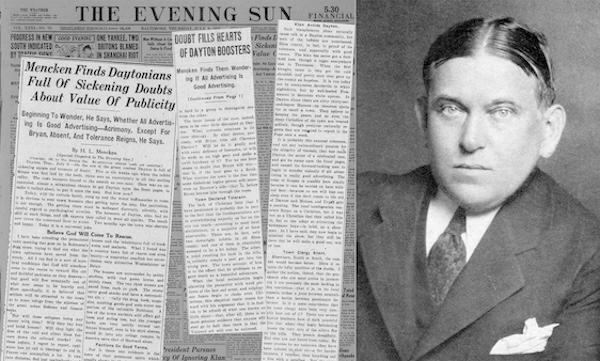
H.L. Mencken reporting in the Baltimore Evening Sun on the first day of the Scopes “Monkey Trial.”
A hundred years ago this week, tongue-slashing social commentator, acidic literary critic, and veteran reporter H. L. Mencken was hunkered down in Dayton, Tennessee during a heat wave, covering what he had proclaimed to be “the greatest trial since that before Pilate!” High school teacher John Thomas Scopes was being tried for violating a state law that forbade teaching evolution to young minds; the proceedings became a national sensation. The Baltimore newspaper for which Mencken worked, The Evening Sun, supplied Scopes’ bail. Mencken had earlier coined the term “The Bible Belt,” and he gifted this legal spectacular with a derisive label that has stuck ever since — “The Monkey Trial.”
At first, Mencken was pleasantly surprised by Dayton. “I expected to find a squalid Southern village,” he noted, “what I found was a country town full of charm and even beauty.” But, from the get-go, he saw that religious fundamentalists were in charge: “It was no more possible in this Christian valley to get a jury unprejudiced against Scopes than would be possible in Wall Street to get a jury unprejudiced against a Bolshevik.” Mencken’s reportage has been accused of being crude and reductionist — the march of Christian Nationalism today, via a combination of realpolitik and fear, underlines the prescience of his vision of religious power-mongering and censorship.
As for the secular forces opposing religious fundamentalism, Mencken offered this trenchant characterization in his 1956 book Minority Report: “Democracy, in the last analysis, is only a sort of dream. It should be put in the same category as Arcadia, Santa Claus, and Heaven. It is always a mistake to think of it as a reality. It never really exists; it is simply a forlorn hope.” A hundred years on, that hope is looking scarily fragile.
July 9, 2025
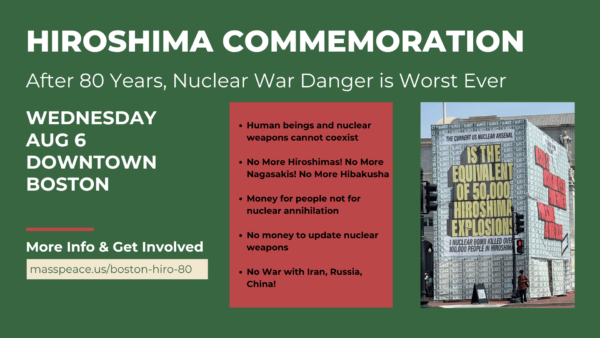
August 6th marks the 80th anniversary of the U.S. military dropping an atomic bomb, from the B-29 bomber Enola Gay, over the Japanese city of Hiroshima. Three days later, Nagasaki would suffer the same fate. Boston’s arts community has taken little notice of the occasion, which is not surprising. America’s performing arts culture is often indifferent to issues of war and peace, particularly when it requires confronting our problematic history of violence. It makes for challenging, rather than empowering, theatrical experiences.
Compelling plays about the bombings exist, such as Michael Mears’ The Mistake and Minoru Betsuyaku’s The Elephant, which tells the story of an atomic bomb survivor (hibakusha) battling health issues along with a society eager to forget the catastrophe. Despite their relevance and power, these scripts—and others like them—are not being produced here.
That said, a coalition of Boston-area peace, justice, and environmental organizations will mark the date with a major event. I also highly recommend Greg Mitchell’s new documentary, The Atomic Bowl: Football at Ground Zero — and Nuclear Peril Today, which will begin streaming on PBS on July 12. For many years, Mitchell has written perceptively and with investigative depth about Hiroshima and Nagasaki; his 1996 book with Robert Lifton, Hiroshima in America: Fifty Years of Denial, is a favorite of mine.
There’s not much buzz about the WWII A-bombs here, but it’s another story in Japan. President Trump’s recent comment, comparing his decision to strike Iran’s nuclear facilities—“That hit ended the war. I don’t want to use an example of Hiroshima, I don’t want to use an example of Nagasaki, but that was essentially the same thing”—has drawn plenty of criticism, including invitations for Trump to visit the cities. I’m not holding my breath on that one. In his soon-to-stream doc, Mitchell points out that Barack Obama was the first—and, to date, only—sitting U.S. president to visit Hiroshima. He did not, however, travel on to Nagasaki.
July 2, 2025
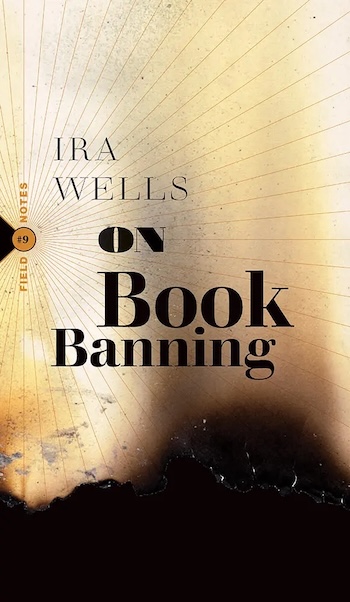
One sign of a dystopian future — an acquiescence to library book purges. Ira Wells’ excellent study, On Book Banning: Or, How the New Censorship Consensus Trivializes Art and Undermines Democracy, chronicles a recent exodus. In September 2023, the school board of the Erindale Secondary School in Mississauga, just west of Toronto, took part in “a new equity-based book weeding process.” Overnight, 50% of the school’s holdings were removed from its library shelves. According to the CBC, the vanishing was part of a regional decision “intended to ensure library books are inclusive … and [it] appears to have led some of the schools to remove thousands of books solely because they were published in 2008 or earlier.”
The offending volumes were deemed a “health hazard,” so they had to be disposed of immediately. And, because the culled books were “causing harm, they [the libraries] were forbidden from donating them to charity.” Not only was there the fear of mold, but the books were not “inclusive, culturally responsive, relevant or accurate (racism, stereotypes, microaggressions, lack of representation or erasure of communities, slurs, oppression, etc.). Fahrenheit 451 got it wrong: books won’t be burned, because big bonfires attract too much attention. Condemned material will be (quietly) trucked off to dumps so it can’t be reused. It is unknown how many thousands of books were trashed by the 259 Canadian schools involved.
Wells’s book discusses the perniciousness of book banning across the ideological spectrum. He emphasizes that both sides are committed to instituting a cutthroat political conformity under the guise of “protecting children from harm.” He helpfully distinguishes between different censorship strategies: parental advocacy groups in Florida push public efforts to eliminate books in libraries; institutional efforts in Canada are much more secretive.
“Book banning,” Wells argues, “is a form of coercion, an attempt to not only control what children read, but also what they think.” And he points out that censorship is inevitably accompanied by violence. Librarians have been fired, and in some cases killed, because of the books on their shelves. “No one should be threatened for providing access to information,” Lisa Radha Vohra, Director of Collections and Membership Services at the Toronto Public Library, told him, “I’m not so naïve to think it couldn’t happen here.” Is anyone clueless enough to believe that it couldn’t happen here?
June 24, 2025
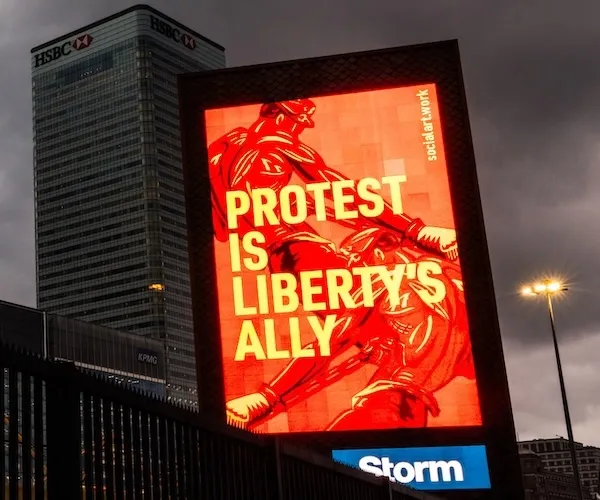
Public art by Martin Firrell presented on digital billboards in the UK in 2019.
Why is the Boston-area artist community so complacent in the face of oppressive censorship and draconian budget cuts? One dismaying answer was provided by a recent opinion piece warning against autocracy on the march in the Commonwealth Beacon. It was signed by Michael Bobbitt, director of the Mass Cultural Council; Brian Boyles, executive director of Mass Humanities; Kayla Coleman, executive director of the New England Museum Association; and Emily Ruddock, executive director of MASSCreative. Unfortunately, those expecting fire in the belly will end up wondering if the pilot light in the oven is lit.
Here is the quartet at its fever pitch: “Our jobs often find us celebrating the successes that unfold in communities that embrace the arts and the humanities. Today, however, we must sound the alarm. In its first 100 days, the Trump administration took steps that represent a clear and present danger to the cultural vitality of the nation and, we believe, to our democracy. We call on the people of New England to respond proactively to these threats.” How are “the people,” particularly arts organizations, supposed to fight back? The piece doesn’t mention protest, resistance, activism, defiance, or mass demonstrations. Our leaders offer no concrete ideas or pragmatic suggestions about how “the people” are supposed to galvanize dissent. No demands are made that repertoire be changed or shaken up to confront the threat. The alarm bell is softly sounded — as if we are expected to keep on sleeping through it.
“We call on public and private supporters to honor the history of New England by celebrating our right to courageous dissent.” Celebrate? Throw parties? That is nonsense. People will join with an arts industry that is seen to be fighting for its survival. And that means the cultural powers-that-be must get off their privileged butts and encourage, organize, and fund protests fighting to preserve the arts and democracy, events that defy authority, that short-circuit business as usual. (Hint: check out our review of The War of Art: A History of Artists’ Protests in America.)
Decades of bureaucratizing and commercializing (every creator an entrepreneur) have turned the artistic community scarily obedient, trained to tumble robotically through hoops for the sake of garnering grants for officially approved advocacy and education goals. The muscles ordained for disobedience, for defiance, for screaming ‘hell no,’ have atrophied. The state’s arts leaders’ weak-kneed rhetoric is symptomatic of that paralytic anemia. The hour for battling back is growing late. New England’s cultural sector needs to snap out of it and tap into its rebellious muscle memory, to flex its brawn as art has done over the centuries when faced with a crisis. We need to bite — as hard as we can — the hand that refuses to feed us, that wants to steal our liberty.
Evidence that Major Arts Organizations Don’t See Autocracy as a Problem: The subject line for the latest marketing email flogging the American Repertory Theater’s production of its Broadway-bound musical Two Strangers (Carry a Cake Across New York) — “We Ask the Tough Questions: What’s Your Favorite Rom-Com?”
June 19, 2025
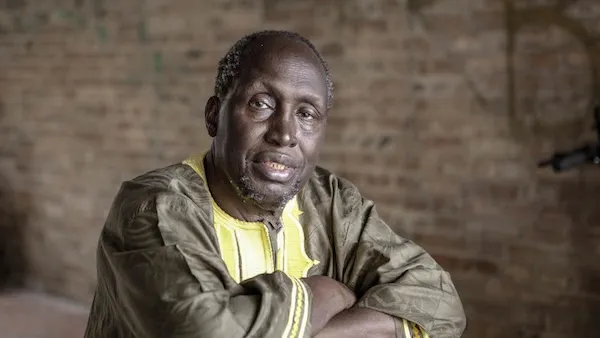
The late East African writer Ngũgĩ wa Thiong’o. Photo: Wiki Common
The encomium is overused, but Kenyan author Ngũgĩ wa Thiong’o, who died on May 28 at the age of 87, was indeed a giant whose writings and actions fused the political and the literary. His iconoclastic perspective, as a novelist, dramatist, activist, and social critic, created the groundwork for debates on the decolonization of literature and thought (in Africa and elsewhere), a commitment that runs through the essays in his latest book, Decolonizing Language and Other Revolutionary Ideas (published last month). “A people can be deprived of wealth and power,” Ngũgĩ argues in the title piece, “but one of the worst privations is depriving them of the means of perceiving and articulating their deprivation, and thereby developing a vision and strategy and tactics for fighting it.”
In America, Ngũgĩ is better known as a novelist than as a dissident dramatist. That is unfortunate, particularly now, given that his stage productions are powerful examples of defying autocracy. In 1977, he and Ngũgĩ wa Mirii co-authored I Will Marry When I Want, an anti-government script produced by the Kamiriithu Community Education and Cultural Centre, an experimental theater — built in a Kenyan village and maintained by peasants, factory workers, and primary school teachers — dedicated to presenting dialogue on cultural and political issues. Ngũgĩ wa Thiong’o was arrested and carted off to a maximum-security prison, where he would be kept without trial for nearly a year. During that period, he wrote, in secret (reportedly on toilet paper), two books: his prison memoir, Detained: A Writer’s Prison Diary, and the powerhouse novel Devil on the Cross, a critique of capitalist corruption that demanded the end of dictatorship.
In 1982, Ngũgĩ’s musical Mother Sing For Me was set to be staged at the Kamiriithu Centre, but Kenyan dictator Daniel arap Moi forbade its production. The higher-ups took censorship a destructive step further: the Centre was demolished by the police.
Since Trump’s return to power in January, there has been scant protest against the threat of encroaching authoritarianism in America’s theaters. Ngũgĩ‘s risk-taking should serve as an inspiration for our stages to speak out, despite the pressures from corporations and various vested interests for them to remain silent — and complicit.
June 11, 2025
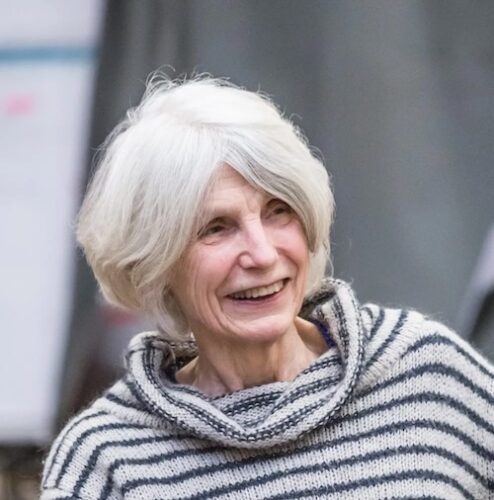
Dramatist Caryl Churchill. Photo: Marc Brenner
As for the power of artists to inspire dissent, English dramatist Caryl Churchill recently withdrew a script for production at London’s Donmar Warehouse because one of the theater’s major sponsors, Barclays, has alleged links to defense companies supplying arms to Israel. Unsurprisingly, her decision has not been reported widely in our country’s mainstream media. But the choice of a renowned British dramatist to refuse a production—on humanitarian grounds—draws much-needed attention to the relationships between theater companies and their corporate funders. In Churchill’s words, “theatres used to say they couldn’t manage without tobacco sponsorship, but they do. Now it’s time they stopped helping advertise banks that support what Israel is doing to Palestinians.”
According to The Guardian, “more than 300 arts workers and creatives, including the actors Alfred Enoch, Samuel West, Tim Crouch, Harriet Walter, and Juliet Stevenson have signed an open letter supporting Churchill’s decision.” Aside from stimulating the debate about Israel’s actions in Gaza, Churchill’s choice highlights how giant banks have long gotten away with using arts sponsorships to improve their public image. For example, JPMorgan Chase was identified as the world’s top fossil fuel financier in 2023, committing $40.8 billion in that year alone. Other humongous U.S. banks, such as Bank of America, Citi, and Wells Fargo, are also listed among the world’s largest lenders to big oil. Perhaps, someday soon, a noted American dramatist will publicize that issue by refusing to have a play produced by a theater company that receives money from banks that are funding the despoliation of our world.
As Mark 8:36 asks, “For what shall it profit a man, if he shall gain the whole world, and lose his own soul?” At this point, what with global warming accelerating and oligarchy on a quick march, it is a question those who run arts organizations should be asking themselves.
Note: This just in — Bank of America, a longtime supporter of Trinity Repertory Company, recently made a $3 million commitment to support transformational capital improvements and artistic programming at the theater, which was announced at the theater’s 2025 Pell Awards Gala on Tuesday. “At Bank of America, we believe that investing in the arts has a decisive impact on the community,” said Kevin Tracy, president of Bank of America Rhode Island. “Trinity Rep is a vital organization that makes the arts more accessible through bold and original theatre and stimulating education programs. We are eager to support Trinity Rep as they make major building renovations that will keep this important cultural resource in downtown Providence providing entertainment to Rhode Islanders of all ages.”
In 2024, Bank of America provided financial commitments to fossil fuel interests totaling almost $34 billion. This amount places them in the top three fossil fuel financiers, along with JPMorgan and Citi, according to Utility Dive and NBC News.
May 28, 2025
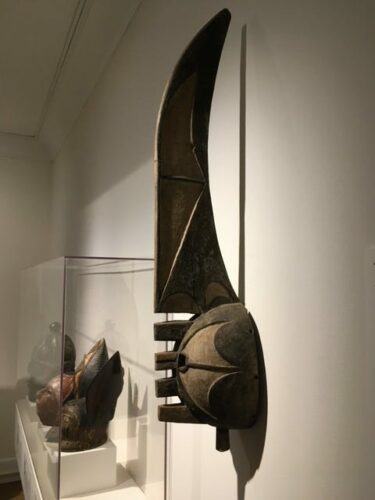
One of the Ibo Yam Knife masks worn in stagings of the Okumpka plays. During these performances, youth had dramatic license to criticize questionable behavior of elders without fear of penalty. At the Fitchburg Art Museum. Photo: Bill Marx
A shout-out to Hyperallergic editor Hakim Bishara’s refreshing polemic on the state of art criticism, which he aptly characterizes as alive and kicking. His kick-ass pick-me-up should serve as a clarion call to those who lament the end of arts commentary and are fixated on the curtailment of cultural evaluation in mainstream media. They neglect the ample evidence that serious consideration of the arts — on Substack, YouTube, Instagram, etc. — more than makes up for the loss of what was (and is) often the work of critics who, even on their best days, churned out publicity-adjacent mediocrity.
From Bishara’s essay: “Good art criticism airs buried truths, challenges tastemakers, questions our beliefs. It links the art on the wall to the world outside, and gets to the bottom of how and by whom it’s marketed, bought, and sold. At the very least, it motivates readers to go out and see the work to make their own judgment. At best, reading criticism can be as transformative as viewing a great piece of art.”
“The real problem with art criticism today is the profusion of bad-faith actors, useful idiots, vapid scenesters, pitiful star-fuckers, press-release recyclers, dull theorists, hopeless graphomaniacs, paid influencers, cheap provocateurs, and apolitical, nihilist hacks.”
I couldn’t have said it better myself about arts commentators in the Boston area and beyond. The problem isn’t that criticism is disappearing, but that we need to make what we have now better — more iconoclastic, more provocative, more thoughtful, more articulate, and more persuasive. A conversation worth having would focus on finding ways to strengthen incisive evaluation and banish marketing chatter, rather than indulging in hand wringing about the supposed decline of arts reviewing or calling for the extinction of gatekeepers. It is the inept ones we can do without.
Bishara doesn’t list one role that good arts criticism plays — it serves as a defense against autocracy. For Hannah Arendt, critical dialogue strengthens community because it purges the culture of pollutants: reasoned judgement both exposes and demolishes unexamined assumptions of value. “Unlike speculative thought, which rarely bothers anyone, critical thought is in principle antiauthoritarian,” she wrote. Thinking and writing critically about the arts nurtures democracy.
May 21, 2025
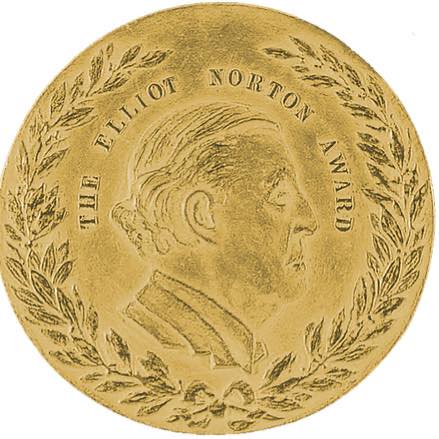
May 21, 2025
Congratulations to the winners of this year’s Elliot Norton Awards, which will be announced at the Huntington Theatre on June 2. In addition, kudos to the Boston Theater Critics Association for finally taking a long, long overdue ethical action.
Back in 2018, I requested that the Boston Theater Critics Association do the right thing and withdraw the Elliot Norton Prize from the former artistic director of the Gloucester Stage Company, Israel Horovitz. My plea followed a 2017 New York Times report that detailed multiple accusations of sexual harassment leveled against him. The NYT piece referred to my 1993 Boston Phoenix articles, which contained numerous allegations of the man’s abusive behavior toward women.
The BTCA’s backhanded response in 2018: “The Boston Theater Critics Association will handle all matters relating to the Elliot Norton Awards in its own good time.” In a recent email, the group’s publicist informed me that, two years ago, an asterisk had been placed by Horovitz’s name in the program for the Norton Prize: a note at the bottom of the page acknowledges the existence of “reported allegations of sexual misconduct, assault, and rape committed by this recipient, which were unknown to The Selection Committee at the time the award was given.”
I stopped making the request in 2022, assuming that, if the rise of #MeToo wouldn’t change the blinkered minds at the BTCA, it was time to give up on a cadre of critics whose politics “are as conventional as its taste.” My suggestion now: keep up the activist momentum! Other uncomfortable realities must be addressed, and we don’t have six years for the organization to dither. Theater critics have an obligation to speak out, often, on a range of issues, including artistic censorship, the hobbling of the NEA, and the responsibility of theater companies to address issues that are crucial to the well-being of the community. In other words, to do more than serve as happy-talk consumer guides shoring up the increasingly absurd line that ‘everything is normal’ while an authoritarian regime cements itself in place as it wrecks democracy.
Since I left in 2007, the BTCA has added to its membership. May this fresh blood push the organization to speak out against the Boston theater community’s apathetic response to autocracy and lawlessness, to call for everyone who values maintaining the independence of the imagination, dramatic and otherwise, to do what they can to agitate for the freedom of speech and thought, and to join with the many advocacy organizations battling for the intellectual / economic health of creative non-profits, such as the Theatre Communications Group, that are waging the indispensable fight against Trump’s fascist-adjacent administration. During the Nazi era, theater critics in the mainstream media either played dumb or enthusiastically collaborated. Silence is complicity, and the time to defeat autocracy is growing short. Theater companies and critics should stand together at center stage — on the right side of history.
May 14, 2025

Happy 95th birthday, poet, essayist, lecturer, Zen Buddhist, and environmental activist Gary Snyder.
We look to the future with pleasure/ we need no fossil fuel/ get power within/ grow strong on less. from “Tomorrow’s Song,” Turtle Island
On May 8, Gary Snyder turned 95. Poet Lawrence Ferlinghetti dubbed him the “Thoreau of the Beat Generation,” an honorific the poet, often with irritation, has distanced himself from. Still, Snyder served as an undeniable influence on the Beat generation and its followers. He was one of the inspirations for the character Japhy Ryder in Jack Kerouac’s The Dharma Bums, and helped initiate the San Francisco Renaissance by organizing poetry readings with his close friend Allen Ginsberg, among others, thus helping to establish the Beats as a social and cultural force.
Few of the essays in the new Library of America volume Gary Synder: Essential Prose deal with the Beats. Snyder has been an important contributor to environmental philosophy and politics, and the pieces here delineate modern society’s alienated relationship to the natural world. His chief concern has been positing ways in which we can protect nature from the savagery of civilization. For Snyder, this is a dynamic process: curtailing our anthropogenic focus on ego and subjectivity serves as a way to strengthen human community as well as reinforce our inseparability with nature.
Along with backing up Snyder’s rep as the “poet laureate of Deep Ecology,” the prose here supplies self-deprecating humor — he is uncomfortable playing the role of guru. That said, Snyder’s writing lacks the eccentric riffing of Thoreau, who at times can be surprising, to the point of head-scratching. As Kim Stanley Robinson suggests in his introduction to the LoA volume, Snyder’s Zen steadiness poses a healthy alternative to the self-destructive (and self-indulgent) behavior of the Beats. His prose follows suit, though some splendid, fantastical passages come along. Here’s a section from one of my favorite essays, 1978’s “Poetry, Community & Climax”: “Art is an assimilator of unfelt experience, perception, sensation, and memory for the whole society. When all that compost of feeling and thinking comes back to us then, it comes not as a flower, but — to complete the metaphor — as a mushroom: the fruiting body of the buried threads of mycelia that run widely through the soil, and are intricately married to root hairs of the trees.” I love it — artists as the nurturing toadstools of the world.
May 7 ,2025

William Everston, Orwell. Wood and polymer clay with bronze. A line from 1984 ishand-carved on the other side: “If you want a picture of the future, imagine a boot stamping on a human face — forever.” Photo: Bill Marx
In his 1987 volume Who Needs Theatre, Robert Brustein asserts that “theatergoing is one of a dwindling group of activities that bring Americans into communication with each other; it is, therefore, an enterprise that preserves some vestige of belief in the possibilities of society, if not of communion. It may be also one of the last remaining shreds of evidence that we are a people, and not just an isolated mass of frightened fantasists, barricaded in our homes, seeking safety from a sinister and threatening external world.” These are salient points, but they don’t go far enough. The stage serves society best when it dares to grapple, mano a mano, with pervasive “sinister and threatening” ideas and forces, especially when they are on the march. Theater is social history: it is a record of resistance and cowardice for the future.
At present, the record of Boston’s major theaters is disheartening. The Huntington Theatre Company recently announced its upcoming season. Artistic director Loretta Greco says the titles were chosen because “we were fascinated by the themes of legacy and family: where we come from, what we leave behind, and what truly matters most.” These may be superior productions, but threats in the external world are not part of “what truly matters” — the rise of authoritarianism, economic chaos, the upending of the postwar global order, Americans being ‘disappeared’ into a gulag in El Salvador, the ravaging of science research, the minimization of the climate crisis. Won’t these issues — and so many others — endanger families and their legacies moving forward? Of course, our well-heeled theater companies may know something those of us deeply concerned about what is happening don’t — worry not, this fascist-adjacent regime is but a passing fad. Perhaps future theatergoers can look forward to being entertained by a stimulating HTC staging of “What the Constitution, Sliced and Diced, Means to Me.”
On a more positive note, some New England theaters are doing more than catering to the appetites of “frightened fantasists.” I have not seen the show, but Yale Repertory Theatre is staging (through May 17) Notes on Killing Seven Oversight, Management and Economic Stability Board Members. A section from the New Haven Independent review sounds promising: “In a time where an unelected Board cuts social services in the name of efficiency, and the right to self-determination and transition is steadily being whittled away, plays like Notes on Killing feel less like a scream into the void and more like a slap on the butt. This is our world. This is our fight. So what are we going to do? How are we going to hold those in power accountable?” These are the kinds of vital questions our self-proclaimed community-minded theaters should be grappling with. Over in the Berkshires, the Great Barrington Public Theater will be staging Maggie Kearnan’s satire (from June 5 to 22) How to NOT Save the World with Mr. Bezos. In this play, the second-richest individual in the world (according to Forbes) receives his just desserts. Sounds like another welcome “slap on the butt” to me.
April 30, 2025

No disrespect to F. Scott Fitzgerald’s The Great Gatsby, but haven’t the celebrations of its 100th anniversary gone over the top, to the point of kitsch? It’s a tip-top novel, yes, but truckloads of hoopla have been dumped into the media, both mainstream and marginal. A sampling includes the Empire State Building being illuminated in green, Gatsby-themed art exhibits, multiple annotated editions, Jazz Age soirées and cocktail events, and a party thrown by the Broadway musical version of the book. Is this about the incisive literary merit of Fitzgerald’s vision, or the obvious fact that the glamorous undercurrents of its plot can be so easily merchandised? Ironically, we are whooping up Gatsby and company at a time when we may, as in the Roaring ’20s, be stampeded off an economic cliff by a president for whom “the chief business of America is business.”
So let’s note two other classic American novels that are also celebrating their 100th birthdays. I would strongly recommend both: their compelling critiques of American class envy, blind idealism, and self-destructive materialism are just as stinging (if not more so) than Fitzgerald’s. Willa Cather’s The Professor’s House is a nuanced study of middle-age ennui propelled by American acquisitiveness and superficiality. A. S. Byatt judged it to be Cather’s masterpiece: “It is almost perfectly constructed, peculiarly moving, and completely original.” Theodore Dreiser’s An American Tragedy is a monumental achievement that took him over a decade to complete. The hulking narrative is based on a real-life murder (a 1906 “accidental” killing). Its methodical ‘true-crime’ vibes inspired Richard Wright’s Native Son (1940), Truman Capote’s In Cold Blood (1966), and Norman Mailer’s The Executioner’s Song (1979). The novel was also the basis for George Stevens’s accomplished 1951 film A Place in the Sun.
Because Dreiser is a neglected giant, a special shout-out for An American Tragedy. A trailblazing writer of the first half of the 20th century, he memorably chronicled the no-holds-barred careers and crimes of 19th-century robber barons (the Musks of their day) in his fine novels The Financier and The Titan. An American Tragedy is not as much “fun” to read as The Great Gatsby, but Dreiser’s vision of the degradations of class and the bedevilments of upward mobility stands as a far more comprehensive attack on the American dream. Gatsby gazes with hope at the green light at the end of Daisy’s dock. Clyde Griffiths, Dreiser’s anti-hero, is crushed by the two-ton machinations of the system, his restricted possibilities on telling display when, early in the novel, he is employed as a bellhop at a fancy Chicago hotel. From the get-go, Clyde is on track to fall to the bottom of society as quickly as he climbs up.
April 23, 2025

Photo: Freedom Forum
Cultural and artistic institutions like the Kennedy Center, PCAH, NEA, and NEH, along with other national, state, and local institutions across the United States, are under attack and, though it has taken a while, their partisans are beginning to fight back. But this lackluster resistance (at least so far) has been hampered by a puzzling reluctance to name names and target the enemy, perhaps because doing so might upset powerful business and political interests. Massachusetts’ defenders of the arts insist on their vital importance to education, entertainment, economic activity, and preserving cultural heritage. All well and good, but arts and culture can also stand as dissenting bulwarks against authoritarianism. Yet a blunt assertion of this stance — a commitment to defending democracy against tyranny — is damned hard to come by. The truth is, defeating Trump and his enablers is about more than just reversing deep cuts in funding. The country is in crisis: the exercise of a free imagination is in just as much danger as the Constitution.
Weirdly, recent statements about DOGE cuts from Mass Humanities and The Boston Foundation are tightlipped about the motives driving the demolition squad. A Boston Globe opinion piece penned by Brian Boyles, executive director of Mass Humanities, dares not mention MAGA or Trump, let alone allude to the specter of his kingship. A Mass Humanities email that advises readers on “How You Can Help” says nada about the admin’s goal of controlling and/or dismantling cultural institutions. A Creative Sector Day is set for April 30, where “members of the arts and cultural community from across the commonwealth will join together at the State House to celebrate the contributions of artists, cultural organizations, creative businesses and arts workers to Massachusetts.” How about protesting the administration’s radical reshaping of the Smithsonian, an attempt to eliminate what Trump described as “improper, divisive or anti-American ideology”? An invite to an upcoming Boston Foundation talk on The Future of Collective Action for the Arts & Culture Sector doesn’t mention the threats to creative freedom posed by oligarchy or monocracy. Instead, we are informed that this is an “unprecedented and challenging moment”. You don’t say!
The timidity can be rationalized, though not easily excused. It is fear and trembling masked by the diplomatic lingo of a cautious bureaucracy. It is the reluctance to place the arts and in any risky contexts, to stay within safe educational and economic borders. The latter is a particularly disturbing reason behind the hesitancy to speak out. In the past, assumptions of the independence of American arts and culture rested on the population’s confidence in the maintenance of democracy. Today, the ground on which creative liberty stands is being systematically undermined. Authoritarian states, such as Hungary, Turkey, and China, often fund obedient museums, theater and dance companies, music and film productions. Artists who refuse to self-censor either leave the country or struggle underground. Our cultural organizations should be about more than just demanding higher funding levels — the creative sector must call out a despotic enemy while there is still time to stop an autocratic coup.
April 16, 2025

African literary giant Wole Soyinka. Photo: Theatre for a New Audience
Wonderful to see the 1958 drama The Swamp Dwellers, by the great living playwright Wole Soyinka, so well received in its off-Broadway premiere (running through April 20). Another extraordinary living dramatist, Adrienne Kennedy, recommended the script to Theater for a New Audience. I learned that in an interview the 90 year-old Nigerian writer, winner of the 1986 Novel prize for literature, had with the NYTimes. The focus was on his disappointment with what was happening in the world, from MAGA America and Gaza, not on his career as a dramatist. There is scant mention of his finest stage works, which to my mind would include The Strong Breed (1964), The Road (1965), The Bacchae of Euripides (1973), and Death and the King’s Horseman (1975).
To my knowledge, there have been no professional productions of these plays in New England. It is an embarrassment, though our record is not entirely shameful. In 1984, Yale Rep staged the world premiere of A Play of Giants, Soyinka’s satiric expose of the inanity of autocracy via a gathering of African heads of state (including Idi Amin) and their cadres of sycophants. The drama uses absurdist humor to savage how delusions of grandeur — entwined with an insatiable will-to-power — undercut civilized values, including democracy. Soyinka is prescience about how egomania, paranoia, messianic fantasy, and unpredictability drive authoritarian repression. His romp resonates with particularly stinging force in the era of Trump.
The NYTimes’s Frank Rich did not like Soyinka’s direction of his own play, but the critic’s opening rings true after four decades: “Political satire hardly exists in the American theater anymore, and when it does, it’s so mild that audiences need never run for cover. That’s why it’s uncommonly bracing to encounter A Play of Giants .. [which] spares no one in this farcical fantasy about African dictators at loose in New York.”
This script is one of a number of theatrical takedowns of megalomaniacal leaders Soyinka has written, including From Zia, With Love (1992), and King Baabu (2002), the latter a lively spoof inspired by Alfred Jarry’s Ubu Roi. Over the past two decades, Nigeria has been classified by its critics as a purported democracy, its corrupt rulers exploiting ethnic bigotry, governmental impunity, a flagrant disregard of the rule of law, and extrajudicial executions. Just this month, Soyinka protested the most recent example of presidential overreach. Given current reality, our fearful and silent stages might consider turning to — or at least being inspired by — the plays of a world-class dramatist who has diagnosed and scathingly lambasted the temperaments of anti-democratic despots.
April 9, 2025

A sign in the recent anti-Trump “Hands Off” march in Boston. Photo: Bill Marx
The Trump administration is coming for arts and culture. Will it meet any opposition?
“Restrictions on Diversity, Equity, and Inclusion initiatives are already directly affecting national institutions including the Smithsonian,” reports Artnet, “while other orders could lead to further challenges for artists seeking grants, sourcing materials, and looking to collaborate or exhibit across borders. Meanwhile, DOGE, helmed by Elon Musk, has made deep funding and staff cuts to key agencies that support museums and other arts initiatives.” In Massachusetts, Mass Humanities learned that its current grants with the NEH have been terminated. The result is a loss of more than $1.3M in funding, nearly 35% of its annual revenue. WBUR reports that the cuts mean that libraries across the state “are worried about how they’ll provide vital services such as interlibrary loans, e-books and access to databases.”
Individual artists are protesting, and The Theater Offensive is among the groups suing the NEA over its new draconian restrictions. But Boston’s big media and arts organizations have pretty much been mum, at least so far. Boston’s major arts groups aren’t even daring enough to carry such ‘rebellious’ banners as “Defend Democracy” or “Save Library Services” on their websites. This week the artistic director of the American Repertory Theater, Diane Paulus, hosted a “virtual fireside chat at the Harvard Chan Studio about the power of shows like Waitress, Jagged Little Pill, and Night Side Songs to illuminate critical public health challenges.” Was treating the cancer of authoritarianism mentioned? Probably not. Still, Paulus must have been cautious about what she opined: Robert Kennedy Jr.’s Department of Health and Human Services was no doubt monitoring the confab for mentions of fluoride.
Around this time, some arts groups announce next year’s season. I just received Lyric Stage Company’s chirpy email about what’s coming up. The troupe advises Bostonians to relax: “Live in the Moment. Let in the Joy”. Concerning its upcoming lineup: “Every story, a love letter to the human spirit.” The Trump administration is attempting to establish its own fear-leveraged version of Mao’s Cultural Revolution. The arts should not obey in advance by sticking their heads into the quicksand of bromidic business-as-usual.
April 2, 2025

Khawla Ibraheem in A Knock on the Roof at the Edinburgh Fringe. Photo: Alex Brenne
Is it possible, in America today, to stage a drama about Gaza? In a January 2024 Los Angeles Times column, theater director Guy Ben-Ahron was pessimistic as he recalled the reaction to his 2015 Israeli Stage production (at Arts Emerson) of Ulysses on Bottles, an award-winning 2012 Israeli drama. “I knew it would shake up audiences,” he confesses, “I too was challenged by what the play brought up: Israelis’ daily indifference to the Gaza siege, which their government hoped would weaken Hamas’ rule but instead became a cruel policy of collective punishment.”
The kickback was predictable. “Reaction to the Boston production could be summed up in one comment: great art but unsettling. Tickets sold out for the majority of the run, but my theater company, Israeli Stage, lost funders and audiences. The head of Boston’s Jewish federation never came to another of our productions, and his organization reduced its sponsorship of our work. The consul general of Israel in Boston summoned me to his office and told me to put on other plays instead.” Ben-Ahron goes on to talk about how difficult it would be to produce the play here or in other countries today (given the inevitable charges of antisemitism). He also points to growing self-censorship among Israeli theater artists. “Ulysses on Bottles was the last major Israeli play to reckon with Gaza, and that was 12 years ago.”
But that silence on Gaza may not be as total as Ben-Ahron suggested over a year ago. Syrian-Palestinian Khwala Ibraheem’s one-person play A Knock on the Roof, directed and developed by Oliver Butler, has had successful runs at off-Broadway’s New York Theatre Workshop and at London’s Royal Court Theatre, where Ibraheem’s script (which focuses on a young mother in Gaza who is rehearsing her evacuation drill, fearing an Israeli bomb will fall on her family) and performance garnered highly positive reviews. That pedigree should reassure Boston theaters working up the gumption to stage a script that meets the political/historical moment.
March 26, 2025
A recent Letter to the Editor in the NYTimes from the founding artistic director of Arizona Theater Matters.
“I run a small theater company that relies on funding from the National Endowment for the Arts. For decades, the N.E.A. has sustained organizations like mine, ensuring that theater belongs to everyone — not just those with the means to fund it themselves. The N.E.A. has stood for artistic freedom. Today, it is being held hostage.
Under federal directives, the N.E.A. has imposed restrictions. Theaters may no longer have to disavow diversity, equity and inclusion in their mission statements, but their projects still do. Productions focusing on racial justice, transgender narratives or systemic critiques are not eligible.
Small theaters cannot afford to reject N.E.A. funding. But the largest theaters in America can. Institutions with multi-million-dollar budgets and major endowments have the power to take a stand. If even one refuses funding under these restrictions, it would send a powerful message: Public arts funding must serve the whole public.
Major theaters must act before April 7, the N.E.A. deadline for Grants for Arts Projects proposals. History is watching.”
The situation is fluid: lawsuits have been filed against the N.E.A. rule changes. I asked Boston’s major regional stages if they had issued any public statements on the N.E.A. requirements. The Huntington Theatre Company: “We don’t have a public statement at this time.” The American Repertory Theater “has not issued a public statement about the guidelines”. Arts Emerson did not reply.
Some major theaters have taken public stands against the N.E.A. guidelines: Portland Center Stage, The Public Theater in New York, New York Theatre Workshop, Long Wharf Theatre in Connecticut. Several theaters have already rejected or are seriously considering refusing N.E.A. funding due to the recent restrictions.
Once, Boston’s major regional stages were somewhat competitive, but over the past decade they’ve started out sending out emails recommending each other’s shows. The rich and powerful theaters now see themselves as members of a friendly club. But do these chums see themselves as pals with the broader theater community? Or are they part of a privileged class, prioritizing business as usual while quietly trimming their political sails—similar to the abject surrender of Columbia University? What do our major regional theaters truly believe in, besides maintaining their safety and status? History — and supporters of artistic freedom — are watching.
March 12, 2025

[Editor’s Note: I am speaking only for myself in this commentary, not for any others who are involved in producing the Climate Crisis Cabaret.]
Why did I help organize the Climate Crisis Cabaret? Because these are not normal times. And we need more theater like it.
But some in the Boston theater community don’t think business as usual needs to be interrupted. Or, they may think it, but aren’t willing to act because it will upset the status quo, undercut decorous social/economic arrangements. The fact is, normality itself is under threat today from both the dangers posed to democracy by the right and our inaction on mitigating the degradation of the environment. Our stages are largely ignoring these existential dangers. This neglect reflects a baffling indifference to the survival of the theater companies themselves as well as to the well-being of future generations. It also represents a retreat from theater’s responsibility to do more than supply entertainment or confirm accepted notions. For the Greeks, the stage had the civic responsibility to speak truth to (or at least dissent from) unjust power.
At the moment, an ascendant right is slicing and dicing our institutions, particularly those that deal with the climate crisis, as it marches toward what looks like an autocratic reign. This anti-democratic movement demands a strong public reaction from our theaters or, at the very least, incisive efforts to dramatize what’s at stake in the contest. What are our elemental values? Why do we hold them? What happens when we forsake them? The first tragedians would have promptly swung into poetic action. (Euripides would have loved Trump – one of his satyr comedies starred a giant, mindless, priapic bull.)
Read the rest of the commentary here
March 5, 2025
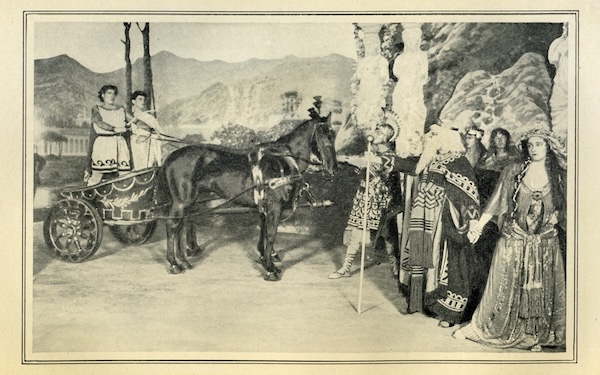
William S. Hart as Messala (posing with a real horse) in the 1899 Broadway production of Ben-Hur, which played at Boston’s Colonial Theatre
“For the first time, the federal government has hijacked what is supposed to be the nation’s premier arts institution in an effort to explicitly censor voices and viewpoints it deems undesirable,” charges Jonathan Blumhofer in his commentary on the changing of the guard at the Kennedy Center. Is it too soon to speculate about the MAGA esthetic, or at least its approach to theatrics? I think not. We saw what will be one of its essential ingredients in the (pre-planned?) televised mugging of Ukrainian President Volodymyr Zelensky in the Oval Office. President Trump characterized the embarrassing takedown as “great television”. The Kremlin agreed. It was a show of power as a spectacle of humiliation, bullying and misinformation used to mortify a weaker opponent. It may well be a precursor to what is to come once FBI honchos Kash Patel and Dan Bongino and Department of Justice head Pam Bondi hunt down the cast of characters for the (televised) political courtroom showdowns to come.
But limiting MAGA to prosecutorial drama may be too limited a way to understand the movement’s strategy for the stage. Hitler attacked “degenerate” theater, but fascist governments are not inevitably doctrinaire. I have been reading up on how theater fares under authoritarian regimes (a critic must be prepared), and I stumbled across Patricia Gaborik’s Mussolini’s Theatre: Fascist Experiments in Art and Politics. It turns out that the dictator fancied himself to be a hands-on “man of the theater”: he wrote scripts, commented on shows, personally shut down productions, including those by Pirandello. Gaborik’s fascinating study makes a surprising — but well-researched — case that Mussolini respected the art of the theater. For Il Duce, what happened on the stage strengthened the fascist cause because he saw “the art form as spiritually uplifting — not merely propagandistic and coercive.”
What does this say about the aesthetics of MAGA? Well, Trump is a self-glorifying impresario. He won’t be writing dramas, but he will have booking power over the Kennedy Center, including vetoing content. As an extension of his efforts to reshape federal institutions, Trump is interested in exerting control over cultural narratives. No doubt “spiritually uplifting” patriotic extravaganzas will be funded to divert us from the new Gilded Age, stage-managed by our tech bro-crypto robber barons. “We have to bring religion back,” Trump said at February’s National Prayer Breakfast. “We have to bring it back much stronger.” In 1899, the muscularly Christian Ben-Hur was a musical smash on Broadway and Trump’s current favorite President, the tariff-crazed, expansionist William McKinley, was in the Oval Office. We are off to the chariot races.
February 26, 2025
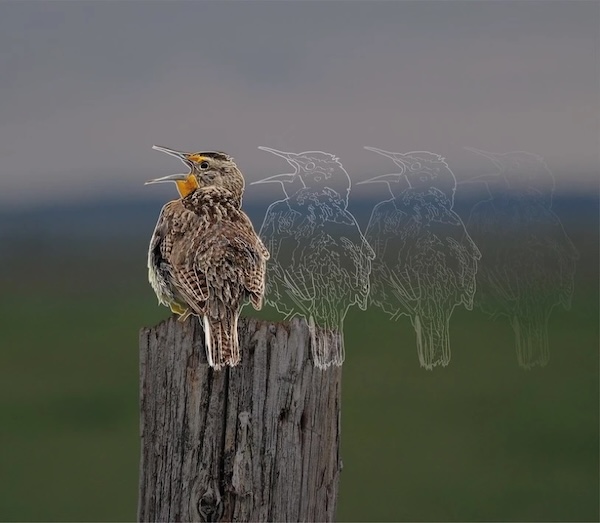
Donald Trump bellows that climate change is a hoax, and his cabinet is a cast of characters poised to deliver on the promise of our self-proclaimed king to ‘drill baby drill’ as he wipes out the environmental legacy of the past decade or so, ripping up whatever international climate commitments that stand in his way. Boston’s opera companies and music schools are mounting productions that sound the alarm. The city’s theater troupes are, as usual, snoozing at the switch. Until now, that is. Come to the Climate Crisis Cabaret: The Warm-Up at Arrow Street Arts on March 24 and 25. This innovative gathering will fuse the arts and climate activism through a lively mix of theatre, comedy, song, and readings that tap into the wealth of emotions stirred by the environmental crisis. Debra Wise and David Keohane are at the directorial helm; John Kuntz will be the M.C.
How can I be sure that CCC will deliver? I am one of the show’s Lead Organizers, along with Wise and dramatist Joyce Van Dyke. The idea was to gather together local stage artists — actors, writers, musicians, etc — to address the climate emergency in vibrant, innovative ways. The cabaret will be followed by a post-show conversation among performers, scientists, and activists. Also helping to get the word out about what can be done: a lobby street fair of groups engaged in environmental issues. The goal of the evening is to inspire our community to act while also encouraging more climate crisis programming from our local theaters. And there is an expectation that the “warm-up” will be the first installment in a series of cabarets on the environment that draws on the talents of Boston-area theater artists.
The Climate Crisis Cabaret: The Warm-Up is funded in part by the Puffin Foundation, with generous administrative support from Arrow Street Arts. I am not only one of the cabaret’s organizers, but a part of the show, reading Ted Hughes’ poem “How Water Began to Play” (think “water sings the blues”). It has been 50 years since I have appeared on stage; in 1976, I was cast as a doctor’s assistant in a Bowdoin College production of Arthur Kopit’s Chamber Music. It was important to me to be in front of the footlights, and not only because of my apprehensions about the future of the planet. This cabaret could serve as a model for other stage efforts. Theater artists strengthening community by putting together pointed entertainments that reflect on contemporary realities, such as defending democracy. May a thousand cabarets bloom.
Check the website for info on CCC: The Warm-Up. Seating is limited in the Arrow Street Arts Studio space, so reserve your Pay-What-You-Can tickets pronto. I will be writing more on this effort — and other stage productions that meet the moment — in the weeks to come.
February 19, 2025
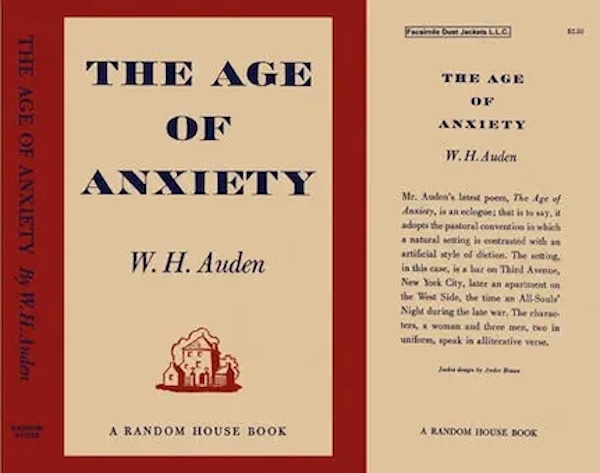
Dust jacket of W.H. Auden’s 1947 The Age of Anxiety: A Baroque Eclogue
First, please read Jonathan Blumhofer’s splendid piece on how the arts should confront the “New Age of Anxiety” as tremors of fear spread throughout the cultural landscape. Some artists are cancelling their appearances after Trump’s hammer-and-tong takeover of the Kennedy Center, motivated by his charges that the organization hosted drag shows and somehow subsidized “Chinese Communist Party propaganda.”
The response has been more subdued, at least so far, to new NEA guidelines revised to grease the rollout of nationalistic flapdoodle. Here is how American Theater characterized the ideological mugging: “Arts organizations that apply for NEA grants in FY 2026 will be required not only to sign on to the openly regressive agenda of the new administration to roll back progress on racial and cultural diversity and trans rights, but to discontinue any programs or efforts they have in place now along those lines at the National Endowment for the Arts.”
“Each day brings new troubles and concerns,” asks Blumhofer, “how should we proceed? Ideally with boldness, though that quality seems to be in short supply, especially in the arts world.” Will local theaters find the courage to fight Trump’s attempt to kneecap democracy? Grow a spine and agitate against his authoritarian demands? Or will they serve up empowering distractions for audiences eager to escape the upheaval in the real world? Blumhofer mentions local productions of the operas of Brecht/Weill. It has been many years (decades?) since a Boston theater mounted plays in the Brechtian mode, selected dramas that proffered hard-hitting critiques of repressive economic and political powers-that-be that might upset our monied powerbrokers. Boston’s arts institutions are well poised to meet the moment, posits Blumhofer. Let’s hope they spring into action.
Reviewers, as well as artists, will be pressured to conform or collaborate. Pulitzer Prize-winning critic Michael Dirda announced recently that he has decided to suspend his Washington Post Book World column. Among his reasons for the decision: “the new American president’s antagonistic relationship with intellectual pursuits.” Back in the ‘90s, conservatives rightfully accused liberals of “dumbing down” American culture. Now Republicans are supersizing the stupidification of a nation. Will arts critics go along to get along?
February 12, 2025
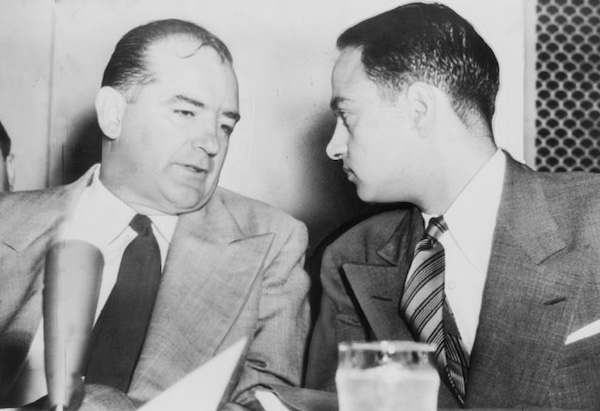
Sen. Joseph McCarthy chats with his attorney Roy Cohn during Senate Subcommittee hearings on the McCarthy-Army dispute. Photo: Wiki Common
Amid Donald Trump’s tsunami of edicts, his appointment of himself as the head of the Kennedy Center for the Performing Arts in Washington D.C., supposedly to usher in a “Golden Age” of American culture, has been met with derision or pooh-poohed. That is a mistake: there is no doubt in my mind that show trials – public drubbings of a strategically chosen lineup of ideological “internal enemies” — ‘degenerates’, radical left-wingers, DEI Advocates — are going to come. Stalin and Joe McCarthy seized on sensationalized courtroom circuses to consolidate power, gin up fear, and manipulate public opinion. Trump will garner retribution for his time in court while distracting the mainstream media with the interrogation of names culled from government and the news media. The authoritarian impresario Stalin held his theatrical beatdowns in august venues like the October Hall of the House of the Unions in Moscow.
Why shouldn’t Trump – ever alert to maximum ratings impact – stage his histrionic roundups of collaborators with the “enemy from within” in the Kennedy Center?
Trump no longer has his favorite fixer, Roy Cohn, but his replacements, tech bros Jeff Bezos, Elon Musk, and Mark Zuckerberg, have positioned themselves and social media to amplify the corrosive power of his carnival courts to the max. Even megalomaniacs like McCarthy and Stalin could not have dreamed how effectively technology can be wielded to spread the poison of show trials – to hyper-accelerate their miasma of misinformation, blurring the line between truth and lies.
What might our theater, if it was courageous rather than servile, do? Educate and provoke by mounting its own trials or docudramas on stage. In the past, plays have drawn on court transcripts, such as Eric Bentley’s Are You Now Or Have You Ever Been: The Investigations of Show-Business by the Un-American Activities Committee 1947–1958 or Peter Weiss’ The Investigation. Why not imaginatively stage edited transcripts of the trials of Trump and/or his criminal entourage? Perhaps present selections from the court proceedings that involved the now pardoned January 6 insurrectionists?
In addition, produce scripts that speak to the present crisis, such as Yukio Mishima’s 1968 drama My Friend Hitler, which includes excerpts from the Fuhrer’s speeches. The plot: it is the early ‘30s and Hitler is consolidating total control with the assistance of the wealthy industrialist Gustav Krupp, who, at the end of the drama, congratulates the Fascist leader: “You cut down the left and, as you turned the sword back, you cut down the right.” Mishima’s Hitler responds: “Yes, government must take the middle road.”
February 5, 2025
Last week, I congratulated White Snake Projects for its commitment to present a “climate change-themed series of performances, conversations, initiatives, and its first community opera”. The Boston Lyric Opera should also be saluted for the world premiere (March 12 through 16) of The Seasons, an opera in which Antonio Vivaldi’s Four Seasons will serve as connective tissue in a libretto written by Sarah Ruhl that “imagines a world whose weather is turned upside down and the impact on artists and affairs of the heart.” The production is part of an ambitious BLO season program called the Rising Waters / Rising Voices initiative, which will include, in this case, “post-show talks about climate change featuring regional experts in related fields.”
This BLO production is one way a venerable work can be re-imagined to address the climate crisis. Another strategy is to re-examine a classic through a contemporary perspective. A recent Boston Globe interview with actor and dramatist Kate Hamill suggests her revised version of Homer’s Odyssey, to be staged soon by the American Repertory Theater, will have a venerable feminist slant: “I have never believed that Penelope just sat on her hands for 20 years.” A solid idea for reenvisioning the story on stage, but “asking how we can embrace healing and forgiveness in order to end cycles of violence and revenge,” as ART publicity puts it, goes back to Aeschylus.
What would be fresher? Over the past couple of decades the Iliad and the Odyssey have been read by critics and scholars for their overlooked insights into the evolution of environmental destruction. Edith Hall’s Epic of the Earth: Reading Homer’s Iliad in the Fight for a Dying World (Yale University Press) argues that “the urgency of the global ecological crisis must impel us to reassess the Homeric warriors yet again, in terms of their rapacity toward their natural environment.” The Odyssey has also been explored for how it speaks to modern ecological concerns, for how Homer’s epic links together “the abuse of nature as well as cavalier attitudes to battlefield casualties and the rape and enslavement of women.” It is time that dramatists looked back at the past through greener lenses.
January 29, 2025
White Snake Projects Music Director Tianhui Ng in action. Photo: Kathy Wittman
When performing arts organizations have the gumption to move in an enlightened direction, particularly into areas where others fear to tread, forward-thinking critics and audiences should celebrate. “Activist opera company” White Snake Projects (WSP) recently announced its 2025 season will present “a climate change-themed series of performances, conversations, initiatives, and its first community opera. Dedicated to using the power of music theater and the arts to effect climate justice, WSP [has] designed a distinct mix of classical and contemporary music inspired by today’s climate crisis.” This commitment to bolstering “an amplified conversation with audiences to better educate, advocate, and converse about climate change” is accompanied by WSP’s pledge to “encourage both the practice of sustainability in opera, as well as to promote the adoption of a philosophy of sustainability that can be woven into every aspect of production, from libretto development to final performance.”
“Our passion for the arts and our love for the planet are not mutually exclusive,” insists WSP founder and librettist Cerise Lim Jacobs. Not everyone agrees with the pairing. There is a discouraging perception, among movers and shakers in the media and the arts, that dramas dealing with the issue turn off audiences. A blogger for “A Younger Theater” put it this way: “climate change is an anti-social subject. It is boring for people (unless you sensationalize it) – it is negative and sad. It produces fear.” Of course, there is no reason that this must be the case. Why shouldn’t WSP’s world premiere of its sci-fi opera, White Raven, Black Dove, provide inspiration and alternatives as it looks at dark realities? As always in the theater, the proof is in the pudding.
But the pudding has to be served. Up until now, Boston theaters have pretty much stayed away from the climate crisis on its stages, along with so many other crucial issues, from war and peace to growing economic inequality.
For Harvard University’s American Repertory Theater, a major regional theater dedicated to developing boffo Broadway shows, global warming is a commercial non-starter. (I am curious to see how Trump’s return will shape what pulls in big bucks on the Great White Way.) Perhaps because of their guilty consciences, many local stages are churning out shows that address issues of racial justice. It is an essential cause, but just one contributor to what historians call our current “polycrisis,” a bundle of rapid changes — environmental, technological, and societal — that are joining forces to disrupt human and planetary health. WSP’s programming decision is an invaluable reminder that our theater companies and music organizations are being called on to expand the reach of their imaginations. More on that obligation to come — watch this space.
January 15, 2025

Mexican born vibraphonist, marimbist, improviser and composer Patricia Brennan. Her album Breaking Stretch won top New Album honors in this year’s Francis Davis Jazz Poll. Photo: Frank Heath
For the third year, the magazine is honored to host the Francis Davis Jazz Poll. As the poll’s organizer extraordinaire Tom Hull writes in his introduction to the 19th edition of the roundup, the initial version of the poll was published in 2006 at the Village Voice. It surveyed the picks of thirty New York writers. But the poll quickly went nationwide and international, ultimately moving about until it ended up at National Public Radio. Why did NPR kick the poll to the curb? Indifference to jazz? Not diverse enough? (Around 280 distinguished jazz journalists and broadcasters took part in this year’s tabulations.) Who knows and who cares? Corporate media’s loss is The Arts Fuse’s gain, which is good news for the world’s jazz lovers. There is an enormous amount of marvelous music to explore — and I guarantee discoveries for any taste.
Among its many virtues, the Francis Davis Jazz Poll is a testament to the value of critics. We need informed sensibilities eager to leapfrog beyond the white noise of PR and Spotify promotion, that look beyond big spenders bankrolling ease of access. Hull puts it this way in his piece The Nuts and Bolts: “….that a sufficient number of critics can overcome such obstacles, and find a few records that don’t have the advantages of the usual rich and famous, and lift them from obscurity to compete — not on an equal playing field, but on any one at all — suggests to me that we aren’t doing such a bad job.”
We need more arts critics, not less, which brings me to the latest local case of cultural coverage downsizing. Here is what Nina McLaughlin recently posted on Instagram:
“I’m sad to report that the Boston Globe is cutting a page of its books coverage. I found out late last week that the column I’d filed a few days before would be my last.
It’s been an honor and a joy writing about New England Literary News every week these last 8+ years. I’ve felt so lucky to be able to shine some light on the books and bookstores, the writers, the poets, the translators, the publishers, the libraries, the journals, the events that make this region so active, exciting, and rich. When I started writing it, I never could’ve anticipated how many amazing encounters it would bring, how many new friendships, how my own life would be so deeply enriched by it.”
Another castoff from the Boston Globe’s ever-shrinking arts section. As with previous reductions, I emailed the powers-of-excision at the newspaper for an explanation. There is only silence.
January 8, 2025

The late Richard Foreman.
Critic Robert Brustein called Richard Foreman, who died at the age of 87 on January 4, “the Renaissance man of avant-garde American theater” and there is truth to that. In 1968 Foreman founded the Ontological-Hysteric Theater, which was dedicated to putting on the over 50 shows he wrote, designed, and directed — simultaneously flaky and brainy funhouse visions that won copious Obie Awards. He also penned, designed, and directed musical works in collaboration with composer Stanley Silverman and directed scripts by a range of dramatists, from the traditional (Mozart, Molière) to modernists early (Gertrude Stein, Bertolt Brecht, Georg Büchner) and late (Kathy Acker, Botho Strauss, Vaclav Havel, Philip Glass)
For Foreman, the art of the drama should be dedicated to overturning deadening conventionality. The director expounded his artistic credo in his invaluable 1993 essay/play collection Unbalancing Acts: Foundations for a Theater: “My plays are an attempt to suggest through example that you can break open the interpretations of life that simplify and suppress the infinite range of inner human energies; that life could be lived according to a different rhythm, seen through changed eyes.” Foreman’s experimentalism dissolved “mind-forg’d manacles” in order to nurture transformation.
In 2013 I reviewed Old-Fashioned Prostitutes, the last play Foreman produced and directed himself. I noted that “an element of pathos has crept into the machinery, a sense of curdled mortality, as if Foreman is beginning to acknowledge that his mental gears are grinding down, or at least they are in search of an inspiring anima.” I am fortunate to have encountered Foreman at the peak of his theatrical powers, and not only via the Ontological-Hysteric Theater. Foreman’s tinker-toyish staging of the American Repertory Theater’s 1988 production of Philip Glass’s opera The Fall of the House of Usher was a disappointment. But in 1990 I witnessed his glorious, primal scream presentation at Hartford Stage of Woyzeck, which is on my short list of most dazzling theatrical experiences ever. I remember reading, bemused, Brustein’s review of the production. He concluded that the evening was “a little bit too relentless.” Both Foreman and Büchner knew that, in the theater, it takes unyielding determination to break out of the prisonhouse of the commonplace.
January 2, 2025
Last month, authorities in northwestern Russia’s Vologda region unveiled a statue of Joseph Stalin, the latest monument to the Soviet dictator to have come along in recent years. Photo: t.me/filimonov_official
Thanks to everyone who contributed to the Arts Fuse’s Winter Appeal. Without your support there would be no magazine, and you came through: we made our goal and then some. I will work hard over the coming year to use these funds fruitfully, to post reviews, features, and interviews that both illuminate the arts and stimulate healthy debate. And there may be surprises to come.
Speaking of appreciation, a shout-out to critic Mark Favermann, who won a 2024 Journalism & Communications Award from the American Planning Association/ Massachusetts Chapter for his contributions, for over two decades, to The Arts Fuse and other publications. Few magazines can boast of being able to draw on the wide-ranging expertise of such a knowledgeable writer on the real world resonances of contemporary happenings in architecture, the built environment, design, and public art. For an example of his work, see Favermann’s Short Fuse about NEOM, a futuristic urban district being built by the Kingdom of Saudi Arabia.
Speaking of awards, the mainstream media details Russia’s military campaign against Ukraine, but they predictably ignore its strategies regarding the ‘weaponizing”‘ of the arts. According to the dissident Russian news magazine Meduza, Sergey Novikov, who heads Russia’s Presidential Directorate for Social Projects, is planning to use culture to airbrush Putin’s aggression: “writers are being encouraged to travel to occupied Ukrainian territories to write about ‘establishing peaceful life,’ ‘liberating cities,’ and the lives of ‘legendary combat units,’ as well as to work with young writers in Russia. Novikov also wants to create a ‘trendy glossy’ literary magazine about the war and to establish a literary prize (‘akin to the Stalin Prize’) with a Kremlin-sanctioned winner.”
Not only is there a possibility the Stalin Prize will be making a comeback, but the genocidal Soviet dictator himself has become a trendy cultural icon in Russia. The Eurasian Review reported a year ago that “more than 100 monuments to Stalin can now be found across Russia, the majority of them erected over President Vladimir Putin’s 24 years in power.” Arts and culture are playing an indispensable role in making Stalin great again, assisting to advance ‘a statist, nationalist, militarized vision of Russia that many analysts say is effectively, if not ideologically, ‘neo-Stalinist’”.
Bill Marx is the editor-in-chief of the Arts Fuse. For four decades, he has written about arts and culture for print, broadcast, and online. He has regularly reviewed theater for National Public Radio Station WBUR and the Boston Globe. He created and edited WBUR Online Arts, a cultural webzine that in 2004 won an Online Journalism Award for Specialty Journalism. In 2007 he created the Arts Fuse, an online magazine dedicated to covering arts and culture in Boston and throughout New England.
Hello Bill! Thought you’d want to learn that Cerise Lim Jacobs of White Snake Projects does call the administration out in this Opera Wire op-ed: https://operawire.com/editorial-cerise-lim-jacobs-america-reflects-on-how-america-taught-her-how-to-think-gave-her-a-voice/
Hi April:
Thanks for this — note that the powerful and monied arts organizations and companies remain quiet about what is happening, the approach of authoritarianism. An apocryphal quotation credited to Dietrich Bonhoeffer: “Silence in the face of evil is itself evil: God will not hold us guiltless.” If we manage to maintain our democracy, those who remained mum and did not act against the threat of tyranny will not be looked at with kindness. They will be seen as complicit …
Regarding the Şeyda Kurt book: I’ve said for a long time, privately to other non-progressives, that progressivism is a hate movement. Now that a progressive has made it official, I’ll start saying so openly. Shame people for disagreeing with you (see Olúfẹ́mi O. Táíwò), murder them if it fails (see Tyler Robinson), justify it by claiming that hate is valid progressive politics (see Kurt). Someone will moan that the other side is also full of hate; I answer in advance that this is the worst aspect of the other side and emulating it makes you as bad as they are.
I’m in the circle of another magazine, Root Quarterly, that is attempting to preserve the liberal order of tolerance, humanism, and dialogue in the face of this kind of preadolescent outrage. Founder’s Weekend in Philadelphia next week will explore the related topics, and we encourage people who rightly find the politics of hate revolting to attend.
https://www.founders-weekend.com/
The anti-progressive hypocrisy here is off the charts — we are dealing with two-foot thick ideological blinders. I ask readers to check out the multi-leveled hate spewed by the Young Republicans — rape, calls for gas chambers, etc — and the increasing appeal of fascism/anti-humanism in what used to be the conservative movement. I suggest that people read Kurt’s book, which argues that hatred should be aimed at those who long for the power to dehumanize and demean — and those voices are loud and clear in a conservative movement that continues to morph into increasingly grotesque forms.
Like I said, someone will moan that the other side is full of hate. This justifies nothing and raises the question of why you’re better than they are.
I am not moaning – I am pointing out, via the USA Today link that I provided, there are alarming indications that a young generation of conservatives are becoming increasingly savage in their words and ideas — and they are being given permission to be so for the sake of maintaining political power. Dehumanization should not be tolerated — on either side.
Correct, and I am pointing out that you do not have an argument against that increasing savagery if you endorse a book that “explores the possibility of a serviceable hatred”; you just disagree with those conservatives about who are the deserving targets. Dehumanization should not be tolerated, and dehumanization is the mechanism of hate.
You need to read Kurt’s book because her vision of hatred is far from the savagery on the right, a barbarism that will eat up the movement if it goes unchecked. I couldn’t really get at the nuance of her argument in such a short space, which has to do with hatred as an impulse that helps to drive protest against injustice, etc. Her call is not to hate people, to rev people up with calls for raping women and gassing undesirables (as the Young Republicans did), but systemic dehumanization. Her real target — to my mind — is indifference, a sort of emotional numbness to the way things are.
You need to read Eric Hoffer, because this book sounds like it mistook The True Believer for an instruction manual: Describe the present situation as intolerable (“She is particularly interested in people as subjects of hatred in a capitalist, racist and patriarchal world”), then channel the ensuing hatred into the mass movement. “Mass movements can rise and spread without belief in a God,” wrote Hoffer, “but never without belief in a devil.” It sounds like the abyss looked back into Ms. Kurt.
I read Eric Hoffer a long time ago, so I can’t say much about your quotation.
Again, I take some of the blame here. It might have been my reductionist reading because I try to keep these pieces short. Again, I say read the book. Kurt is not talking about a mass army of haters — more like the growth of political demands for justice made by groups — unions, protesters, etc – who are, in part, energized by rage at what is going on. She uses examples of protest groups in Germany and Chile as well as Jewish anti-fascist activities. What keeps them going over the long haul? The rage nurtured by fixation and perseverance at the sources of injustice and exploitation.
As for the devil, I will leave it to families who can’t buy groceries, can’t afford health care, fear masked ICE agents in their neighborhoods, are panicked by the authoritarian smackdown of free speech, and care about the future of democracy to locate the locus of the demonic.
Though for me, the whiffs of sulfur were immediately apparent in the abrupt cancelation USAID — money that had been allotted to women and children in need around the world.
Ah – you were catching the odor of USAID itself. I wrote about it in February.
https://dissidentmuse.substack.com/p/time-for-a-refreshing-bottle-of-frozenaid
Obviously, the smell of too much death has affected your schnoz — the stench of 4 million dead …perhaps it is the corpses — not the cruelty — that is the point?
I’ll tell you what – I’ll ask Bryan Caplan of Bet On It to adjudicate a bet on 14 million excess deaths worldwide, including more than 4.5 million children, by 2030, directly attributable to USAID cuts during the Trump administration. I’ll gladly bet against it; those figures sound like a hysterical attempt to frame Trump as a mass murderer. Loser donates to the winner’s charity of choice.
https://www.betonit.ai/
It occurred to me that Kurt’s book has some analogous precedent. There was Against Civility: The Hidden Racism in Our Obsession with Civility
by Alex Zamalin (2022), and In Defense of Looting: A Riotous History of Uncivil Action by Vicky Osterweil (2020). It might be interesting to probe what other manifestations of clinical sociopathy have been passed off as a working basis for progressive politics.
A devil’s wager if I ever heard one. I will stick with the credible study by Lancet, which can be read here. Your paranoia is showing: “those figures sound like a hysterical attempt to frame Trump as a mass murderer.” No need to frame the man who brought us DOGE — unless you think all the ascribable deaths to the denial of already paid for medicine, food to the needy, etc, was instigated by someone else. Either that, or you are registering a faint (moral?) recognition of the fact that mass murder has been committed. And by Trump/MAGA … whose inhumane actions serve as a supremely effective example of clinical sociopathy in action — propelled by Misanthropic Political Ideology? Nihilism? Racist Cruelty? I bet on all three.
Recent evidence that Trump and DOGE are mass murderers — 600,000 dead and counting, two-thirds of them children.
From the New Yorker article of November 5.
Won’t somebody think of the statistical children! As has been pointed out by many critics, there are no actual death tallies associated with these figures, just models that don’t account for possibilities of replacement aid or any possibility of self-sufficiency, created by people whose jobs depended on one of the most wasteful and partisan government programs ever instituted.
Won’t someone show some elemental humanity? It is difficult to get stats, partly because cuts have been made in those hired to collect that kind of documentation (I wonder why?) — but let’s just say all that can be reasonably documented right now is around 600,000 (conservative estimates). Not yet Stalin-level deaths, but we are still counting. It will take time. (Putin disputes the number that Stalin killed, by the way, and there are “critics” who agree that the number should be lowered. Perhaps his victims should have been more “self-sufficient”?) Food and medicine had been allotted, American farmers who counted on payment are incensed that they were not reimbursed for food that is literally rotting away in warehouses. Why not let the help, which had been legislated, go through this time? Then cut the program to your heartless content, through Congressional debate, Presidential order, later?
Because this was an opening salvo in the Trump admin’s vicious and immoral cruelty. Rooting for self-sufficiency in the poorest countries in the world? That’s nice — if you are not families facing starvation. Assistance from others? Trump could at least have given the countries some foreshadowing that there would be a complete cut off so that they could have looked for replacements for the food and medicine. At least that would have shown some human regard — but, as I suggested before, many of these people were brown or black. To the creatures who wanted USAID killed immediately these human beings did not deserve elemental respect. The utter moral bankruptcy of the decision is clear. I am confident that history will prove this to be so.
Key Estimates
November 2025: 600,000 deaths (two-thirds children), per Nichols’ conservative model cited by Harvard’s Atul Gawande.
January 2026: 757,314 deaths, updated via ImpactCounter for USAID cuts including PEPFAR disruptions.
Projections to 2030: Up to 14 million excess deaths if cuts persist, including 4.5 million children under 5, per Lancet analysis.
An update about the statistical children. The count is up to 750,000 that can be accounted for with more to come.
There is a new book about this mass murder (of mostly children) — Into the Wood Chipper: A Whistleblower’s Account of How the Trump Administration Shredded USAID. The account shows that the DOGE/Trump forces charged with destroying the agency had no idea what USAID did — they thought it was all about abortion, not helping with childbirth and health, medicine and food. According to the author, the knights of conservatism were split into two segments — the clowns and the sadists.
I have always thought that Trump was closer to Stalin than Hitler — utter indifference to human life, enshrining incompetence and corruption everywhere, a war-loving government manned by sycophants. An early instance of the administration’s mass murder of innocents (Many in what Trump has called the “shithole countries,” but then the money had been allotted, by Congress, to save these nonwhite lives. Maybe USAID would still be around if it had focused on funding projects in Scandinavia?). The instigators of this crime should face justice in the future.
He’s Stalin without the intelligence, and I’m not sure if that is better or worse.
From Perplexity AI:
Stalin appears more intellectually capable based on historical evidence of his calculated rise and governance, despite flaws, while Trump’s intelligence lacks similar depth in analyses—making Stalin the less “less intelligent” of the two.