
Book Review: “A Precise Chaos” — The Omnipresence of Change
By Leigh Rastivo
A Precise Chaos examines, with profundity, intricate human patterns of memory, history, and love, where the personal and the political intertwine and nothing ends cleanly because nothing is ever entirely lost.
A Precise Chaos by Jo-Ann Mort. Arrowsmith Press, 94 pages, $18
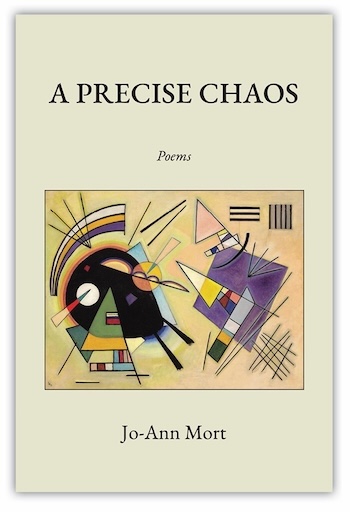 Set in real places and liminal spaces, the poems in Jo-Ann Mort’s A Precise Chaos grapple with life’s inevitable transitions, contending, often concretely, with time as a relentless force. This dramatic impulse moves gracefully between glory days and decline as it takes up the challenges of war, friendship, and the wayward turns of the human will. There is a hint of the book’s turbulent theme in its epigraph, taken from Stanley Kunitz’s “Layers”: “Oh, I have made myself a tribe / Out of my true affections / And my tribe is scattered!” This outcry foreshadows the volume’s concentration on impermanence, particularly the varied passions generated by dispersal. Whether Mort is reflecting on revolutions or love affairs, these poems reveal a profound awareness of the impact of change.
The opening poem, “The Men,” sets the stage with a commentary on the vicissitudes of history. Grand ambitions fade with time: men who once whispered “into the ears of governors and presidents” are outpaced by events and existence itself. “The revolution failed, the workers lost / their jobs to China, and we all grew older.” The speaker, once tethered to these figures — “my life, my circle, my hearth, my home” — must yield to the broader authority of ordinary joy: “…life is larger than these men / and now, life is where I am.”
The next poem, “In Mostar, City of Bridges,” pulls us into the terrain of a specific world event, flashing from the present back to the past. The speaker recalls sitting at a café “just a year ago, sipping cold beer” in a place now transformed into “a mass grave” — a stark testament to the brutality of the Bosnian War. The next stanzas detail “windows shattered… glass and blood,” evoking fear for “the red-headed Muslim woman who tended bar.” Later, memories of drinking beer and walking with a companion reappear — but they are now shadowed by foreboding. Posters at the time “couldn’t portend how the world will erupt / when civil politics becomes anathema.” Eventually, all the recollections of Mostar — its minarets, rivers, and quiet pleasures — are absorbed into the horrors that followed. The poet uses italics to separate past from present: “Body parts on the street/ splayed like a child’s forgotten play set. There’s a stray leg, a finger. / The unclouded Adriatic, your tiny villa, your garden with lemons and rosemary, / the puny tangerines.”
Poem after poem echoes these themes of traumatic loss. In “Market Day,” the narrator lives with the “…reflex of wanting the air / beside [her] to welcome…” her lover who has died. In “Cocktails in Warsaw, 2019,” the poet sets present-day casual experience — sitting with friends at a wine bar, taking a taxi — against a history so devastating that “God is crying” and Poland “gets pushed and pulled like an accordion / between past and present.” “How She Remembers Him” piles on ritualized, repeated gestures in order to blur time: aggrieved moods occur over and over again, as does the singing of mournful songs and the donning of blue shirts and a tapered top. The mordant suggestion is that there are no new beginnings. In “Snow Day,” time “has simply stopped” and two people in distant cities struggle to make contact over the phone during the pandemic, but they do not really connect.
Time also falters and fails again later in the collection. In “Dressing for My Father’s Funeral,” grief pulls the speaker into the “precise chaos” of the book’s title — a space of order and disorder, structure and tumult, where, on a “journey without / minutes or hours or days or years,” the ordinary dissolves as ritual and inevitability struggle to impose form. This captures the book’s overarching paradox — change is both unruly and part of the natural order.
Mort signals that the poem “Paris” is distinct, setting it sideways on the page while all the other poems appear in portrait orientation. The poem traces a relationship across a series of landmarks — “the Louvre… Trocadero… a bar near the Odeon” — that resonate with a city renowned for its art and romance. But it also gathers in past political upheaval and future disillusionments: “All before the Gulag, Cambodia, tenure, child support.” The landscape format mirrors this expansive embrace of things and events; it underscores how the weight of history, both collective and personal, can erode idealism.
The impact of Mort’s work is heightened by the startling clarity of her phraseology. Again and again, a single line delivers an aha moment, when a complex feeling is struck from the articulation of an elegant, immediate truth. Consider the logic and wisdom of “The men were larger than life, / so life eluded them” or “a sky that offers nothing. / A god, torn in so many pieces, he explodes across the countryside.” Elsewhere, intimacy and longing are interlaced with quiet force: “…you took my picture to freeze my love for you forever” and “…you took my hand / promising me nothing and everything.” Passing prosaic moments are rendered with delicate exactness, as in “the gentle whisper of acquaintance” and “covering my mouth / so that no one sees me talking to myself, to you / to our years.” Here, time itself is part of an internal dialogue, a conduit for absence and loss.
The final poem in A Precise Chaos, “The Ladder,” brings the narrator face-to-face with the fragility of aging. She meditates on moving into her 60s and 70s. As in the opening of the volume, the poem is framed by a Stanley Kunitz epigraph — “I am not done with my changes.” This strategy suggests symmetry, but “The Ladder” presents a new paradox: aging unfolds as both momentum and decline, at once swift and suspended, until “time becomes nominal.” Time recedes in importance as the speaker’s identity wavers. The mirror reflects a shifting amalgam — self, mother, and stranger. Continuity is recognized, but there’s estrangement as well, as physical pain pulls her inward “into a cocoon / backwards into childhood,” even as she continues to age “up the rungs.”
This unflinching final vision completes Mort’s experience of transience. Change is ascent and return, chaos and control, rupture and continuity. A Precise Chaos examines, with profundity, intricate human patterns of memory, history, and love, where the personal and the political intertwine and nothing ends cleanly because nothing is ever entirely lost.
Leigh Rastivo is a fiction writer, reviewer, and essayist. She holds an MFA from the Bennington Writing Seminars, where she was also a postgraduate fellow. Her work has appeared in L’Esprit Literary Review, MicroLit Almanac, and other publications, with more forthcoming.