
Poetry Review: Ron Padgett’s “Pink Dust” — The Joyful Weight of Words
By Michael Londra
Ron Padgett’s Pink Dust proves that W.H. Auden was wrong — the nothing of poetry contains everything required to make a good (even heroic) life happen.
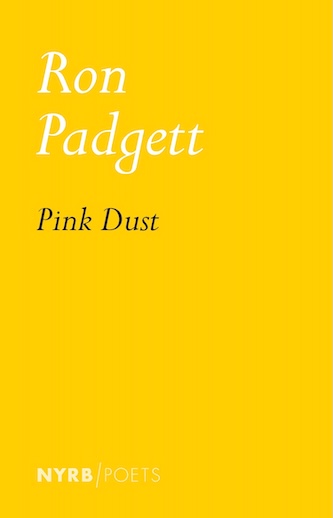
Pink Dust by Ron Padgett. NYRB Poets, 2025, 128 pp, $16.
 W.H. Auden once declared “poetry makes nothing happen.” Usually this is taken to mean poetry can’t influence the world. An alternative viewpoint might propose the reverse. In the same way that the number zero enables advanced mathematics, the concept of nothingness introduces difference into language — empty spaces between words make sentences possible. Reality is “nothing,” except for the different words we use to interpret what we see and express how we feel. Countering Auden’s statement, William Carlos Williams advocated on behalf of “the poem as a field of action.” For Williams, life was poetically constructed perception, a way to shape useful narratives out of the data of existence — you are what you dream — and reading poetry teaches how to rewrite/revise these dreams. Looked at from this perspective, reality might be described as a bus and poetry the driver. Don’t like the direction you’re heading in life? Get a book of poetry, hit the directional signals, and switch routes.
Jim Jarmusch’s 2016 movie Paterson (same name as a long poem by WCW) put wheels on this metaphor. Adam Driver played a poet who pilots a bus, composing whenever he is not behind the wheel. The poetic lines — visualized on the silver screen as Driver recited them in voice-over — were written by Ron Padgett, a choice that reflected the director’s intuitive understanding of Padgett’s spiritual connection to Williams. Indeed, Padgett’s new book of poetry, Pink Dust, invokes WCW:
On a prescription pad
William Carlos Williams
scribbled some notes about poetry,
a few words on each sheet,
some indecipherable.
It looks terrific his scrawl
but it makes you wonder
why he didn’t use a regular notebook,
as his mind didn’t fit
onto those small sheets.
His mind just jumped into my notebook,
which has plenty of room for him.
Here is the Padgett palette: a playful, conversational tone collides with unusual shifts of perspective, which produces an effect of awe. His poems cosplay at deception. Padgett appears to be light and spontaneous, but lines like these suggest his fanatical obsession with the weight of words. His polished vernacular rhythm is the result of years of disciplined focus on fitting complex feelings into a natural, unforced cadence. Neat and tidy and free of neurosis, there are no dramatic nosedives into depression. But that doesn’t mean he sidesteps the darkness. What in another writer’s hands would be a banal lyric about a sad childhood is transformed, by Padgett’s surprising syncopations, into a sardonic yet poignant commentary capped by an offbeat ending. The trick is in how the conclusion is punctuated:
I wish my mother and father
would have been able to open
a window and look in
to see their own personalities
and to have found me
sitting in there waiting for them,
so they could have opened
a window in me too,
but it didn’t happen,
and we all three stayed
who we didn’t think we were.
It’s too bad,
we could have known how
wonderful we were!
A transgressive exclamation point (forbidden by today’s MFA workshops) changes the direction of the poem’s bus from bitter regret toward hopeful joy. This is what Jarmusch loves in Padgett. They each studied with Kenneth Koch, so it is not surprising that this impish literary sensibility — pioneered in the ’50s and ’60s by Koch and fellow New York School luminaries Frank O’Hara, John Ashbery, and James Schuyler — rubbed off on both artists.
My pun is intended, given that Padgett’s title for this volume, Pink Dust, references the remnants of an old school eraser used to rub out pencil marks on paper. The poet insists that what the practical world devalues can be a source of beauty that inspires appreciation for life’s deeper meanings: “a little pink dust…I preferred to brush it away with my hand / or puff up my cheeks / and blow it away. / I’d like to replay those moments in my life.”
Padgett’s memory — like all poets’ — is a “history” of writing and erasing words. But “pink dust” is an image that carries other significances too, resonances that are developed over the course of the volume’s three sections. Beginning with “Residue” (“Geezer” and “Lockdown” are the other two), Padgett sifts memories of friends and incidents from the past, attempting to ripen the ordinary into the surreal:
When I was around ten
someone said that if
I put some horse hairs
in a jar of water
and left it in full sunlight
the hairs would turn
into snakes, and so
I did, and when
I went back a week later
there was the jar,
full of small snakes,
which I heaved
into the shrubbery
and never said a word
to anybody
it was so horrible.
“Geezer” is a group of counterintuitive jolts that envision growing older as a conspiracy of joy:
As a young man I wanted to live
a long time so I could know
what it feels like to be old
Now I’m trying to remember
what it feels like to be young.
Young, old, old, young.
Do you need more proof
of how ridiculous I am?
If so, look inside yourself,
for you are just like me.
There is nothing more ridiculous
than a human being.
The rest of nature doesn’t know this.
It’s our little secret.
The last, “Lockdown,” written during the Covid quarantine, is filled with lonely meditations. His pandemic anguish is repurposed into a redemptive vision. Sitting in his cabin in the woods, Padgett does not nurture the trademark winking insouciance found elsewhere in Pink Dust, such as when he jokes that he is “…a wolfman / wearing clothes.” Or when he indulges in kooky humor: “Once in a museum I saw the Bible / on a grain of rice / displayed under a microscope … I’ve never read the entire Bible. / This morning, though, / I did eat a bowl of rice / with hot milk, sugar, butter, and salt. / That’s a lot of Bibles I ate.” These closing verses show Padgett at his wordsmith best, a practitioner of what Paul Celan dubbed “breathturn,” infusing vast eternities of emotion stripped of pretense and purified into single bursts of syllabic breath. Padgett’s Pink Dust proves that Auden was wrong — the nothing of poetry contains everything required to make a good (even heroic) life happen:
There is nothing like
a house seen from the outside
lights on,
in the dark winter night,
to make you feel
close to all the humans
inside that house
and out.
Pretty great
to love humanity
if only for a moment.
Michael Londra’s fiction, poetry, and reviews have appeared in Restless Messengers, Asian Review of Books, The Fortnightly Review, The Blue Mountain Review, among many others. His is the author of the forthcoming Delmore&Lou: A Novel of Delmore Schwartz and Lou Reed. He lives in Manhattan.
I just bought this book. Was looking for a new book of poetry!
Auden’s ‘Poetry makes nothing happen’ is contextual, in the advent of WWII, what he meant, as in ‘Musee des Beaux Arts’, was that there was a coming human tragedy of great magnitude that nothing was going to prevent, and that not everybody would need to be taken up with – It was not an important failure.
At least this is how I read these poems.