
Film Review: “There’s Still Tomorrow” — Hearing Women’s Voices
By Tim Jackson
Director/actress Paola Cortellesi’s There’s Still Tomorrow is yet another bold cinematic plea for women’s rights.
There’s Still Tomorrow, directed by Paola Cortellesi. Screening at the Landmark Kendall and on VOD starting April 8.
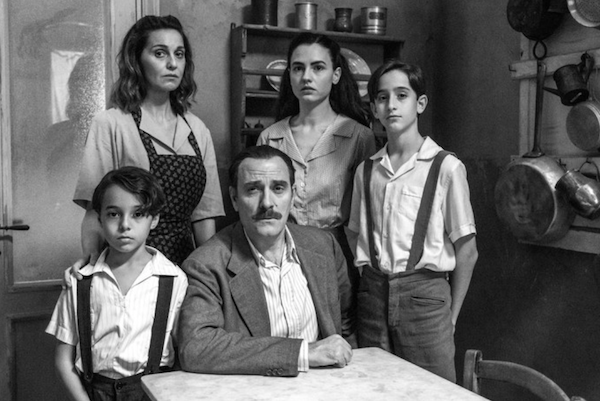
A scene from There’s Still Tomorrow.
Not to be confused with Douglas Sirk’s weepy soap opera from 1956, There’s Always Tomorrow, 2023’s There’s Still Tomorrow (C’è ancora domani) is Italian actress Paola Cortellesi’s first film, a feminist drama set in postwar Italy. The director, who also stars in the movie, plays Delia, an embattled housewife with a physically and emotionally abusive husband. She is the mother of two endlessly squabbling boys and a daughter who is about to be married. She also cares for her bitter, bedridden father-in-law. The film touches on many tropes of Neorealist cinema: the squabbles of the marketplace, gossiping women, a lover left behind, an American military presence on the streets, and the struggles of working-class life. But the real focus of the narrative is on women caught in rigid patriarchy. The story is set in 1946, the year women were first allowed to vote in Italy’s political elections. Delia’s journey is one of liberation for her and her daughter. The film builds its suspense toward that end, but the journey is not smooth or predictable.
There’s Still Tomorrow was a big hit in Italy, outperforming Barbie and Oppenheimer, released in the same year. Women’s rights in Italy have a disturbing history, which may explain its enormous popularity. As late as 1998, an 18-year-old girl was raped by her driving instructor. He was acquitted of the charge in court, which concluded that “the victim wore very tight jeans; she had to help him remove them.” Placards at protests read “Jeans: An Alibi for Rape.” Jump ahead 25 years, just a few weeks after the release of There’s Still Tomorrow. Mass protests were held over the killing of 22-year-old university student Giulia Cecchettin, who was allegedly murdered by her ex-boyfriend. The case once again thrust femicide, patriarchy, and male violence into the headlines. The killer, Filippo Turetta, was sentenced to life in December of last year. These are not the only cases; director Cortellesi explains that the issue has been going on for millennia and that “the subject of the killing of women is unfortunately very, very topical, especially in Italy.”
Cortellesi is a charismatic actor and heads a fine cast that may be unfamiliar to American audiences. Valerio Mastandrea plays her husband, Ivano. Vinicio Marchion plays Nino, the lover who Delia left behind. Romana Maggiora Vergano plays Marcella, the daughter who is about to be engaged. The dark side of that betrothal: Ivano’s disdain for the bridegroom’s family. He permits the marriage only because the groom’s family is somewhat better off because they own their own business. The groom’s family is also hostile — it considers Ivano a lout and drunkard. The bedridden old father-in-law stumbles, with comic ineptitude, into the engagement dinner. Recalling her own courtship, Delia begins to note troubling signs of stubborn male chauvinism in her daughter’s fiancé. Unable to free herself from her own oppressive marriage but determined to save her daughter, she manages to undermine the engagement. In an awkward side plot, a Black American soldier is stationed in the town and takes a liking to Delia. That arrangement serves as a slightly implausible but convenient plot device.
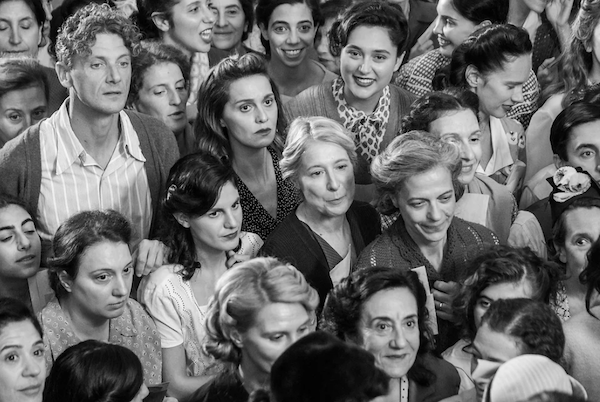
A scene from There’s Still Tomorrow.
There are other moments when our credibility is stretched, including how the somewhat schematic plot is wrapped up via a surprising twist. Cortellesi compensates for the narrative’s inconsistencies in a couple of ways. First, Davide Leone’s rich monochromic cinematography gives the film a nostalgic resonance that unites Italy’s past and present into a dreamlike scenario. Second, and key to the film’s effectiveness, is the use of music. Anachronistic song choices distance viewers from immersion in the past, serving as reminders that the film’s issues are very much in the present. Most striking: a jarring scene of domestic abuse that morphs into a romantic dance routine. These choices are not Brechtian alienation so much as unexpected moments of magical realism that distance us from the film’s determinedly Neorealist look. The film’s fantastical elements also help to set up its climax, which is not tidy. The contemporary song “Little Things” by the American electronica hip hop and jazz duo Big Giganti” comes roaring in over the credits. Past meets the future in its lyrics:
I could feel it coming back
I didn’t know, was I built to last?
I’ve come so far so fast
And it feels like a hundred years
Am I dreaming? Is it gonna last?
I could be better still
Than anything I’ve done
I know you think you could do too
I know you think you feel it’s true
It’s the little things in life that I feel
Women’s rights are still under threat; the ladies are being heard. Recently, there have been several excellent films with feminist agendas that address our uncertain political moment. In addition to Greta Gerwig’s Barbie, there is French director Coralie Fargeat ‘s Revenge and The Substance, Audrey Diwan’s Happening, British-Indian director Sandhya Suri’s Santosh, Japanese director Shiori Itō’s documentary Black Box Diaries, and Marielle Heller’s Nightbitch. Male director Sean Baker has long championed a feminist agenda, and Anora must be mentioned in this list. Cortellesi’s There’s Still Tomorrow is yet another bold statement for liberation.
Tim Jackson was an assistant professor of Digital Film and Video for 20 years. His music career in Boston began in the 1970s and includes some 20 groups, recordings, national and international tours, and contributions to film soundtracks. He studied theater and English as an undergraduate, and has also worked helter-skelter as an actor and member of SAG and AFTRA since the 1980s. He has directed three feature documentaries: Chaos and Order: Making American Theater about the American Repertory Theater; Radical Jesters, which profiles the practices of 11 interventionist artists and agit-prop performance groups; When Things Go Wrong: The Robin Lane Story. And two short films: Joan Walsh Anglund: Life in Story and Poem and The American Gurner. He is a member of the Boston Society of Film Critics. You can read more of his work on his blog