
Classical Album Reviews: Debussy Sonatas and Arc III
By Jonathan Blumhofer
Nash Ensemble’s new album captures much of what makes Claude Debussy’s chamber music so fresh and beloved. Orion Weiss’s Arc III is smart, timely programming, dispatched with insight and care.
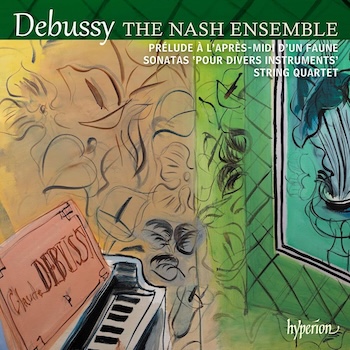 Had Claude Debussy lived to complete his projected set of six sonatas “for various instruments,” he would have increased his total output of chamber music by about 50 percent. As it stands, that body of the French composer’s oeuvre fits conveniently onto just about one disc, so it’s not surprising to find it serving as the focus of the Nash Ensemble’s newest release. While their program isn’t quite comprehensive — there’s no Syrinx or Première Rhapsodie on offer — it does capture much of what makes this music so fresh and beloved.
The most singular offering is, of course, the Sonata for flute, viola, and harp. Here, the favorite benefits from an exceptionally warm and lucid performance courtesy of, respectively, Philippa Davies, Lawrence Power, and Lucy Wakeford.
The trio’s rapport is evident everywhere, from the freely conversational aspect that underlines their reading to the lovely plays of character and style that mark each movement and the interpretation’s winsomely flexible phrasings. Those all come out in the dovetailing between the instruments in the opening Pastorale, which is breathtaking. Meantime, the Interlude is warmly shaped, and the Finale paints a picture of feisty vigor.
In the Cello Sonata, cellist Adrian Brendel and pianist Simon Crawford-Phillips capture much of the aphoristic strangeness of Debussy’s writing, though also its beauty: the closing bars of the Prologue are enchanting. Violinist Stephanie Gonley and pianist Alasdair Beatson are similarly well matched in the Violin Sonata, whose rhapsodic sense of space and rhythm leaves a lovely — but also somewhat unsettling — aura in its wake.
Debussy’s String Quartet is a rather less volatile composition, though the Nash’s account here leans into the first movement’s pungent anticipations of Bartók-like dissonance and offers a nice foreshadowing of La mer’s billowing seascapes during the finale. In between come moments of whimsy — the second movement’s transformation of its opening theme charms the ear — and, in the Andantino, devotion.
Filling out the album is David Walter’s arrangement of the Prélude à l’après-midi d’un faune. His is a lovely adaptation, though climaxes sometimes make it sound like Debussy’s faun has gone on a diet. Regardless, the Nash, here expanded to 12 players, does the transcription full, lush justice.
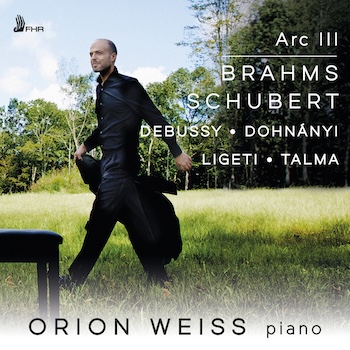
Of all the emotions absent from the public sphere these days, joy must rank near the top. Yet it’s a necessary one, as Orion Weiss’s new album, Arc III, reminds. The first two installments of the pianist’s triptych focused, respectively, on music composed in the years before World War I and repertoire from the 1920s and ’40s, the last alongside some Brahms. This final one examines what he calls “the bright points of life.”
Those aren’t, however, entirely free from the shadows, as the album’s biggest item, Brahms’s F-minor Piano Sonata (No. 3), establishes. The music’s bold, stormy gestures portend any number of things — though those are ultimately overcome: the big outer movements resolve triumphantly. Weiss manages the whole piece with a good bit of spirit (the finale’s coda is particularly cathartic), and his close attention to dynamics and articulations, plus snapping rhythms, really brings the reading to life.
Similarly invigorating is the pianist’s take on Schubert’s Wanderer Fantasy. Again, the music’s tumultuous spots stand out; throughout, too, there’s an invitingly freewheeling sensibility to Weiss’s performance. While those pay dividends in the music’s explosive episodes — the closing fugue, in particular, is terrifically clear and directed — it’s the introspective ones that really linger: voicings in the Adagio (especially the busy left-hand writing) give that section just the right weight and color.
Weiss’s reading of Debussy’s L’Isle joyeuse is likewise carefree and well balanced, as is his traversal of Ernö Dohnányi’s Pastorale. The latter is conspicuously free and overflowing with sunshine. Much the same can be said for the disc’s opener, Louise Talma’s ecstatic Alleluia.
Its closer, on the other hand, is György Ligeti’s Arc-en-ciel. The four-minute-long selection makes for an elliptical finale, beautiful and mysterious, with a fade-out into nothingness that offers both a warning of oblivion and the promise of rebirth.
Taken together, this is smart, timely programming, dispatched with insight and care. Warmly recommended.
Jonathan Blumhofer is a composer and violist who has been active in the greater Boston area since 2004. His music has received numerous awards and been performed by various ensembles, including the American Composers Orchestra, Kiev Philharmonic, Camerata Chicago, Xanthos Ensemble, and Juventas New Music Group. Since receiving his doctorate from Boston University in 2010, Jon has taught at Clark University, Worcester Polytechnic Institute, and online for the University of Phoenix, in addition to writing music criticism for the Worcester Telegram & Gazette.
I appreciate your thorough and detailed review of these recordings, but I am perplexed by one omission that you and so many other reviewers make. Nowhere in the article do you indicate whether the recordings are on vinyl or compact disc. As I am interested only in vinyl, this is information important to me (and many other readers I suspect). It would be of much value to me if you could provide this bit of information, as well as the identifying issue number.
The review and its evaluation is the thing — it not difficult to go online and find the information you are asking for …AI will be at your service.